

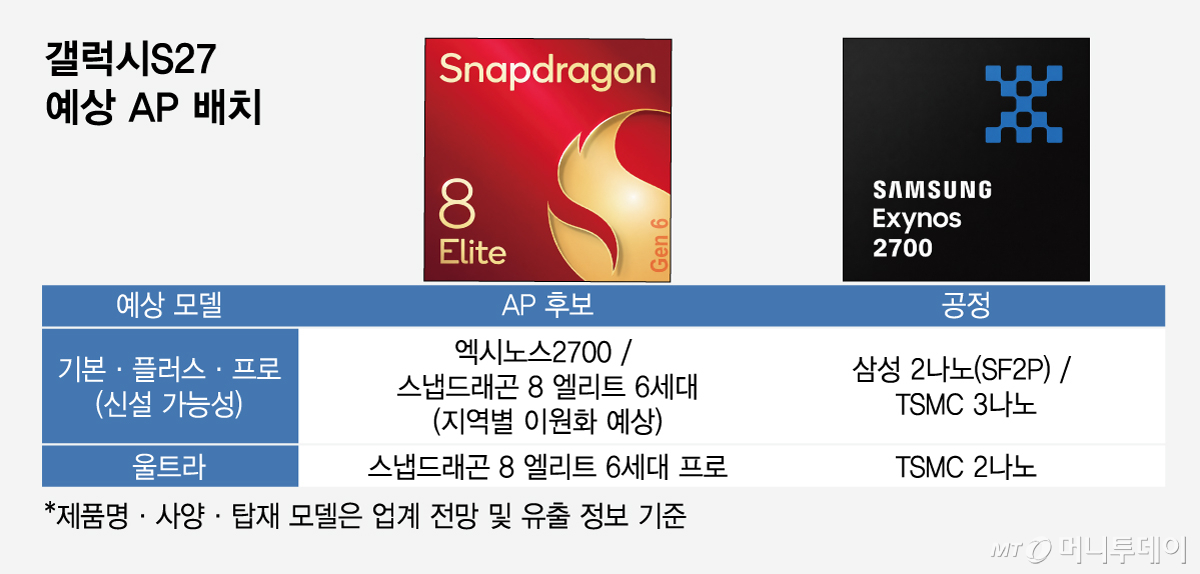
Samsung Electronics is facing a more complex selection of mobile APs (application processors), which serve as the brain of smartphones, in its upcoming 'Galaxy S27' series. As Qualcomm segments its next-generation flagship chips into two variants, Samsung Electronics is also reportedly pushing to expand the use of its own AP, 'Exynos,' drawing attention to model- and region-specific AP placements.
According to the IT industry on the 23rd, Qualcomm recently hinted via official social media that it will unveil two next-generation Snapdragon chips at 'Snapdragon Summit 2026,' which opens on the 22nd in Hawaii, USA. The teaser video features two chips, with Qualcomm adopting the slogan "When Two Changes the Game."
Industry observers expect the two products to be the 'Snapdragon 8 Elite Gen 6' and its higher-end counterpart, the 'Snapdragon 8 Elite Gen 6 Pro.' The Pro version is rumored to have first been applied in the Xiaomi 18 Pro lineup before potentially being included in the Galaxy S27 Ultra.
According to leaked information, the Pro version is expected to adopt TSMC's 2nm process, Qualcomm's self-designed Orion CPU (central processing unit), and Adreno 850 GPU (graphics processing unit). The standard version is predicted to use a 3nm process and the Adreno 845 GPU. This strategy of splitting flagship chips into two variants aims to simultaneously target top-tier products requiring peak performance and the general flagship market where cost considerations are critical.
Samsung Electronics is also reportedly considering expanding the scope of Exynos adoption in the Galaxy S27. There is speculation that a 'Pro' model may be newly introduced for the Galaxy S27. It is anticipated that the Basic, Plus, and Pro models will feature both 'Exynos 2700' and 'Snapdragon 8 Elite Gen 6' depending on the region, while the Ultra model will likely use the 'Snapdragon 8 Elite Gen 6 Pro.' The Exynos 2700 is currently under development based on Samsung Electronics Foundry's second-generation 2nm process (SF2P).
The competitiveness of Exynos 2700 remains a variable. Recent internal benchmark tests by Samsung Electronics revealed that the Exynos 2700's CPU multi-core performance is 19% higher than the Snapdragon 8 Elite Gen 6 and 9.5% higher than the Pro version. Its GPU performance in a low-power environment of 2.5W (watts) also exceeded the Pro version by 22%.
Cost considerations are further driving the incentive to expand Exynos usage. Samsung Electronics spent 7.4383 trillion won on purchasing mobile APs from Qualcomm and MediaTek in the first half of this year, accounting for 17.9% of the total raw material costs for its DX (Device Experience) division. Due to cost pressures from rising memory prices, the MX and Network Business Units, which are responsible for smartphone operations, recorded an operating loss of 700 billion won in the second quarter, shifting into deficit.
Additionally, overseas IT media outlets have reported that the Snapdragon 8 Elite Gen 6 Pro could be priced at approximately $300 (about 420,000 won). If the Exynos 2700 can prove its competitiveness in actual products, Samsung Electronics would be able to reduce its reliance on Qualcomm, alleviate cost burdens, and secure system LSI and foundry volumes.

 in TECH
