

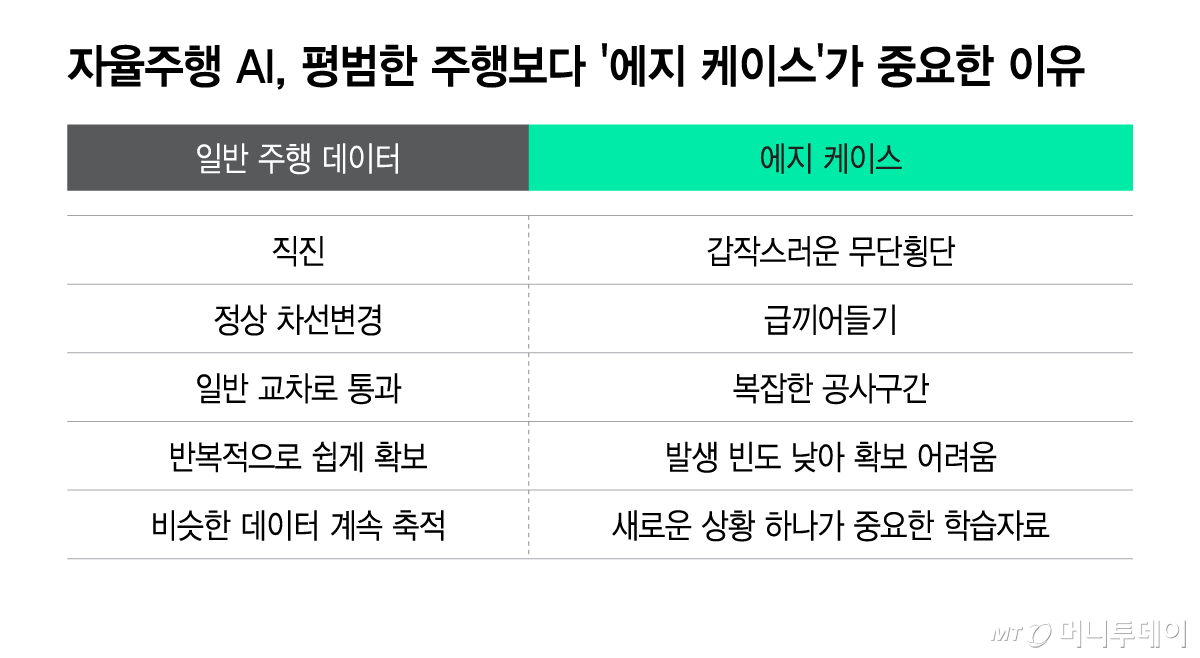
For autonomous vehicles, a situation occurring in the 10th meters just before an accident becomes more valuable learning material than data from driving 10,000 km without any accidents. Normal driving—staying in lanes and stopping at signals—accumulates naturally as vehicles operate for longer periods. In contrast, situations that AI cannot easily predict, such as pedestrians suddenly darting into the roadway, vehicles abruptly merging from adjacent lanes, or lane markings disappearing due to construction work, rarely occur. The autonomous driving industry refers to these rare scenarios as 'edge cases.'
Scenes of proceeding straight in a designated lane are repeated countless times daily. Common maneuvers like lane changes and intersections can be acquired in large quantities by operating vehicles at a certain scale. However, situations such as a young child suddenly running out from between parked cars, motorcycles cutting in from unexpected directions, or construction vehicles blocking existing lanes are different. Although the probability of occurrence is low, a single judgment error can directly lead to an accident. From the perspective of autonomous driving AI, the ability to properly handle rarely encountered scenes rather than frequently seen ones determines safety.
Autonomous driving companies separately select footage where AI hesitated in its decision-making on actual roads, situations where safety personnel intervened, or cases where movements differed from expectations. The selected data is then used for retraining. The same scenarios are repeatedly simulated in virtual environments, or conditions such as pedestrian speed and vehicle positions are slightly altered to verify how the AI responds. When new models are released, they are re-verified to ensure that past problematic situations are properly resolved. This is akin to building a 'notebook of wrong answers.'
Even for the same 'cutting in,' responses can vary depending on the speed and distance of the opposing vehicle and the positions of surrounding vehicles. This is why rare scenes once captured are transformed under multiple conditions and repeatedly tested. Ultimately, a single edge case does not remain confined to one video but becomes the starting point for new learning and verification scenarios.
As autonomous driving competition intensifies, it becomes increasingly difficult to explain technological capability solely by accumulated mileage. Ordinary data eventually leads to repetitive scenes, but securing each rare scenario expands the range of situations the AI can handle. What matters more than the distance driven itself is 'how many diverse exceptional situations were encountered and how well those situations were reflected in learning.'
Waymo's plan to prepare for entry into Korea by separately selecting certain scenes involving accidents or incidents for use in overseas research and development aligns with these data characteristics. The company does not intend to transfer all driving footage but rather to select rare scenarios with high research value, anonymize them, and then utilize them.
Autonomous driving requires relearning many things in each country. Not only road signs and signal systems but also the behavioral patterns of drivers and pedestrians differ. Scenarios such as vehicles and people moving mixed together in narrow alleys, having to cross the centerline to avoid illegally parked cars, or motorcycles weaving between vehicles at complex intersections are variables that can be newly encountered on Korean roads. Even if a vehicle has driven sufficient distances in the United States, it cannot be assumed that all situations occurring in Korea have been mastered. Especially in environments like Korea with many narrow alleys and complex intersections, pedestrians and vehicles may exhibit movements different from patterns learned on U.S. roads.
In this process, personal information issues arise. Cameras on autonomous vehicles capture not only the faces of pedestrians passing by and license plates but also how people and vehicles move at specific times and locations. While useful for training autonomous driving AI, separate management is required from the perspective of personal information protection.
The government implemented a revised Autonomous Driving Vehicle Act on June 18, allowing temporary operation permit holders to collect driving footage containing personal information to improve performance and safety, and to utilize original footage without anonymizing or pseudonymizing faces for research and development purposes. This measure reflects industry demands that there are limitations in training autonomous driving AI using only blurred videos. Instead, the law prohibits acts that identify specific individuals or use or provide data for purposes other than intended, and mandates safety measures such as establishing internal management plans and retaining access logs. Collected original footage must be destroyed after five years.
However, this special exception opens a path to utilize original footage for research and development within Korea but does not permit transfer overseas. Waymo's inquiry to the Personal Information Protection Commission was not about taking the original footage itself abroad but rather about selecting necessary accident and incident scenes from footage acquired on Korean roads, pseudonymizing them so that people and vehicles cannot be identified, and then utilizing them overseas.
For Waymo to localize its technology in Korea, what matters is not simply driving more but how quickly it can identify 'exceptional situations unique to Korea' and connect them back to AI learning and verification. A few seconds of unexpected incidents encountered by chance on Korean roads can become textbooks that make global autonomous driving AI one step smarter.

 in TECH
