

Waymo, Google’s autonomous driving subsidiary, is moving to export driving data collected on Korean roads. While its stance is that only necessary scenes will be selected and anonymized before being sent abroad, the industry remains deeply concerned. Recent moves—including discussions on permitting high-precision map data exports, establishing a domestic subsidiary, and addressing Street View processing—are widely interpreted as all tied to "advancing autonomous driving technology."
Earlier this year, the government conditionally approved Google’s request to export 1:5,000 scale maps. A 1:5,000 scale map represents actual distances reduced by a factor of 5,000—equivalent to compressing 50 meters into 1 centimeter on the map. The government imposed conditions including: masking military and security facilities; removing and restricting exposure of South Korean territorial coordinates; allowing only limited export of data reviewed and verified by the government; and excluding security-sensitive information such as contour lines.
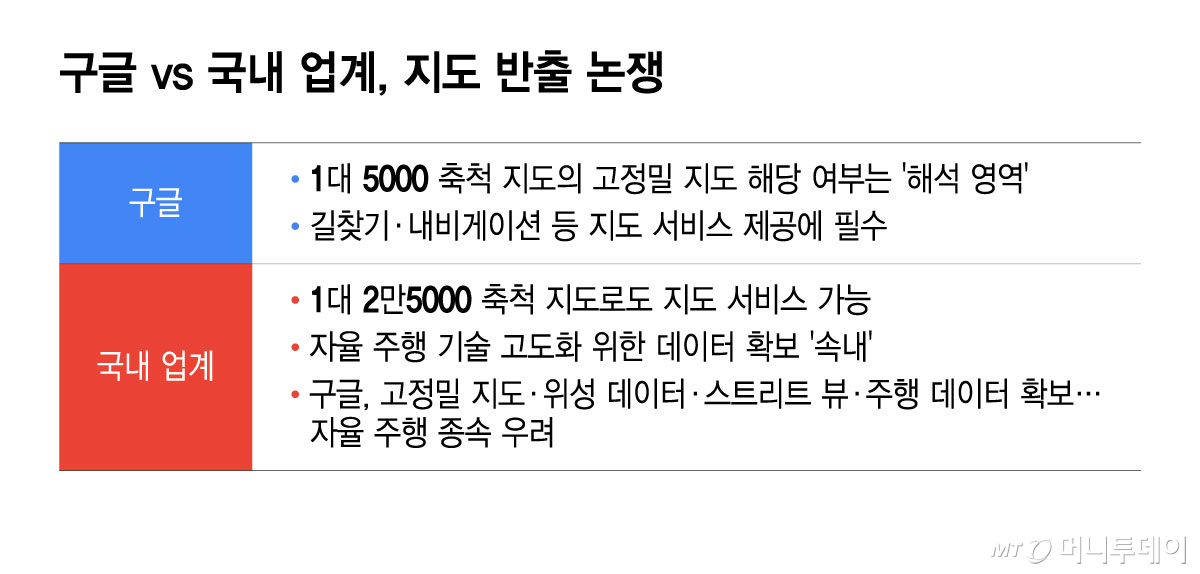
Google first requested the export of 1:5,000 scale maps in 2007—taking 19 years to secure approval. It had also sought export permission in 2016, but the government rejected both requests. In response, Google argued whether 1:5,000 scale maps qualify as high-precision maps is a matter of interpretation, and insisted they are necessary for providing map services such as route guidance and navigation.
At that time, Korea’s domestic IT industry sharply opposed the request. It maintained that map services could be fully provided using 1:25,000 scale maps, making Google’s demand excessive. The industry further stated, "Google is pushing for 1:5,000 scale maps for ulterior motives—to secure data for future advancement of autonomous driving technology."
Waymo’s push to export actual driving data abroad lends late but significant weight to the IT industry’s argument. A 1:5,000 scale map contains far more detailed lane information and narrow alleyway data than standard maps. Its high resolution makes it easier to train autonomous driving systems. An industry official explained, "While a 1:25,000 scale map might only allow identification of the Cheong Wa Dae location, a 1:5,000 scale map reveals even individual guard post locations."
Waymo established its domestic subsidiary, Waymo Korea, last month—just five months after map export was permitted. This time, it has inquired with the Personal Information Protection Commission on whether anonymized incident and accident data collected on Korean roads can be used for overseas research and development. Recently, Google is also reported to have asked the Ministry of Land, Infrastructure and Transport about how to handle 'Street View' information—showing street scenery via 360-degree omnidirectional cameras. Satellite data used for its 'Google Earth' service has been held by Google for several years.
The industry warns that Korea’s autonomous driving sector risks becoming dependent on Big Tech firms like Google. Another industry official stated, "If high-precision maps, satellite imagery, Street View, and driving data are all combined, Google will secure a clear technological lead in the autonomous driving field." Issues of overseas leakage of personal information also remain unresolved. Although last June’s special exemption for autonomous driving allowed temporary operation permit holders to use original autonomous driving footage for research and learning, exporting such data abroad remains a separate and serious concern.

 in TECH
