

As regulations on network separation for public institutions and financial institutional investors are relaxed and the use of generative AI increases, the security market focused on protecting documents and data themselves is expanding. SoftCamp and DST International (DSTI) will jointly target this growing market.
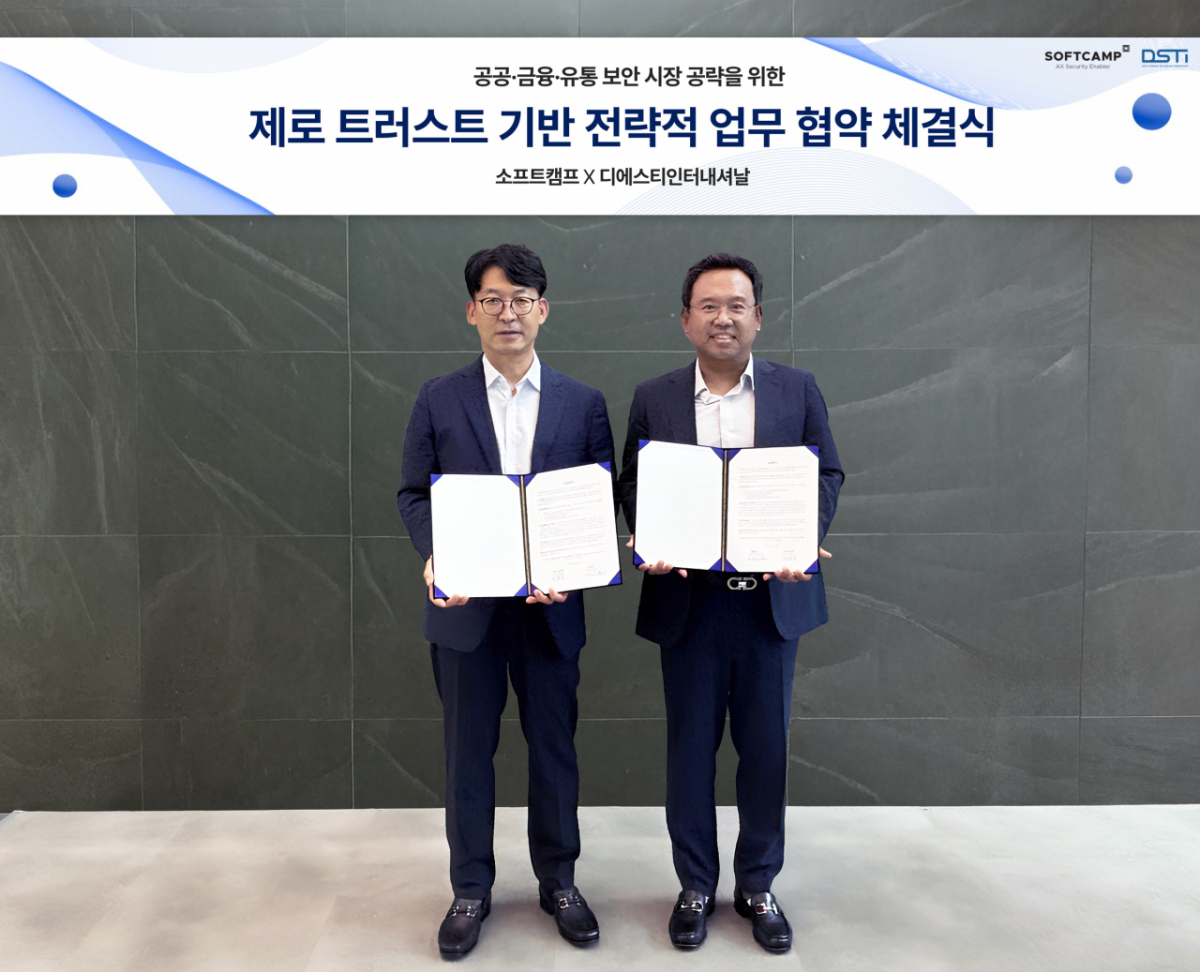
SoftCamp announced on the 25th that it signed a memorandum of understanding (MOU) with DSTI for cooperation in zero-trust-based security business at DX Tower in Gwacheon, Gyeonggi Province, on the 24th.
The two companies will combine SoftCamp's document security technology with DSTI's IT infrastructure construction and sales network. They plan to jointly propose zero-trust security services and document security solutions targeting public institutions, financial firms, and retail enterprises, while also cooperating in acquiring new customers.
SoftCamp provides zero-trust-based solutions such as document rights management (DRM) and remote browser isolation (RBI). DSTI, established in 2000, will lead market expansion by leveraging its accumulated experience in IT infrastructure and security system construction for public institutions, state-owned enterprises, and private companies, along with its sales channels.
DSTI began its business centered on IT infrastructure construction including servers and storage, as well as systems integration (SI), before expanding into the information protection sector. Last year, it launched a data security platform integrating document centralization, data encryption, output watermarking, screen watermarking, and ransomware detection and blocking functions.
The two companies anticipate that demand for document-centric security will grow due to the transition to the National Network Security Framework (N2SF) and the expanded adoption of AI and cloud technologies. Instead of physically separating networks as before, they must protect documents and data themselves by setting different access permissions based on the importance of the data.
As generative AI spreads in corporate operations, new risks of information leakage have emerged, such as employees inputting confidential documents into external AI services. The two companies plan to respond to this demand by controlling the entire process from document creation and usage to external transmission.
Bae Hwan-guk, CEO of SoftCamp, said, "We will expand zero-trust security in new markets including public institutions, financial firms, and retail enterprises together with DSTI." Kim Hyung-tae, CEO of DST International, stated, "By combining our companies' technologies and construction experience, we will propose a complete document and data security system to customers."

 in TECH
