

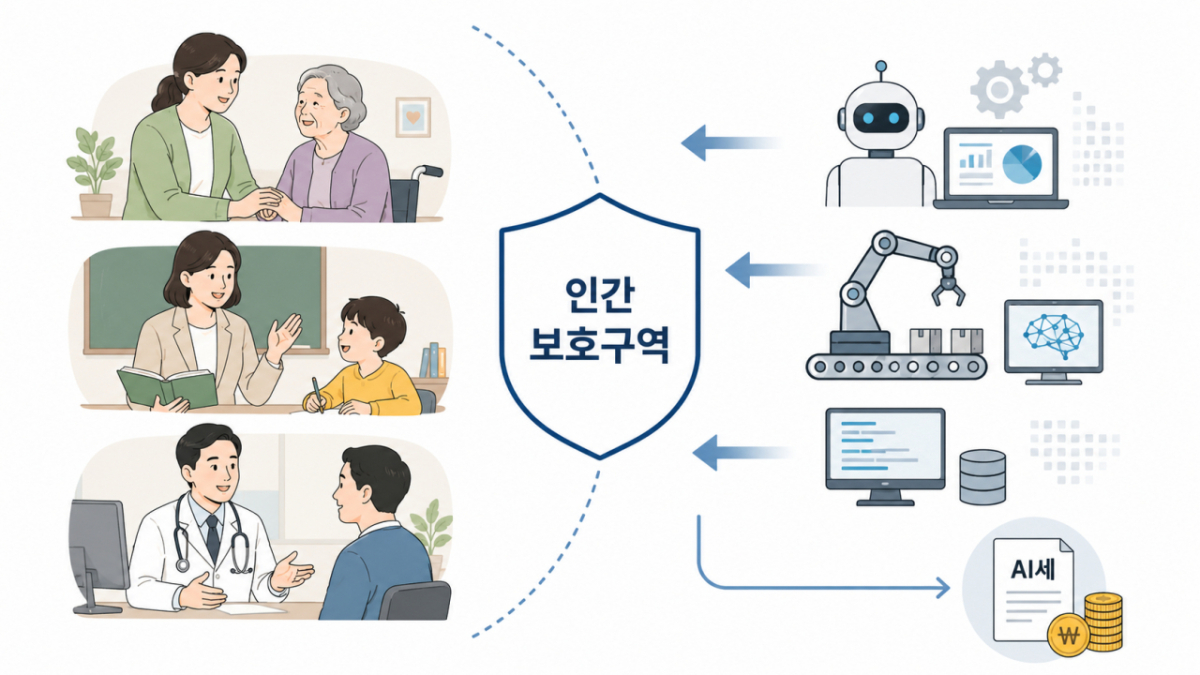
Even if an AI's diagnosis is more accurate than a doctor's, would you want to hear a terminal cancer diagnosis from an AI? Should tasks like caring for children or judging guilt in court be left to robots?
Bill Gates, co-founder of Microsoft, proposed that even if AI performs better than humans at certain jobs, some professions should remain human responsibilities. In a recently published essay of approximately 6,000 words, he coined the term "Human Reserved." The idea is similar to nature reserves where areas are preserved rather than developed: even if tasks can be automated technically, those with significant social value should be left to humans.
The example he cited was caregivers who looked after his father. His father, suffering from Alzheimer's disease, could not even properly express when he was hungry. Caregivers noticed what was needed by observing his expressions and actions. Gates stated that there are "irreplaceable human elements." The same logic applies to the idea that while AI can recommend treatment plans, it should not be entrusted with informing patients of terminal illnesses.
This does not mean banning AI in all medical or educational settings. Instead, doctors and teachers would use AI as a tool, but final responsibility and roles involving direct human interaction would remain with humans. Jobs such as childcare or jury duty, which are entirely reserved for humans, could also be considered. He suggested that some professions should be permanently protected, while others heavily impacted by automation could gradually adopt AI over an extended period.
As AI integrates not only with office work but also with robots to penetrate construction, manufacturing, and service industries, there is no guarantee that new jobs will replace those lost. Gates believes that in the AI era, up to 40% of all jobs could remain human responsibilities. However, he acknowledged many unresolved issues, such as who decides which jobs are protected and whether restrictions on automation can apply only to domestic companies when foreign firms automate.
The card Gates also played is an "AI tax." He proposed taxing tokens used by AI or robots themselves. Currently, when companies hire humans, various employment-related taxes are applied to wages. In contrast, money spent purchasing robots or AI systems is treated as a "cost." Gates argued that such a tax structure could signal to companies to replace humans with machines. Introducing an AI tax would slow the pace of layoffs and substitution with AI. Additionally, funds collected from this tax would be used for retraining programs and social safety nets.
Anxiety over AI-related job losses is already growing. According to a survey conducted by the Pew Research Center from the 22nd to 28 last year among 3,488 adults in the U.S., 71% believe that AI will reduce American jobs over the next 20 years. This represents a 7 percentage point increase from 64% in 2024.
Gates' question is whether humans should decide how much to delegate to AI, even when it is technically feasible. Even if machines are more efficient, tasks that society has decided "must be done by humans" can survive.

 in TECH
