

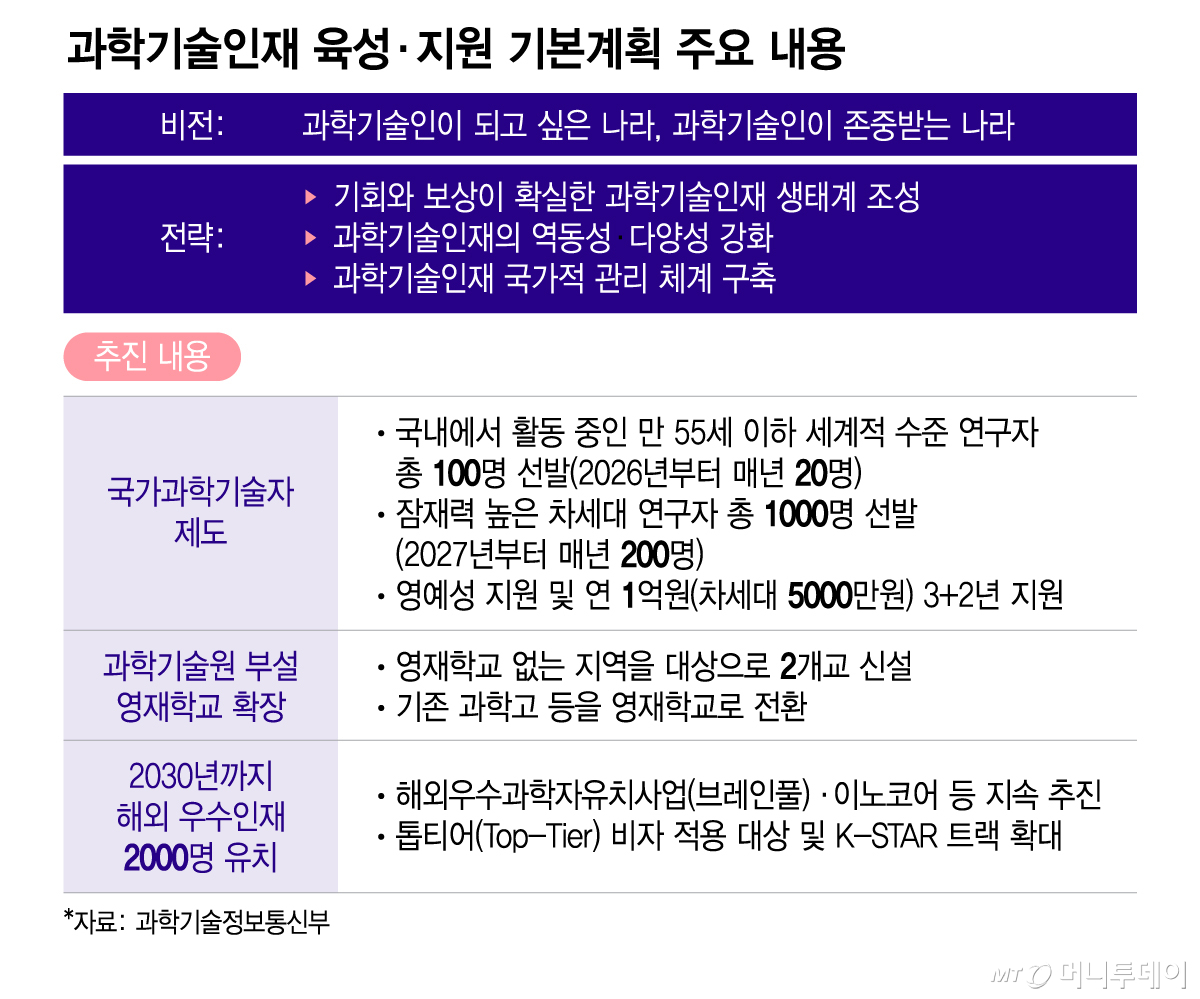
Twenty 'National Scientists of Korea' will be unveiled in the second half of this year to represent the Republic of Korea. Three additional gifted schools dedicated to nurturing science and technology talent will also be established.
The Ministry of Science and ICT confirmed the '5th Basic Plan for Nurturing and Supporting Science and Technology Talent (2026–2030)' at its 9th deliberation meeting of the National Council on Science and Technology Advisory Affairs on the 31st.
The Basic Plan for Nurturing and Supporting Science and Technology Talent is the state's top-level legal plan outlining medium- to long-term policy goals and fundamental directions for developing science and technology talent in the Republic of Korea. It was jointly formulated by 11 ministries, including the Ministry of Science and ICT, the Ministry of Economy and Finance, and the Ministry of Education. Its core objective is to build a 'brain highway' that facilitates talent inflow from initial recruitment through growth and active contribution, aiming for a nation where science and technology professionals are desired and respected.
Accordingly, the 'National Scientist of Korea' system, under which the state directly identifies and honors world-class science and technology experts, will be implemented for the first time in the second half of this year. Selection targets include researchers affiliated with universities and government-funded research institutions as well as those working in industry. The title previously announced in November last year as 'National Scientist' was finalized as 'National Scientist of Korea.'
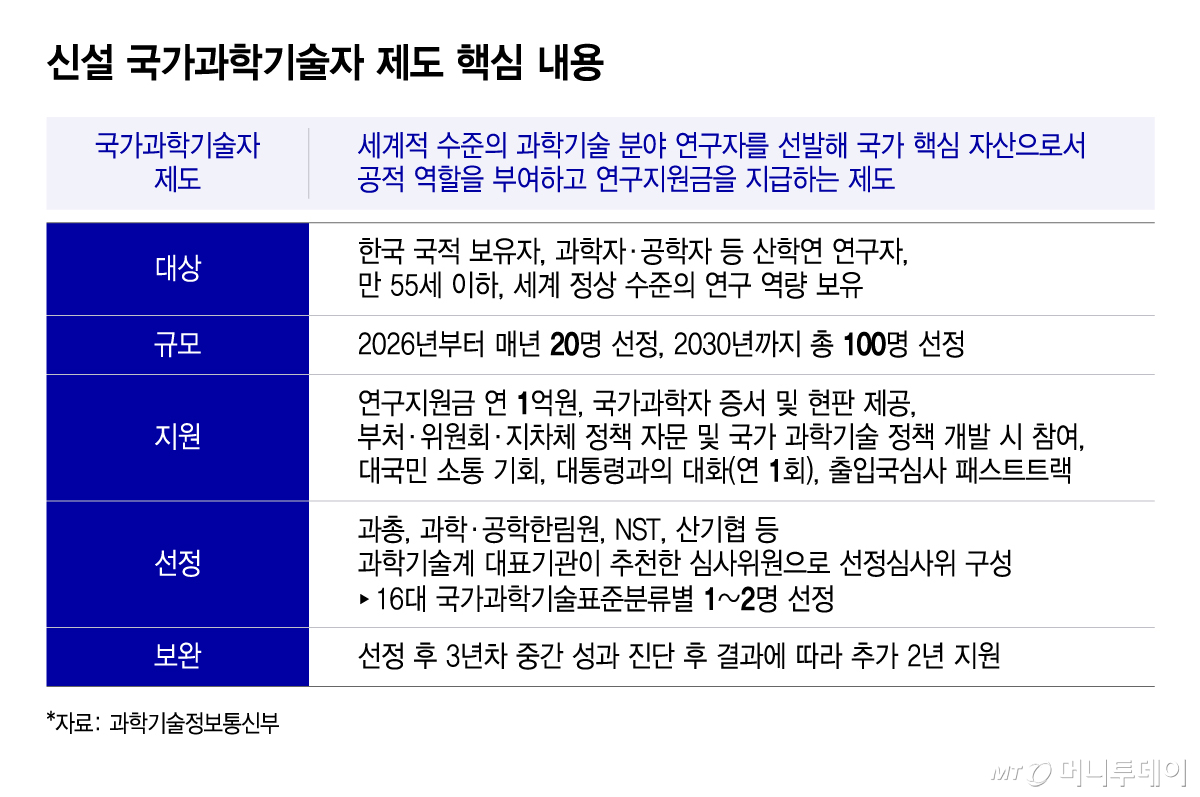
The National Scientist of Korea system is divided into 'Leader-level' and 'Next-generation.' Leader-level candidates are Korean nationals aged 55 or younger who are actively conducting research in science or engineering fields within the country. Starting with 20 individuals in 2026, a total of 100 will be selected by 2030. Selected recipients will receive annual research activity grants of up to 100 million won for a maximum of five years. These funds may be freely utilized for purposes directly related to research. Recipients will also receive national-level honors, including fast-track processing during entry and exit procedures and an annual dialogue with the President. They will serve in advisory roles when formulating national R&D (research and development) policies.
The Next-generation category targets Korean nationals with high potential to become world-class researchers. For university and government-funded research institution affiliates, young researchers appointed within the past 10 years will be selected. In industry, researchers with at least a master's degree and 15 or fewer years of research experience will be eligible. A total of 1,000 Next-generation National Scientists of Korea will be selected by 2030. Starting next year, 200 individuals will be chosen annually, each receiving an annual research activity grant of 50 million won.
National Scientists of Korea will be awarded official certificates and plaques, and provided opportunities to attend major national events alongside science and technology experts. The government will also support public relations efforts highlighting their research achievements. Administration of support for National Scientists of Korea will be managed by the Korea Research Foundation. An interim evaluation will be conducted in the third year after selection to assess past performance and determine whether to extend support for an additional two years. The Selection Committee will be composed of reviewers recommended by representative organizations in the domestic science and technology community, including the Federation of Korean Science and Technology Societies, the Academy of Korea, and the Engineering Academy of Korea.
The Ministry of Science and ICT plans to announce the selection of Leader-level National Scientists of Korea next month, complete evaluations by early December, and release final results in mid-December.
Meanwhile, gifted schools under the Korea Institute of Science and Technology will also be expanded nationwide. The core initiative involves converting existing high schools into gifted schools in regions currently lacking such institutions (Gangwon, Gyeongnam, Gyeongbuk, Ulsan, Jeonbuk, Jeju, and Chungnam). Currently, eight gifted schools operate nationwide; the only one under the Korea Institute of Science and Technology is the Korea Advanced Institute of Science and Technology (KAIST) affiliated Korea Science Academy of Gifted Education located in Busan.
When a school, local education office, and local government jointly form a consultation body with a nearby science institute to apply for conversion into a gifted school, they will undergo evaluation and be designated around December. The expected scale of conversion is three schools. Additionally, two new gifted schools will be established: one affiliated with GIST (Gwangju Institute of Science and Technology) in Gwangju, South Jeolla Province, and another affiliated with KAIST in North Chungcheong Province.
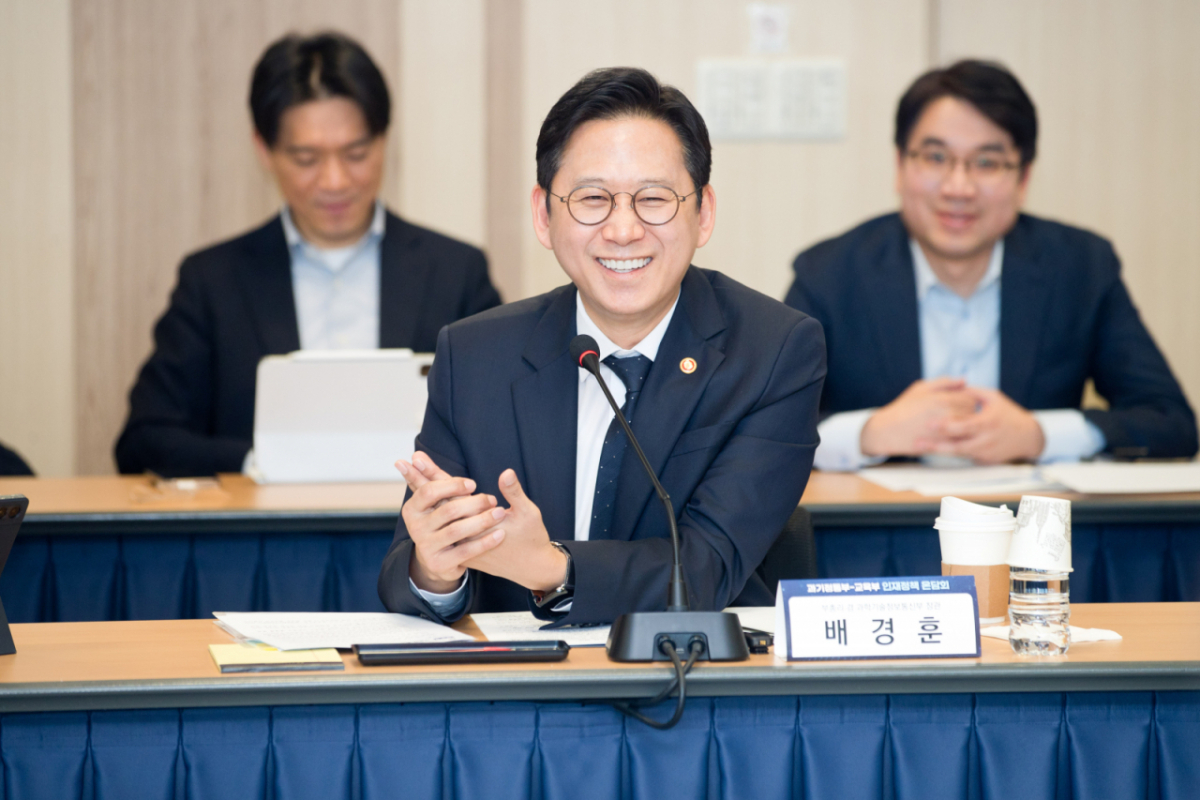
Bae Kyung-hoon, Deputy Prime Minister and Minister of Science and ICT, stated, "In the face of a complex crisis involving global technological hegemony competition, declining birthrates, and shrinking school-age populations, the only path for the Republic of Korea to leapfrog as a global leading nation is ultimately through people." He added, "With all ministries working as one team, we will create a nation that dreams of becoming home to world-class scientists."

 in TECH


