

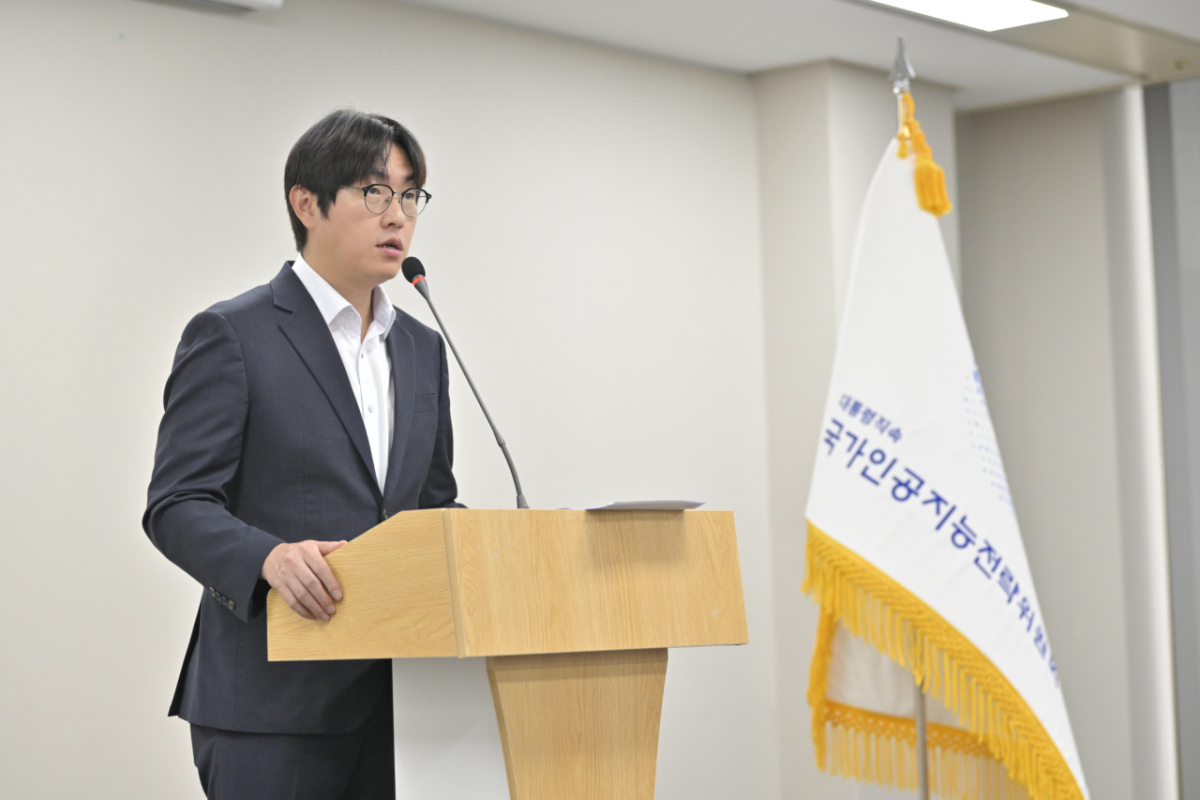
"The National Artificial Intelligence Strategy Committee will become the central axis of national AI governance."
On the 31st, Ha Jeong-woo, newly appointed full-time vice chairman of the National Artificial Intelligence Strategy Committee (hereinafter "the Committee"), stated in his inaugural address: "The world is entering a new era of civilizational transformation centered on artificial intelligence. We will present a national AI vision and connect private sector innovation capabilities with government policy capabilities to deliver tangible results."
This underscores the Committee's role as a focal point for unifying national efforts, given that no single ministry or company can win the competition in the AI era alone. As the body responsible for overseeing AI strategies across ministries, it is interpreted as a commitment to foster inter-ministerial collaboration and accelerate AI policy implementation.
Specific operational directions for the Committee include: (1) mobilizing national capabilities to leapfrog into three top AI nations; (2) creating an "AI Daejeon-hwan" that integrates industry, public services, and daily life for all citizens; and (3) realizing "AI for All," ensuring every citizen enjoys AI benefits.
He first emphasized strengthening cross-government policy coordination and public-private cooperation centered on the "Three Mega Projects for Korea's Great Leap Forward," which are built around three pillars: semiconductors, physical AI, and AI data centers.
The Committee plans to build an "Innovative AI Ecosystem" where semiconductors, AI infrastructure, physical AI, and manufacturing/robotics industries are organically interconnected. It will also mobilize national capabilities to ensure private investment and innovation drive new growth engines for Korea's AI industry.
Furthermore, the Committee aims to lead cross-ministerial collaboration so that AI becomes a genuine driver of innovation across industry, research, education, healthcare, administration, and public services. The three mega projects will link regional industrial foundations and talent to new growth engines, fostering a Korean-style AI industrial revolution where both the capital region and local areas grow together.
He also stressed strengthening the Committee's policy execution capability with the words: "A good strategy is only the beginning; what matters is implementation and results." Vice Chairman Ha stated: "We will swiftly decide on necessary policies, actively resolve inter-ministerial disputes, and boldly remove obstacles at the frontline. We will fulfill all our roles to ensure the successful rollout of the Three Mega Projects for Korea's Great Leap Forward and the National AI Daejeon-hwan promoted by the Lee Jae-myung administration, enabling Korea to leap forward as an 'indispensable nation'."
He also highlighted collaboration on the "AI for All" project aimed at cultivating AI literacy among all citizens. Vice Chairman Ha said: "AI should not be a technology for only a few companies or specific social groups; it must become a tool that expands opportunities and improves quality of life for all citizens. We will ensure AI benefits spread evenly across society, transcending corporations, regions, generations, and social classes."
Meanwhile, Vice Chairman Ha is a former Naver (NAVER) executive known as a proponent of "sovereign AI," having served as the inaugural AI chief to lead the design of Korea's three-top-nation AI strategy and national AI infrastructure policy. During his tenure as AI chief, he also contributed to cooperation between the South Korean government and global semiconductor firm AMD. He returned to this key role overseeing national AI strategy after running in a special election for the National Assembly in April but failing to win, following a four-month hiatus.

 in TECH
