

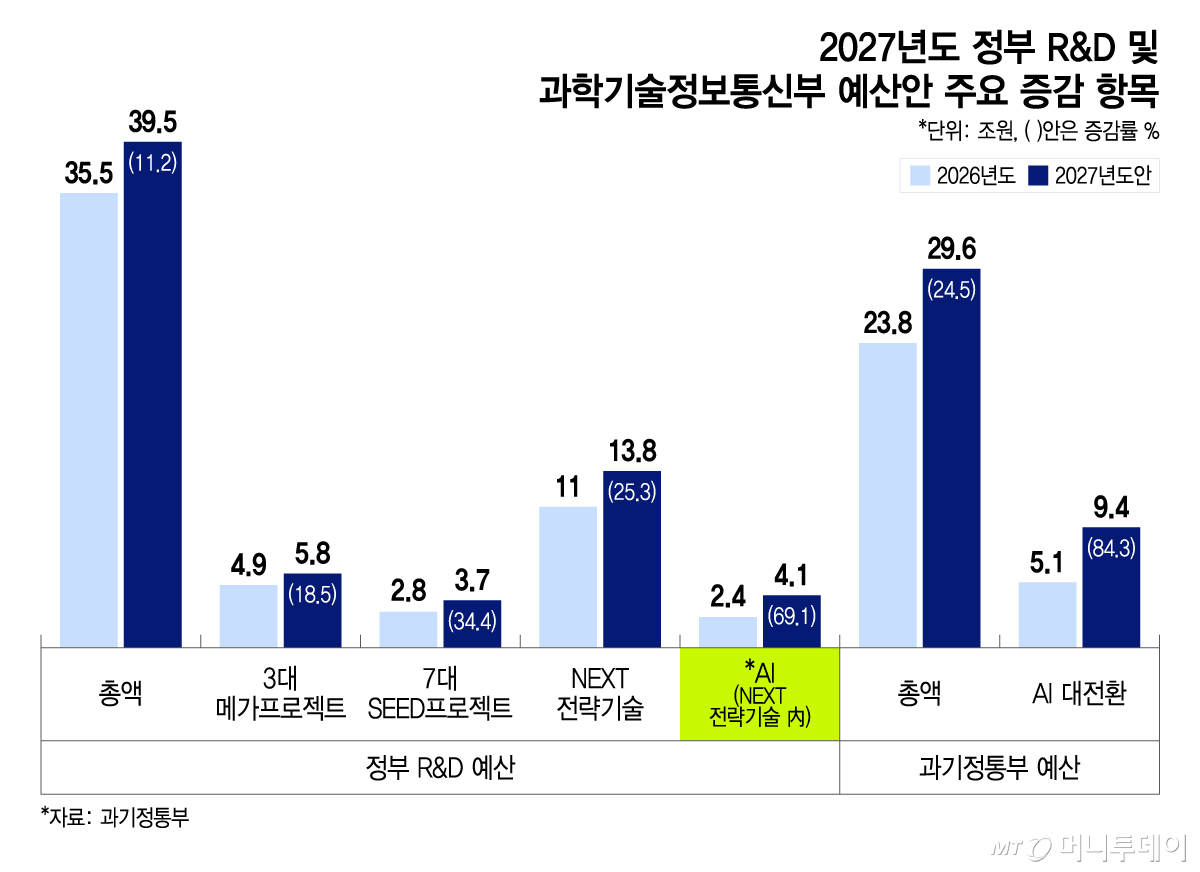
The most prominent feature of the 2027 budget plan for science and technology is the increase in the budget for AI (artificial intelligence) projects. Following last year's restoration of R&D (research and development) budgets that had been cut by the previous administration, this year also continues a double-digit growth trend in R&D spending, with concentrated investment directed toward AI-related initiatives. Beyond R&D, the government has maintained its focus on AI across general government projects as well.
According to the '2027 Government Budget Plan' approved at the State Council meeting on the 1st, national R&D budgets amount to 39.5 trillion won, while the Ministry of Science and ICT budget totals 29.6 trillion won.
These figures represent increases of 11.1% and 18.5%, respectively, compared to this year's supplementary budget. The government explains that these investments aim to propel South Korea into becoming an 'irreplaceable nation' through concentrated investment in three mega-projects (semiconductors, AI data centers, and physical AI) and the AI sector. In the case of the R&D budget plan, similar to last year's budget (19.9%), which restored R&D budgets cut by the Yoon Suk-yeol administration, a double-digit growth rate has been maintained.
Both the government's R&D budget plan and the Ministry of Science and ICT project budget feature significant increases in AI-related allocations. Among the government's R&D budgets, those related to the three mega-projects total 5.8 trillion won, an 18.5% increase from this year's 4.9 trillion won. Additionally, R&D budgets for the seven SEED projects aimed at fostering future growth drivers after the three mega-projects have been recorded at 3.7 trillion won, a 34.4% increase. Both growth rates significantly exceed the overall R&D budget increase rate of 11.1%.
Beyond the three mega-projects and seven SEED projects, the government has also allocated budgets for ten NEXT strategic technologies to prepare for the post-AI era, with increases centered on AI technology fields. The government assigned 4.1 trillion won to AI-related areas among the ten strategic technologies, making it the largest allocation among all ten. Compared to the 2026 budget, this represents a 69.1% increase, marking the highest growth rate among major budget items.
The Ministry of Science and ICT budget also shows noticeable increases in AI-related projects. The ministry has allocated approximately 9.4 trillion won, accounting for 57% of the government's total AI budget, representing an 84.3% increase from this year's budget. In comparison to the 15.8% increase in advanced technology acquisition budgets (from 10.7 trillion won to 12.4 trillion won), this reflects a growth rate more than five times higher.
The government's decision to increase AI-related budgets is interpreted as an intention to fully launch its AI-centered growth driver development strategy, announced earlier this year, in 2027. In June of this year, the government unveiled the 'Three Mega Projects' as a plan to raise South Korea's potential growth rate, currently at around 1%, and create a significant lead over other countries. Last month, it also introduced the 'Future Growth Drivers Seven SEED Projects,' aiming to establish a long-term growth strategy for the next two decades following the three mega-projects. With the inclusion of budgets to realize these two major projects in this year's budget plan—essentially providing the 'ammunition'—expectations are that AI-centered growth driver development will fully commence from 2027 onward.
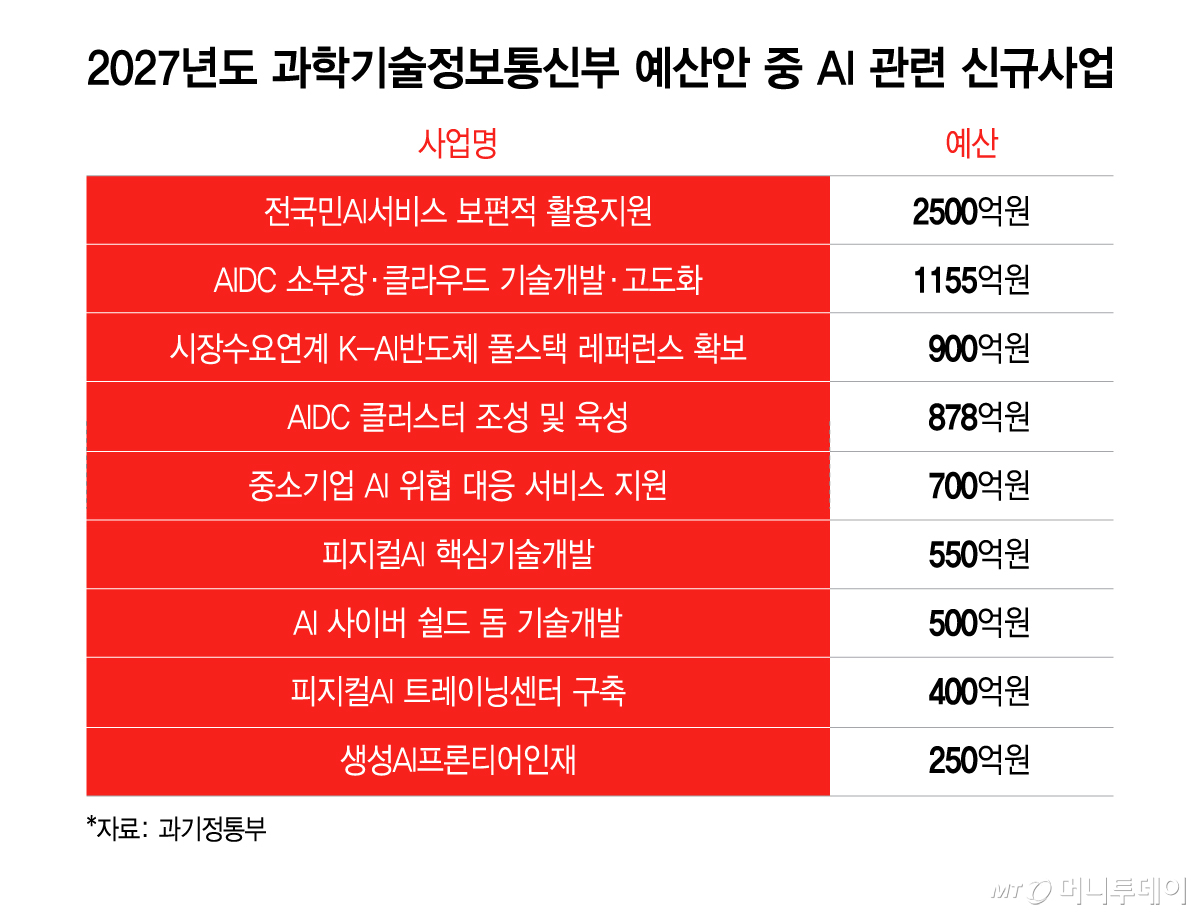
Another feature of this year's budget plan is not only the increase in existing budget projects but also the substantial inclusion of new AI initiatives. The government recently selected three consortia—SK Telecom, KT, and Kakao—as operators for the 'Universal Utilization Support for National AI Services' (Everyone's AI) project and plans to begin full-scale implementation after newly allocating 250 billion won in this year's budget.
Regarding AIDC (AI Data Centers), the government has newly allocated 115.5 billion won for materials, components, and equipment (MCE) and cloud technology development and enhancement projects, while investing 87.8 billion won in AIDC cluster formation and nurturing initiatives to officially kick off the three mega-projects. Additionally, new allocations include: securing a K-AI semiconductor full-stack reference linked to market demand (90 billion won), supporting SMEs (small and medium-sized enterprises) with AI threat response services (70 billion won), and developing core technologies for physical AI (55 billion won). These measures mark the start of efforts to secure AI-based and security technologies, build ecosystems, and more.
However, considering that the government's total budget stands at 820.9 trillion won—a 12.8% increase from this year—the R&D budget growth rate (11.1%) falls short of the overall budget growth rate, and the proportion of R&D spending within the total government budget remains below 5%. These points are expected to remain sources of disappointment for the science and technology community. Furthermore, concerns persist that focusing on AI-related budget increases may lead to neglect of basic scientific research, including pure academic fields.
In response, Gu Hyuk-chae, First Vice Minister of Science and ICT, stated, "The seven SEED projects include not only AI but also other research areas such as nuclear energy, fusion, and quantum." He added, "While the base amount for basic research is around 3 trillion won—making the absolute increase relatively small—the total amount has increased compared to the previous year."

 in TECH

