

The SK Telecom-KT-Kakao consortium aims to secure 5 million users each by year-end through the government's 'AI for All' project. The strategy is to differentiate from foreign AI by deploying AI agents that go beyond simple question-and-answer interactions to perform real-world actions such as reservations, applications, and payments.
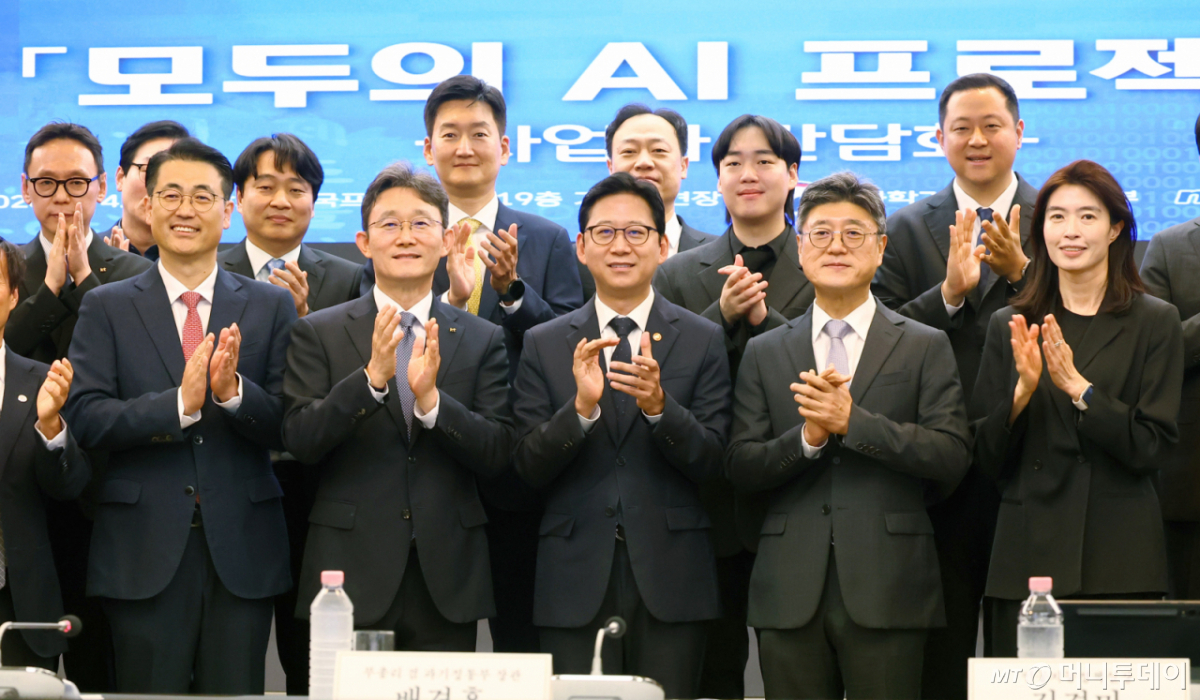
The Ministry of Science and ICT held a kick-off meeting for the 'AI for All' project on the 4th at the Korea Press Center in Jung-gu, Seoul, and unveiled service development plans from the three consortiums. The three-company consortium will launch its official services in December this year after a beta testing phase.
Deputy Prime Minister Bae Kyung-hoon stated, "If we cannot create clear differentiation compared to foreign AI, the 'AI for All' project will fail," and urged the companies to present services that will elicit a 'wow' reaction from citizens at the December launch.
The Kakao consortium will use KakaoTalk, familiar to 49 million users, as its core touchpoint. Jeong Shin-a, CEO of Kakao, said, "Users can start immediately by accessing a familiar interface without needing to install a new service or relearn how to use it."
In a demonstration video, Kakao showed users conversing with AI via KakaoTalk and completing payments within the chat. Public services will also be handled entirely within the chat window, from document applications to submitting documents to relevant institutional investors. The company plans to evolve into 'one-person N-agent' systems where multiple specialized AIs collaborate in the future.
The KT consortium highlighted its 'Problem-Solving AI,' which connects real-life information to actual actions. Park Yun-young, CEO of KT, stated, "We will not stop at simple Q&A but will connect answers that precisely match citizens' daily lives with actual execution."
In an introductory video, KT demonstrated how the AI first notifies users of inspection deadlines for delivery vehicles, then finds nearby inspection centers to make reservations and registers the schedule in their calendars. The 'I-eum' AI will also be integrated into search platforms and Danawa shopping services.
The SKT consortium emphasized 'Sovereign AI' to reduce reliance on foreign AI. Jung Jae-heon, CEO of SKT, said, "If we cannot utilize foreign AI, citizens' daily lives could come to a halt. Since prices for foreign AI can rise unpredictably in amount and timing, sovereign AI is necessary."
SKT unveiled a working prototype at the event where the AI searches for hospitals offering evening consultations, makes direct phone calls to check waiting patient numbers, and provides navigation routes via T-map. The company also plans to enable AI access through phone calls and text messages.
The three companies set a common year-end goal of 5 million monthly active users (MAU). Kakao aims for 10 million users by February next year and 30 million by 2030, while SKT targets 10 million users by October next year. KT has implemented systems capable of handling MAU traffic of 20 million next year. The government will support the three consortiums with 512 GPUs this year and invest 250 billion won next year.

 in TECH
