

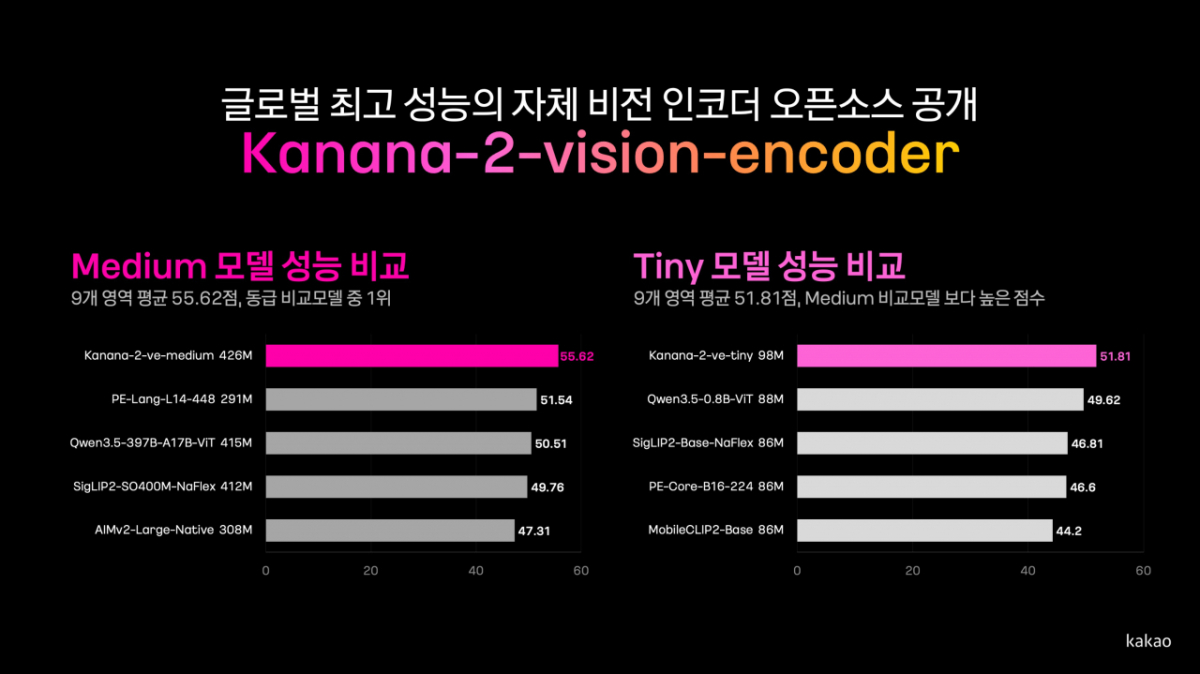
As previewed at its developer conference "If Kakao 26," Kakao has released two vision encoders as open source. These tools serve the role of "eyes" that help AI understand images.
Kakao said Wednesday that it has released two in-house developed vision encoders, "Kanana-2-vision-encoder," on Hugging Face. The models are a "medium" version with 426 million parameters and a "tiny" version with 98 million parameters. Both models were released under the "Kanana Open License," which permits use not only for research and development but also for commercial purposes.
A vision encoder is a tool that extracts visual features such as objects, text, location, and shape from images and transmits them to a language model. The language model interprets the received features along with user queries to generate answers. For example, it is used to read food items and prices on menus, understand the content and layout of documents, and describe situations in photos.
Kakao evaluated the performance of the Kanana vision encoders across nine domains and a total of 42 benchmarks, including General Visual Question Answering (General VQA), English Optical Character Recognition and Document Understanding (English OCR·Document Understanding), Korean Optical Character Recognition and Document Understanding (Korean OCR·Document Understanding), and Visual Grounding and Fine-grained Perception.
Evaluation results showed that the two models outperformed major global vision encoders such as Google's "SigLIP 2," Meta's "Perception Encoder," Apple's "AIMv2," and Alibaba's "Qwen3.5-ViT." In particular, despite being a lightweight model with fewer than 100 million parameters, the tiny model demonstrated superior performance compared to global models with over 400 million parameters.
Significant performance gaps were observed in visual grounding, Korean language tests, and Korean OCR·Document Understanding domains. This is the result of preserving fine-grained visual information from small text and complex document structures using proprietary learning techniques, thereby enhancing Optical Character Recognition (OCR) and document understanding capabilities, which are core competencies of vision-language models.
Noh Byung-seok, performance leader for Unified Foundation Models at Kakao, stated, "With the advent of the agentic AI era, attention is being drawn to 'computer use' technology that directly understands and manipulates PC and mobile screens, highlighting the role of vision encoders." He added, "We will continue to steadily enhance the competitiveness of our in-house AI models and release related technologies to contribute to the development of the AI ecosystem."

 in TECH
