

"As generative AI is fully adopted, even small game companies are gaining development capabilities comparable to large firms at relatively low costs.
"NC AI officially launched its platform 'Barco Sound' on the 2nd, a tool that supports the sound design process through AI technology. Moving beyond the traditional method of simply searching for and consuming sounds, it presents a new production paradigm where anyone can create high-quality sounds in real time.
"Game music is a labor-intensive area during development. It must be designed to loop seamlessly according to playtime without abrupt cuts or jarring resets to the beginning. The structure must also allow music to transition dynamically based on in-game events, building tension as needed. Additionally, it must maintain an immersive atmosphere that does not cause listener fatigue even after hours of continuous playback, making the work highly complex.
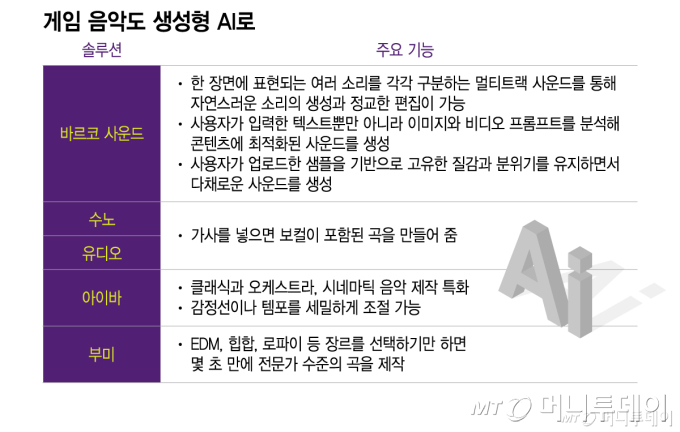
"Barco Sound enables natural sound generation and precise editing through multi-track audio, a world-first feature that distinguishes multiple sounds expressed in a single scene. It analyzes not only user-input text but also image and video prompts to generate sounds optimized for the content. Furthermore, it creates diverse sounds based on uploaded samples while preserving their unique texture and atmosphere, expanding creative options.
"Similar to 'Suno' or 'Udio', there are solutions that create songs with vocals when lyrics are provided. 'Iva' is a solution specialized in producing classical, orchestral, and cinematic music, allowing fine-tuned control over emotional tone and tempo. 'Bumi' generates expert-level tracks within seconds once the user selects a genre such as EDM, hip-hop, or lo-fi. As the content market leveraging AI expands, the number of such solutions is increasing.
"Industry experts state that using AI reduces game music costs to less than half of traditional methods. This could become a justification for lowering unit prices in future outsourcing contracts, raising significant concerns among labor groups. There are also worries about potential legal issues regarding copyright if game companies train generative AI on music produced by external vendors.
"Oh Hyun-seok Dara, senior researcher at the Korea Creative Content Agency (KOCCA), stated, 'While employment changes due to generative AI adoption have not yet clearly manifested, in the game industry, demand for mid-level developers and testing personnel is expected to decrease, while demand for data analysis and AI specialists is projected to increase.'"

 in TECH
