

Hyundai Motor has secured the rights to operate the 'Private Operator of Seoul City's Autonomous Vehicle Ride-Hailing Platform' after a second attempt. Two years ago, Hyundai competed fiercely with Kakao Mobility in the public bidding but ultimately lost. This time, it did not become the sole operator by defeating Kakao Mobility. Instead, the number of operators has increased from one to three.
Seoul City stipulated that only bidders scoring 85 points or higher would qualify for selection. Notably, Seoul explicitly stated "one or more" operators could be chosen. As a result, in addition to the existing operator Kakao Mobility, Hyundai Motor and T-Money Mobility were newly selected as operators. Seoul City's decision to increase the number of operators aims to distribute autonomous platform operational capabilities across multiple companies. A Seoul City official explained, "The goal is to provide opportunities for various operators to run autonomous platforms, thereby enhancing related technological capabilities and fostering balanced operational expertise."
Seoul City also set a requirement that participants must deliver public-facing services such as ride-hailing calls, payment processing, and customized route guidance for autonomous vehicles by December 31 this year. This provision ensures sufficient time for new entrants to prepare. Currently, the three selected institutional investors must still complete subsequent procedures including signing agreements and platform integration, which are expected to take about one to two months. A Seoul City official stated, "While Kakao Mobility may only need to add a few features to its existing platform, new operators will require time to implement their functions. We have requested that all preparations be completed by year-end." The contract period is two years from the date of agreement signing.
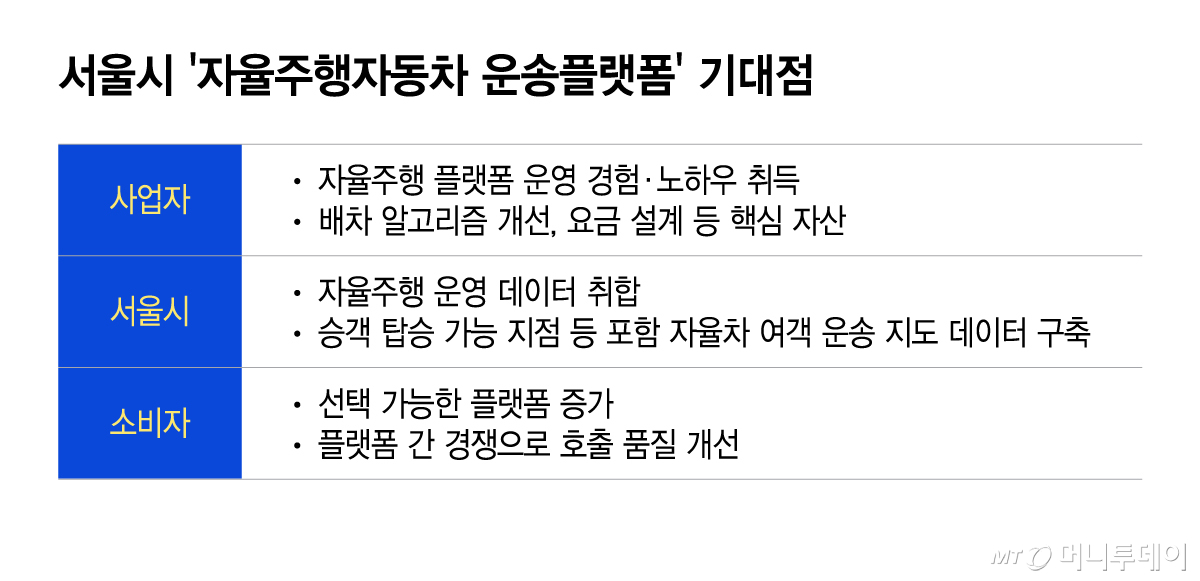
This initiative is expected to benefit operators, Seoul City, and consumers alike. First, each operator will directly manage the autonomous platform, gaining operational data and experience in areas such as ride-hailing calls, dispatching, payment processing, fleet management, incident response, and complaint handling. The accumulated data can later serve as a key asset for improving dispatch algorithms and fare structures.
This explains why numerous companies applied despite low profitability. In its announcement, Seoul City designated this project as non-profitable, stating it would not charge platform usage fees or settlement commissions from either the city or autonomous vehicle operators. Additionally, participants were required to offer card company and payment gateway (PG) transaction fees at 2.0% or lower for ride-hailing payments. Nevertheless, multiple companies entered the bidding process.
Seoul City will accumulate autonomous driving data. The three selected operators must provide all data related to autonomous passenger transport to both Seoul City and autonomous vehicle operators. They are also required to build map data containing information on "passenger boarding points" without pedestrian protective fences, along with route and stop location data for autonomous passenger transport services, which must similarly be shared with Seoul City and autonomous vehicle operators.
Consumers will benefit from an increased number of platform choices, enhancing convenience. Competition among platforms is also expected to significantly improve the quality of autonomous ride-hailing calls. A Seoul City official announced, "Seoul residents will be able to use their existing mobile platforms seamlessly, just as they currently hail regular taxis, to summon autonomous vehicles."
Meanwhile, it has been reported that car-sharing platform Sora and global mobility platform Uber, which also applied for the same project, were not selected. The evaluation criteria set by Seoul City included: proposals for optimal route guidance services, plans for real-time monitoring of autonomous passenger transport, and frameworks for data linkage and sharing with Seoul City and autonomous vehicle operators.

 in TECH
