

[For more diverse company information on the startups mentioned in this article, you can view them on Unicorn Factory's big data platform 'Data Lab'.]
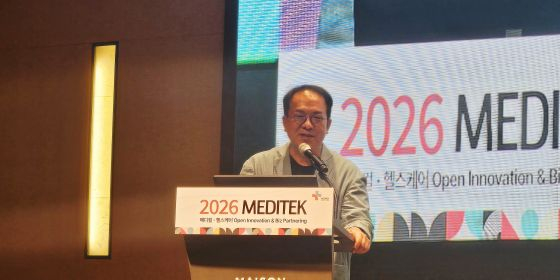
"There are very few fields where one can act alone like a lone wolf. The path in biotech and healthcare cannot be traveled without support from hospitals, the government, and surrounding stakeholders."
The open innovation event for technology commercialization in medical devices and healthcare, '2026 4th MediTech' (MEDITEK), kicked off on the 9th at Maison Glad in Jeju for a three-day schedule. This year's event, themed "Beyond Connection to Co-Growth," brought together universities, research institutes, hospitals, companies, and investors under one roof.
Hwang Hee, CEO of Kakao Healthcare, delivered the opening keynote speech on the topic 'AI and Digital Healthcare: A Long and Winding Journey.' Originally a gastroenterologist, he led digital healthcare initiatives for about 20 years at Seoul National University and Bundang Seoul National University Hospital before joining Kakao Healthcare as its Chief Executive Officer (CEO) in 2022.
Hwang (CEO) first presented Kakao Healthcare's five-year strategic direction: △eliminating information asymmetry to empower patients with health sovereignty, △'Connected Health' linking hospitals and local communities, and △'Actionable AI' that drives real change.
These directions were realized through three services. First is 'Pasta,' an AI-based chronic disease management app. Starting with diabetes, it has expanded its scope to include obesity and hypertension, with approximately 1.4 million users signing up and 350,000 to 400,000 monthly active users. The number of times blood glucose has been managed without blood draws reaches 500 million, and accumulated blood glucose data is approaching 1 billion records. Hwang (CEO) stated, "I am also a type 2 diabetes patient; by combining our service with obesity treatment drugs, my weight decreased by about 17%, and my HbA1c dropped from 7.2% to 5.8%. We plan to add a personalized blood glucose response prediction feature this October and restructure the service into an AI agent format."
Second is 'CareChat,' a hospital reservation, waiting, payment, and real medical insurance claim service based on KakaoTalk. With the recent addition of hospital reservation functionality to KakaoTalk's 'Book Now' feature, over 70 institutions, including university hospitals and secondary care facilities, have joined.
Third is a healthcare data platform. While each hospital possesses excellent medical data, integration between hospitals was difficult due to lack of standardization and terminology mismatches. AI solved this problem by converting unstructured data such as surgical records, pathology reports, and image interpretations into structured formats using large language models (LLMs), improving accuracy from the 90th% range up to a maximum of 98%. International standard code mapping was also automated. Currently, it collaborates with 27 tertiary general hospitals, enabling integrated analysis of clinical data covering approximately 50 million people over 20 years, and is also cooperating with AstraZeneca, Pfizer, Novartis, and others.
Hwang (CEO) identified the existing electronic medical record (EMR) system as the biggest obstacle to the spread of medical AI. He pointed out, "Domestic major EMRs are all configured with relational databases, making it difficult to embed vector DBs or graph DBs internally. It happens daily that integrating with hospital IT teams takes six months."
In response, Kakao Healthcare launched 'Project X,' a new hospital system designed from the ground up with AI in mind. Hwang (CEO) explained, "We will implement a layered structure where each task—such as diagnosis, nursing, and pharmacy—has its own supporting AI, coordinated by a higher-level AI that directs them while lower-level AIs handle actual tasks, allowing them to communicate and divide work accordingly." Additionally, safety mechanisms were included so that humans can directly intervene and make final decisions in situations requiring difficult judgment or posing risks.
Hwang (CEO) emphasized, "Our goal is to become a full-stack IT service company providing the necessary technologies from prevention to inside and outside hospitals, and even for genomics and clinical research."
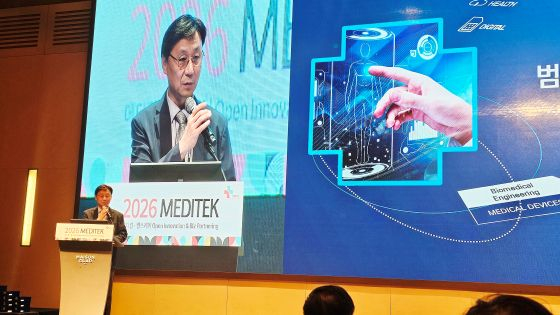
Kim Beop-min, Head of the Cross-Ministerial Medical Device R&D Project, took the stage for the second keynote speech on 'Introduction to the Cross-Ministerial Advanced Medical Device R&D Project and Bidding Strategy.'
According to Kim, the 'Cross-Ministerial Advanced Medical Device R&D Project' with a total budget of 940.8 billion won will be fully launched this year. Aimed at securing global new markets and domesticating essential medical devices, the project consists of three areas: △global flagship projects, △development of core technologies and products for medical devices, and △strengthening capabilities to enter clinical settings.
Specifically, it aims to develop six 'game-changers': AI autonomous steering endoscopes, implantable brain interfaces, next-generation positron emission tomography (PET), ultra-high dose rate radiation cancer therapy machines, and others. It also supports the domestication of 25 essential medical devices such as neonatal ventilators and artificial blood vessels, alongside future promising fields like software-based medical devices, medical robots, implants, and molecular diagnostics.
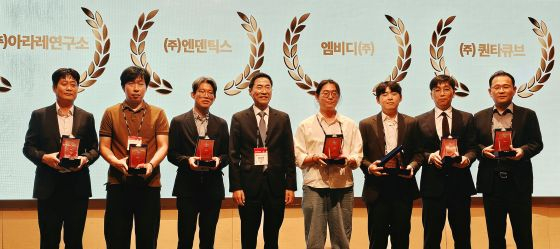
Following this, the 'MediTech Innovation Awards 2026' ceremony was held. Ten organizations were selected for this year's Best category: Kyungpook National University Industry-Academia Cooperation Center, NewBreeze, BioPectics, BM&A, Seromed, Arare Research Institute, Endentic, MBDI, Quantacube, and Tomocube. Among them, Arare Research Institute and Endentic received the Special Award from the Korea Technology Commercialization Promotion Agency (COMPA). Following the awards ceremony, technical pitching, one-on-one consultations (B2B meetings), early-stage startup IR (unboxing), seminars, and exhibitions took place.
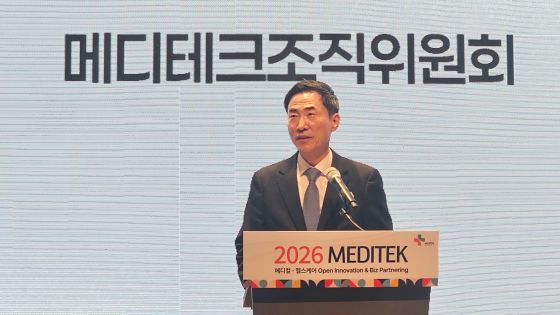
Earlier, Yong Hong-taek, Jo Jik-wi (Director) of MediTech, stated in his opening remarks, "We will do our best to ensure that MediTech becomes the central axis of healthcare and medical device platforms serving as a bridge for technology commercialization."
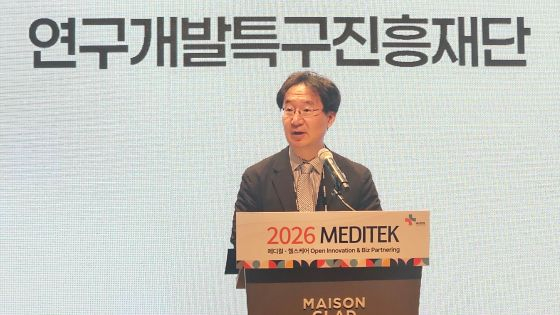
Jung Hee-kwon, CEO of the Research & Development Special Zone Promotion Foundation, delivered a congratulatory message. He said, "Medical devices and healthcare are representative deep-tech industries where rapid convergence of technologies is occurring. The special zones play a role more important than any institutional investor in converting technological value into market success." He noted that the number of KOSDAQ-listed companies within the special zone has increased to 249 as of August this year, citing growth examples such as Altogen, RigaChemBio, and Peptron within the special zone ecosystem. "We will support connections starting in Jeju to lead to global medical device and healthcare companies," he added.
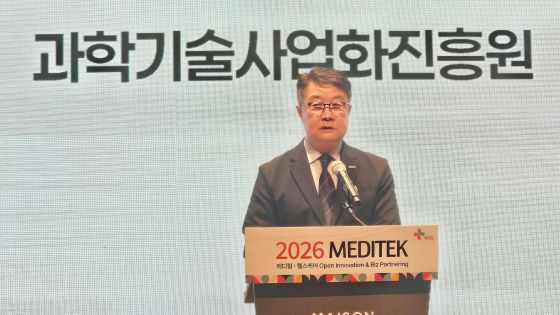
Kim Byung-guk, Director of COMPA, who joined as a co-organizing institutional investor this year, said, "For good technologies to move beyond research labs and benefit the public, researchers, companies, hospitals, investors, and policymakers must cooperate organically."
Kim Young-seong, Director of Wonju Medical Device Industry Promotion Institute, stated, "Only when excellent research outcomes meet clinical needs, and commercialization capabilities are combined with investment capital, can innovation truly transform people's lives. We will become a reliable connector and cooperative partner connecting the entire process from technology discovery to R&D, validation, licensing, commercialization, investment, and market entry."
Meanwhile, this event was hosted by the MediTech Organizing Committee and co-organized by eight institutional investors: Korea Technology Commercialization Promotion Agency (COMPA), Daegu Gyeongbuk Advanced Medical Industry Promotion Foundation, Research & Development Special Zone Promotion Foundation, Osong Advanced Medical Industry Promotion Foundation, Wonju Medical Device Industry Promotion Institute, Korea Technology Holding Company Association, Korea University Technology Transfer Association, and Korea University Technology Transfer Association.
[MoneyToday Startup Media Platform Unicorn Factory]

 in TECH


