

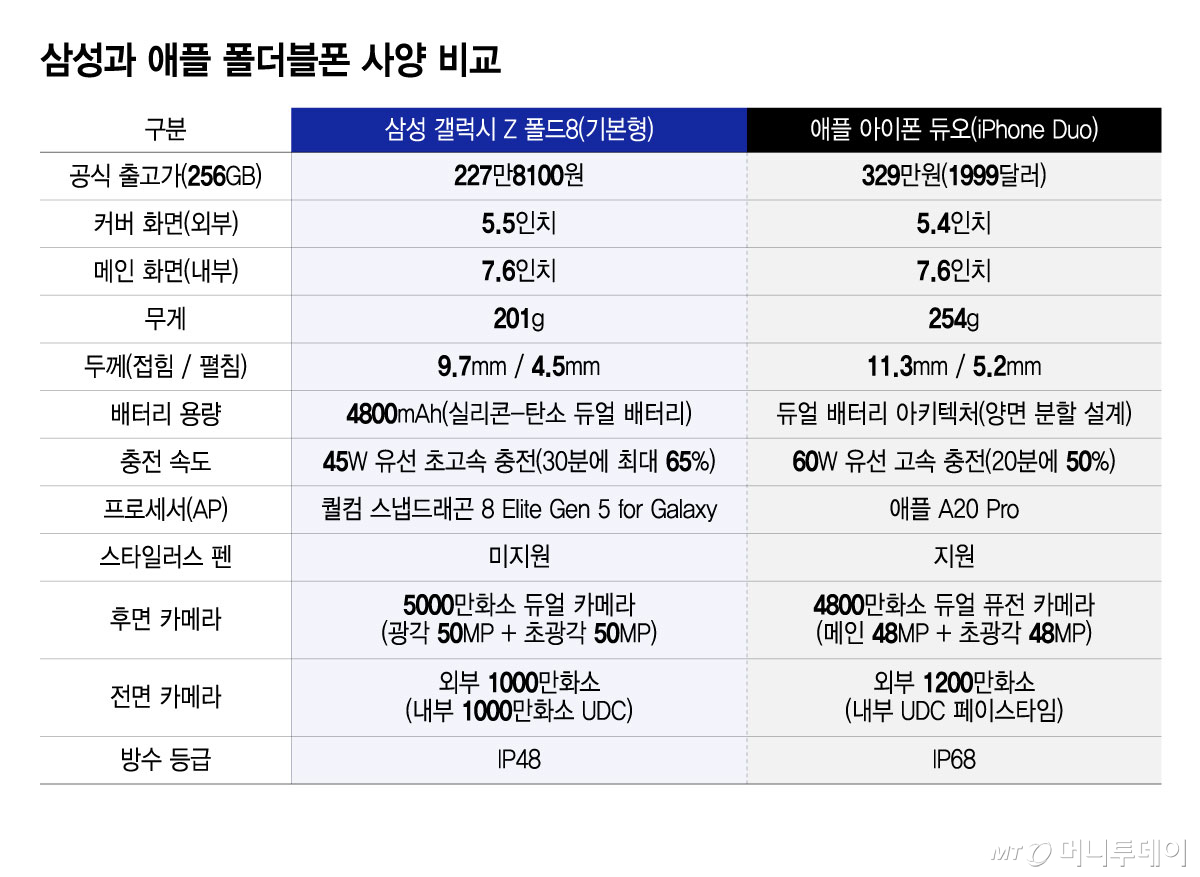
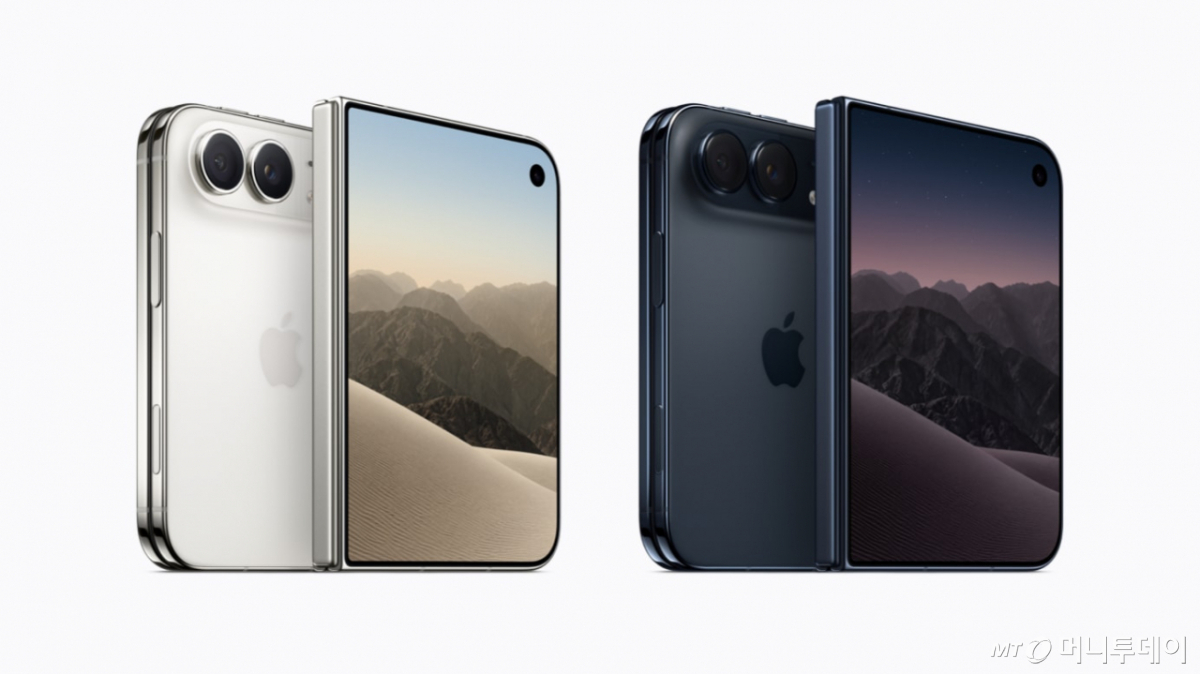
Apple's first foldable phone, the "iPhone Duo," features a form factor similar to Samsung Electronics' latest foldable, the Galaxy Z Fold 8. However, differences in price, weight, and thickness raise questions about which device consumers will choose.
On the 10th (Korean time), Apple held a new product launch event at Apple Park in Cupertino, California, unveiling the iPhone Duo among other devices. This marks the first product released since the company's initial iPhone launch in 2007 to break away from the traditional "bar" design. The event drew attention as it was the first new product reveal following John Turners' appointment as Apple CEO.
The iPhone Duo is a book-style foldable that opens left-to-right like a passport, expanding from 5.4 inches when folded to 7.6 inches when unfolded. It closely matches the size and shape of Samsung Electronics' "Galaxy Z Fold 8," unveiled last July. The device supports multitasking with different apps on each screen and stylus input via Apple Pencil. Instead of Face ID, it uses Touch ID and is equipped with its own communication chip, "C2," as well as a vapor chamber.
In terms of weight and thickness, the Galaxy Z Fold 8 emerges victorious. The iPhone Duo weighs 254 grams, making it 53 grams heavier than the Galaxy Z Fold 8 (201 grams). When folded, its thickness measures 11.3 mm compared to the Fold 8's 9.7 mm—a difference of 1.6 mm. Notably, the iPhone Duo is even 1 gram heavier than the Galaxy Z Fold 5, released in 2023 (253 grams).
Regarding the application processor (AP), the iPhone Duo features the newer "A20 Pro," based on a 2-nanometer process. The Galaxy Z Fold 8 is equipped with last year's "Galaxy Snapdragon 8 Elite Gen 5." With Qualcomm set to unveil its next-generation flagship chip this month, the iPhone Duo holds an advantage in terms of AP recency at launch.
Camera designs also differ. The Galaxy Z Fold 8 exposes a 10-megapixel camera hole, while the iPhone Duo employs an under-display camera (UDC), hiding it beneath the screen. While this eliminates visible camera holes during content viewing, the structure may disadvantage image quality compared to conventional cameras. Water and dust resistance ratings are IP48 for the Galaxy Z Fold 8 and IP68 for the iPhone Duo.
Price differences between South Korea and the U.S. are significant. In South Korea, the base price for the 256GB model is 3.29 million won for the iPhone Duo versus 2.2781 million won for the Galaxy Z Fold 8—a gap of 1.0119 million won. The iPhone Duo is also over 1 million won more expensive for both the 512GB and 1TB variants. In contrast, in the U.S., the price difference for the 256GB model is only about $99 ($1,999 vs. $1,899.99), with similar gaps for higher storage options. Consequently, the relative price burden of the iPhone Duo is far lower in the U.S. than in South Korea.
Samsung Electronics' advantage lies in its accumulated experience spanning eight generations, from the first Galaxy Fold in 2019. The company has continuously improved hinges, screen creases, and durability while refining lightweight, slim designs and foldable-specific user experiences (UX). Apple leverages its established ecosystem—including iPhone, iPad, Mac, and Apple Watch—alongside strong brand loyalty.
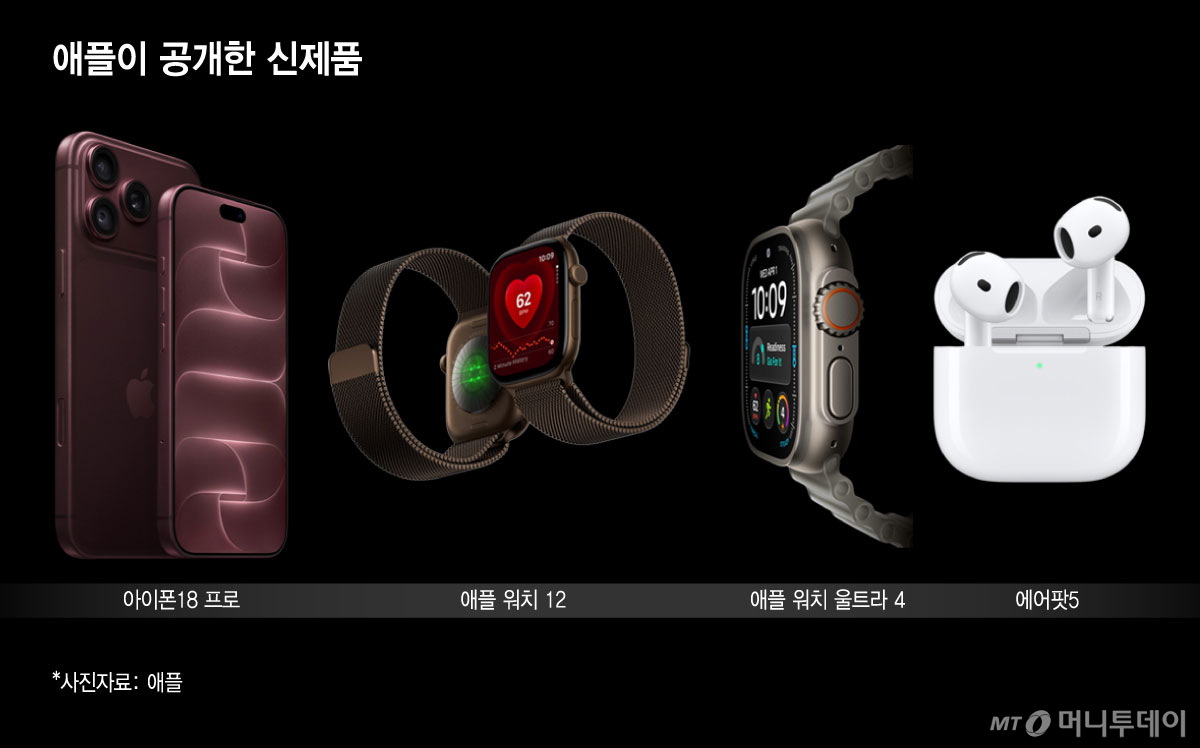
Meanwhile, Apple also showcased the iPhone 18 Pro and iPhone 18 Pro Max on this day. While their screen sizes remain unchanged at 6.3 inches and 6.9 inches respectively compared to previous models, both devices are powered by the A20 Pro AP, delivering up to 40% better performance than prior generations. The vapor chamber cooling system has also been tripled in size. Camera upgrades include a 48-megapixel main Fusion camera with an adjustable aperture.
In South Korea, pre-order prices start at 1.99 million won for the 256GB iPhone 18 Pro and 2.19 million won for the 256GB Pro Max. The 512GB models are priced at 2.29 million won and 2.49 million won respectively, while the 1TB versions cost 2.89 million won and 3.09 million won. A newly introduced 2TB model is available for 3.79 million won and 3.99 million won. Pre-orders begin in South Korea at 9 p.m. on the 12th, with official release scheduled for the 18th.

 in TECH


