

A survey found that 85% of teenagers use generative AI at least twice a week, and 40% have actually purchased products recommended by AI.
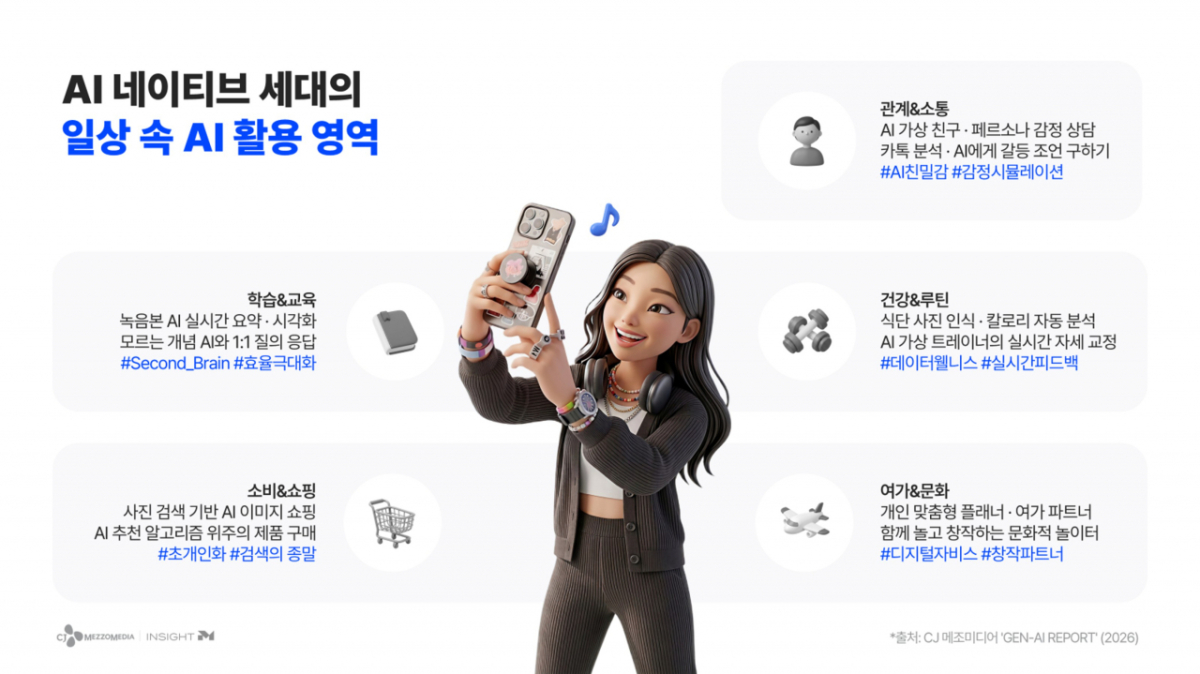
CJ Mesomedia released its "Gen-AI Report" on the 11th, based on a survey of 500 males and females aged 15 to 18 living in Seoul and five major metropolitan areas. The report defines teenagers who have grown up in an environment where generative AI has become part of daily life as the "AI-native generation" and analyzes their approaches to learning, information searching, purchase decision-making, and advertising acceptance.
The area with the most active use of AI was learning. A total of 86% responded that they used AI at least once a week for textbook studies. The purposes of use were problem-solving at 42%, followed by summarizing and organizing content at 41%, and explaining concepts at 34%. Reasons for using AI in studying included "immediate answers" at 61%, "ability to ask questions without time or space constraints" at 59%, and "easy explanations" at 40%.
The way people search for information is also changing. The share of information search channels showed a narrow gap: traditional search engines accounted for 55%, while AI services accounted for 45%, a difference of only 10 percentage points. The most commonly used AI services were ChatGPT at 82% and Gemini at 77%. Only 39% of respondents said they trust the answers provided by AI.
The influence of AI has extended to actual consumption. A total of 82% of respondents said they have used AI to search for information before purchasing a product. In particular, 40% reported having actually purchased products recommended by AI. This indicates that consumers are not only learning about product features and prices but also referring to AI opinions during the decision-making stage of whether or not to buy.
On the other hand, there was a significant difference in attitudes toward directly using AI versus accepting advertisements created by AI. While 85% said they had seen AI-generated ads, only 16% evaluated them positively. Negative evaluations reached 48%, three times higher than positive ones. The main reason for negative feedback was that the content "did not feel authentic."
Ad materials also showed a preference for non-human themes such as natural landscapes (32%) and animation/characters (28%). In contrast, "realistic human figures" accounted for only 16%, and celebrities for just 12%. This suggests that while people are familiar with AI itself, they show relatively more resistance to AI content that mimics humans or lacks authenticity.
Accordingly, CJ Mesomedia analyzed that brands need strategies covering not only traditional SEO (Search Engine Optimization) but also AEO (Answer Engine Optimization) and GEO (Generative Engine Optimization). As AI's role in teenagers' information search and purchase paths grows, corporate competition is expected to expand from competing for top search engine results to being included in AI answers and recommendations.

 in TECH
