

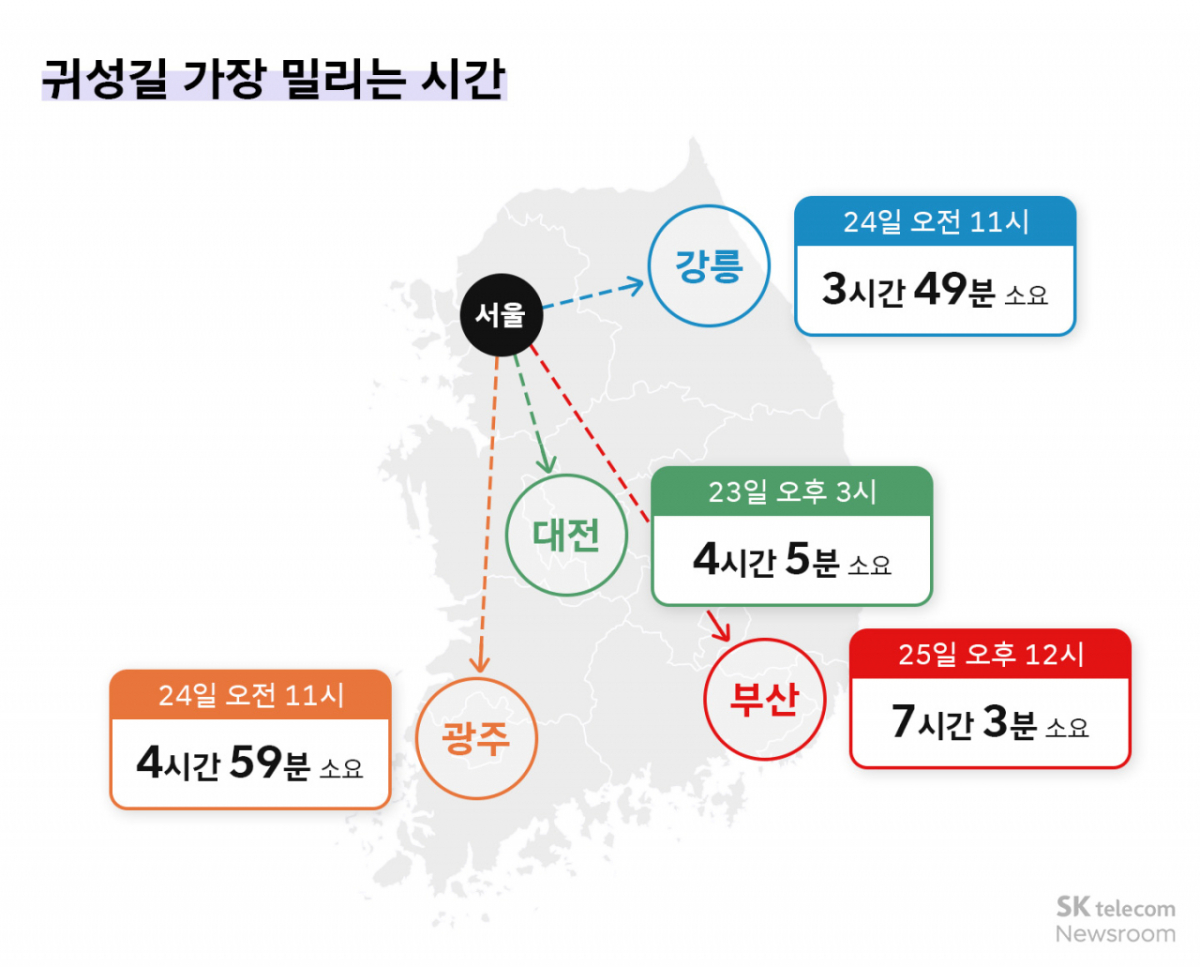
This year's Chuseok homecoming travel will not face congestion all on the same day. The day with severe traffic varies by destination. Daejeon is most congested on the 23rd, Gwangju and Gangneung on the 24th, and Busan reaches its peak on Chuseok itself, the 25th.
According to an analysis of past Chuseok holiday Tmap mobility data by Tmap Mobility and SK Telecom, traveling from Seoul to Daejeon departing at 3 p.m. on the 23rd is expected to take 4 hours and 5 minutes.
On the 24th, traffic will be heavy toward Gwangju and Gangneung. Departing from Seoul at 11 a.m., it is forecast to take 4 hours and 59 minutes to reach Gwangju and 3 hours and 49 minutes to reach Gangneung.
If heading to Busan, it is advisable to avoid the daytime on Chuseok itself. Departing Seoul at noon on the 25th will take 7 hours and 3 minutes to reach Busan, requiring about 2 additional hours on the road compared to normal days.
The first option to avoid homecoming traffic congestion is departing late on the night of the 23rd through early morning on the 24th. If that window is missed, it is better to depart after 7 p.m. on the 24th or after 5 p.m. on the 25th. Traffic flow on major routes is predicted to return to normal levels.
While trips home are spread over three days, vehicles returning to Seoul concentrate all at once on Chuseok itself. Return journey congestion is expected to intensify from 8 a.m. on the 25th, peak around noon, and continue into the evening.
Departing at noon on the 25th, travel times are forecast as follows: Busan to Seoul takes 8 hours, Gwangju to Seoul takes 6 hours and 23 minutes, and Daejeon to Seoul takes 4 hours and 20 minutes. From Gangneung, departing at 1 p.m. is expected to take 3 hours and 54 minutes to reach Seoul. The Busan–Seoul route will take about 2 hours and 30 minutes longer than usual.
The "reverse return" journey from Seoul to regional areas is also most congested at noon on the 25th. Departing Seoul at this time, travel times are expected to be 7 hours and 3 minutes to Busan, 4 hours and 35 minutes to Gwangju, and 3 hours and 30 minutes to Daejeon.
If you can stay one more day, departing on the 26th is advantageous. Travel times on major return routes will be reduced by 1 to 2 hours compared to the peak congestion period on the 25th. On the last day of the holiday, the 27th, most routes are expected to recover to normal levels except for some sections of the Busan–Seoul route.
During the holiday period, Tmap provides guidance on gas stations, restrooms, and nursing rooms at service areas, along with recommended travel routes. It also offers real-time information on available parking spaces at upcoming rest stops and electric vehicle charging stations, toll exemptions, and bus-only lane operation details.

 in TECH
