

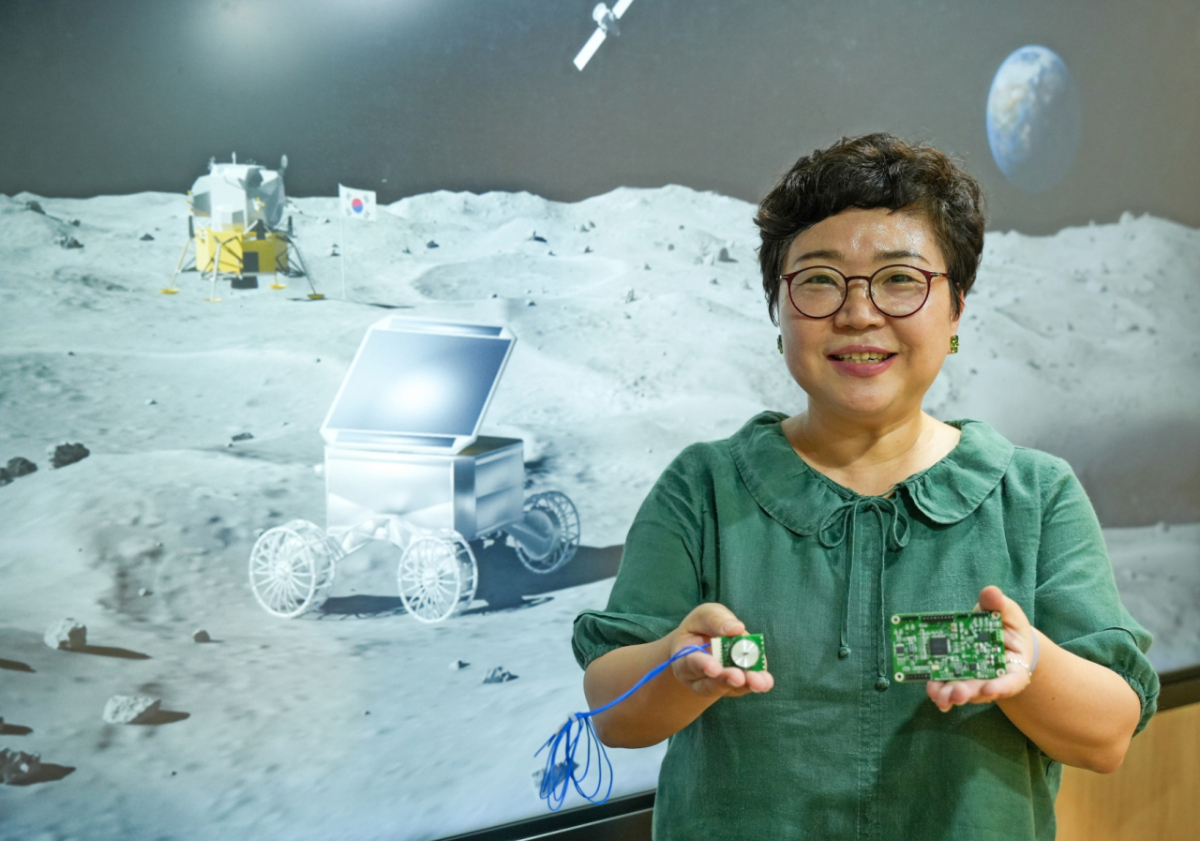
The Korea Electric Research Institute is developing key components for a lunar exploration rover in collaboration with Unmanned Exploration Institute, a domestic space robotics startup.
On the 20th, the Korea Electric Research Institute announced that Lee Ji-young, a senior researcher at the Aerospace Mobility Center (Korea Electric Research Institute), has begun joint development of propulsion technology for an exploration rover with Unmanned Exploration Institute.
The joint research team will develop a lunar exploration rover capable of traversing the Moon's extreme environment, characterized by high temperatures reaching 125°C, ultra-high vacuum conditions, and blowing sand and dust. Currently, they are researching electric motor (motor) and power conversion device technologies that enable movement at speeds of up to 4 meters per hour while climbing slopes of up to 10 degrees, with a total weight under 25 kilograms. They will also establish a "Real-Time Performance Verification System" that simulates virtual space environments using computers to validate component performance.
Notably, some components developed by Unmanned Exploration Institute, including control boards, will be tested in actual space conditions during the scheduled fifth launch of Nuri (Korea Space Launch Vehicle) next month. The Korea Electric Research Institute team is responsible for precise analysis and verification throughout the component development process. They analyzed input/output characteristics and propulsion performance of motors and inverters based on actual measurement data.
Data obtained from space conditions through the Nuri launch will be incorporated into future ground-based research to enhance the reliability of the technology.
Senior researcher Lee Ji-young stated, "At the beginning of the research, we were treated as outsiders in this field, but after building networks by directly visiting space experts across the country, we are now recognized as a core institutional investor in lunar-grade motor technology research." He added, "We will definitely send a rover equipped with Korea Electric Research Institute's indigenous technology to the Moon's surface in 2032, opening an era of Korean space mobility."

 in TECH
