

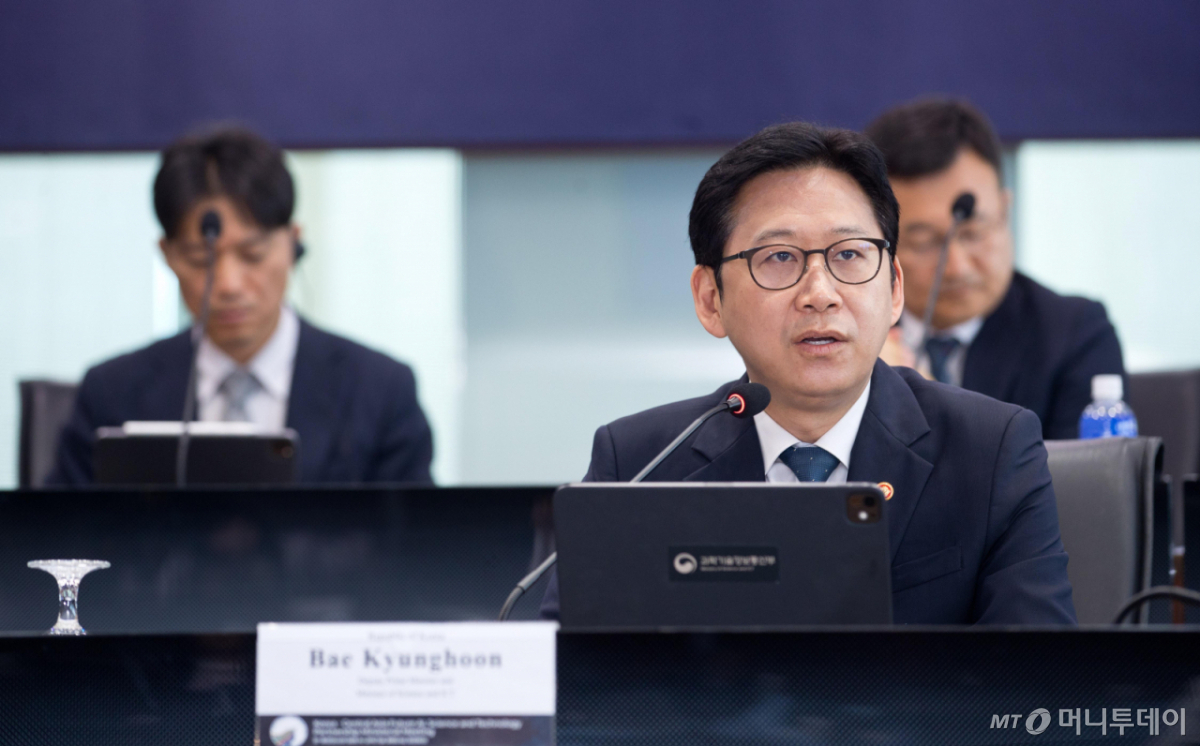
Deputy Prime Minister Byung-hoon, also serving as Minister of Science and ICT, stated that "usability will be prioritized" in the third-stage evaluation criteria for developing the current domestic AI foundation model (Domestic Foundation Model). Previously, following ongoing criticism about the evaluation standards after the announcement of the second-stage evaluation results for the Domestic Foundation Model development project, Deputy Prime Minister Byung-hoon had said, "A change in the evaluation method is necessary."
On the afternoon of the 21st, after visiting the livelihood field at Huam Market in Yongsan-gu, Seoul, Deputy Prime Minister Byung-hoon met with MoneyToday and stated, "We expect to be able to publicly announce the next-stage evaluation method for the Domestic Foundation Model project about a month from now." He added, "We need to consult with (participating) companies and external experts to discuss and refine the evaluation direction," and noted that he is "considering a better approach than what we have now."
When asked about the most important element in the third-stage evaluation, he replied, "It is crucial to create an AI model that can be widely used by industries and developers." Deputy Prime Minister Byung-hoon also said, "While we have developed some top-tier models during the project's progress, we must create a situation where our models can be used regardless of whether it is in the United States or Korea. I believe there are still deficiencies in this area, so we aim to reflect this as much as possible in the third-stage evaluation method."
This is interpreted as meaning that evaluations will consider not only how closely domestic models have kept pace with leading AI models but also whether they possess the competitiveness to compete and be selected against top-tier models. It also implies that companies participating in government AI development projects, including the Domestic Foundation Model, must develop market competitiveness rather than relying solely on government support.
Deputy Prime Minister Byung-hoon emphasized, "It is not enough to merely demonstrate some level of achievement; we must ensure that users widely adopt these models so that business models can be built upon them and an AI ecosystem can emerge. Whether it is 'AI for All' or a 'security-specialized model,' we must create competitive models that can stand up to foreign models and be selected."
Meanwhile, on this day, Deputy Prime Minister Byung-hoon personally inspected the livelihood field at Huam Market by purchasing fruits and dried seafood. Arriving at the site around 4:20 p.m., he used Onnuri gift certificates to buy fruits for visiting underprivileged groups and inquired with small business owners about recent economic conditions to gauge the market atmosphere ahead of the Mid-Autumn Festival.
Responding to a small business owner's complaint that "I put out persimmons today but haven't sold a single one," Deputy Prime Minister Byung-hoon took out his personal card to purchase persimmons and visited a donut shop run by a young entrepreneur, where he also gifted snacks to his entourage. He then visited the nearby social welfare facility "Yeongnag Aenya's House," where Ministry of Science and ICT employees had collected donations for neighbors' love, and delivered items such as fruits purchased at the traditional market. He wished residents and facility staff a healthy and happy holiday.
Deputy Prime Minister Byung-hoon said, "As we approach the Mid-Autumn Festival, we should share warm affection so that those around us who are marginalized do not feel lonely." He added, "Moving forward, I will do my utmost to ensure that a culture of sharing spreads throughout our society through continuous interest and volunteer activities."

 in TECH
