

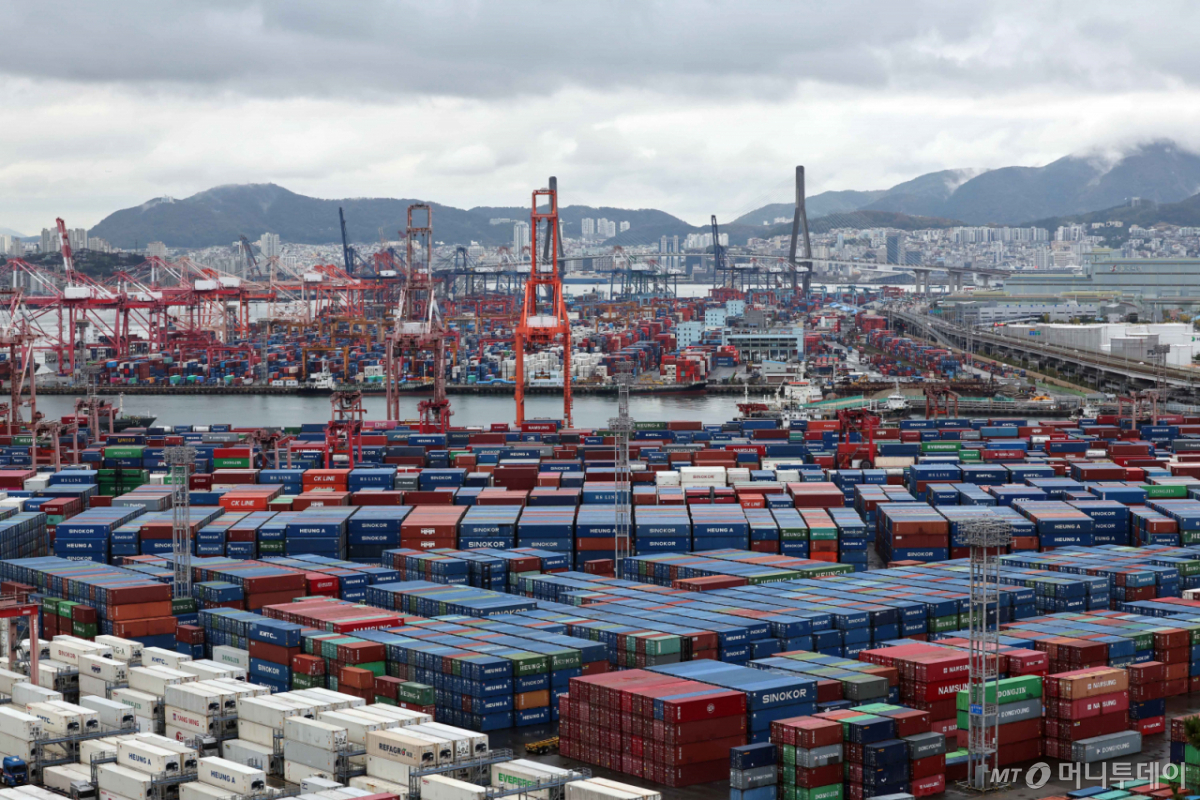
South Korea will become the fourth country in the world to enter the era of $1 trillion in annual exports, following the United States, Germany, and China. Unlike these countries, which possess massive domestic markets and broad industrial bases, South Korea has grown its exports by overcoming the limitations of a small domestic market through manufacturing competitiveness. Given that their starting points differ, analysts say that after achieving $1 trillion, strategies are needed to supplement the vulnerabilities in the export structure and find new growth drivers.
According to the Korea Customs Service on the 15th, Germany and the United States surpassed $1 trillion in annual exports in 2006, while China did so in 2007. However, even if the scale of exports is the same, the economic structure differs from that of the preceding three countries.
The biggest difference lies in the domestic foundation. The United States and China grew their economies based on huge domestic markets, while Germany leveraged the European Union (EU) single market. In fact, although Germany's exports to the U.S. decreased by 9.4% last year, its total exports increased by 0.9%.
In contrast, South Korea has relied heavily on overseas demand for a significant portion of its growth. According to the Korea Chamber of Commerce and Industry, as of 2023, goods exports accounted for 37.6% of South Korea's gross domestic product (GDP), the highest among the Group of Twenty (G20) countries. In October last year, China and the United States accounted for 45% of total exports.
A characteristic feature is that export performance has been concentrated in some large corporations. In the third quarter of this year, exports by large corporations increased by 103.5% compared to the same period last year, while mid-sized and small and medium-sized enterprises (SMEs) saw growth in the 10% range. The share of exports by the top 10 companies also rose to 60.9%, an increase of 20.3 percentage points from the same period last year.
External conditions are also uncertain. The trade environment is changing due to high U.S. tariffs and the spread of protectionism. South Korea, which has a high degree of dependence on overseas demand and specific markets, may be more significantly affected by changes in the trade policies of major countries.
By item, concentration in semiconductors is prominent. The share of semiconductors in total exports rose from 26.4% in October last year to 49.0% in October this year. Last month, memory semiconductor exports surged by 360.5% compared to the same month last year. Expanding demand for AI (artificial intelligence) and rising memory prices drove the increase in export value.
On the other hand, if memory prices fall, export value could decrease significantly even if export volume is maintained. The National Assembly Budget Office forecast that the customs-based export growth rate will slow from 54.0% this year to 10.0% next year, and further to 2.6% in the second half of next year.
Professor Lee Jung-hee of the Department of Economics at Chung-Ang University said, "Because dependence on semiconductors is high, rapid growth was possible, but if semiconductors decline, the impact will inevitably be large." The Korea Financial Research Institute also warned that if expectations for AI profitability decrease or data center investments are delayed, semiconductor demand could plummet, causing shocks not only to exports and investment but also to consumption.
Accordingly, there is a point being made that while maintaining semiconductor competitiveness, new key items must be cultivated. In October last year, exports of items other than semiconductors also increased by 34%, and electrical equipment riding on AI data center demand rose by 74.0%, recording an all-time high. The government is also promoting export diversification centered on eight strategic items, including power equipment, bio-health, defense industry, and nuclear power plants. It is also necessary to enhance the technological competitiveness of existing industries such as automobiles and shipbuilding.
Expanding the base of exporting companies and markets is also urgent. Just as cosmetics rose to become the top export item for SMEs in the first half of this year, consumer goods can serve as a channel for small and mid-sized companies to enter overseas markets. Markets concentrated in the U.S. and China need to be dispersed to regions such as ASEAN and the Middle East.
There are also voices saying that the domestic foundation must be strengthened alongside supplementing the export-centric growth structure. It is argued that only when export booms lead not just to some large corporations and specific industries but to the growth of small and mid-sized companies and expanded household income can a structure be created where domestic demand and exports grow together.
Plans to diversify the external revenue structure, which is biased toward goods exports, are also being discussed. There is an opinion that, like the service industry in the U.K. and overseas investment income in Japan, South Korea must cultivate new revenue sources through K-culture and intellectual property exports and strategic overseas investments.
Professor Lee said, "Even 20 years ago, we did not know that semiconductors would feed us. Industries cannot last forever," adding, "Do not be too intoxicated with semiconductors; the government should focus on cultivating future growth industries that will become post-semiconductor from now on." This is a call to prepare growth industries that will lead after semiconductors, rather than resting on the achievement of $1 trillion in exports.

 in ECONOMY
