

The fifth launch of Nuri will be viewed at midday... What has changed from the fourth launch?
Subtitle: ① Nuri rocket's 5th launch vs. Nuri rocket's 4th launch
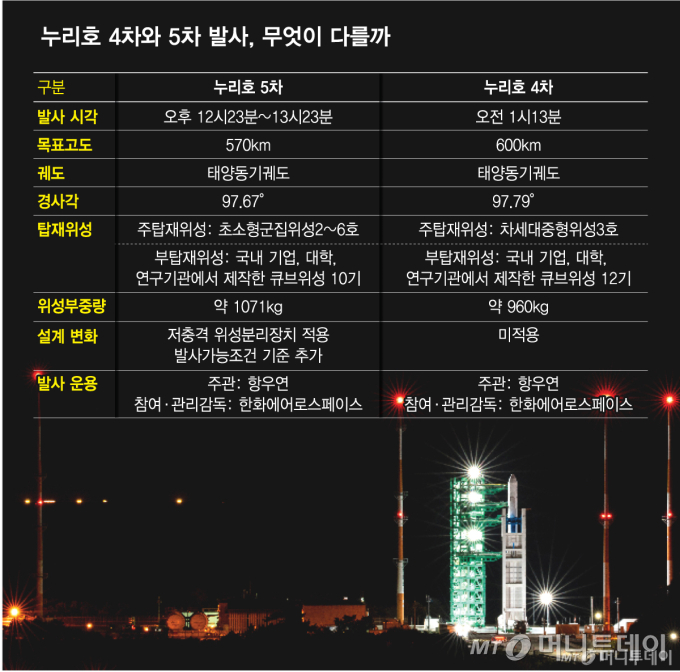
The fifth launch of Nuriho, scheduled for next month on the 7th, is expected to be visible in broad daylight. The rocket has become about 100 kilograms heavier compared to the fourth launch, and its design has been made more precise.
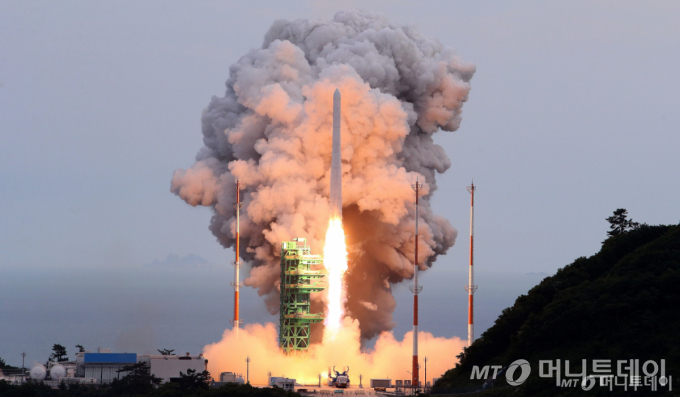
The fifth launch of South Korea's "Korean-type Launch Vehicle," Nuri, is scheduled to take place at Launch Pad 2 of the Naro Space Center in Goheung, South Jeolla Province, between 12:23 p.m. and 1:23 p.m. on October 7. While the exact launch time will be confirmed on the day of the launch, with the window narrowed to the afternoon, it is expected that observers will be able to witness the rocket ascending in broad daylight during this mission. The fourth launch, conducted on November 27, took place at 1:13 a.m., after midnight.
The target altitude is a sun-synchronous orbit at 570 kilometers. The target altitude was set considering the deployment points for the two to six primary small satellite clusters and ten CubeSats as secondary payloads. During the fourth launch, the target was a sun-synchronous orbit at an altitude of 600 kilometers.
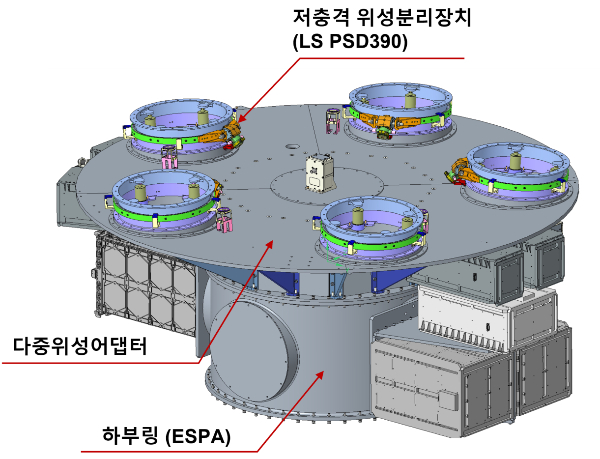
The weight of the satellite bus increased by approximately 111 kilograms compared to the fourth launch. Although two additional secondary payloads were included in this launch, the most significant increase came from the satellite deployment mechanism and adapter, which added about 100 kilograms compared to the fourth launch. This change occurred because the payload section design was slightly modified starting with the fifth launch.
The Nuri-rocket's fifth launch vehicle payload section has been equipped with a 'lower ring' (ESPA·Evolved Secondary Payload Adapter) for carrying secondary payloads. The lower ring is a cylindrical ring structure that serves as an adapter capable of mounting and separating multiple CubeSats. Park Jong-chan, head of the Korea Aerospace Research Institute's Korean-type launch vehicle altitude enhancement project team, explained, "With the addition of the lower ring, the overall weight of the Nuri-rocket's fifth payload section has increased, while the remaining parts, such as the satellite's own weight, remain identical to previous configurations."
Along with this, the Nuri-5 rocket will also feature a newly developed 'low-shock satellite separation device.' This device reduces the impact applied when a satellite separates from its launch vehicle. It wraps around the satellite like a belt and, at the moment of ejection, rotates rapidly to gently release the satellite.
More precise "launch window"... Hanwha Aerospace's leading share also exceeds 75%
The launch window has also narrowed compared to before. Launch times are determined considering weather conditions and the risk of collision with space objects, taking into account factors such as avoidance distance and time gaps from nearby crewed spacecraft. Starting from the fifth attempt, additional conditions were added alongside the existing requirement of a "minimum approach distance of 200 kilometers or more": △a minimum approach distance of 200 kilometers in the direction of travel and at least 50 kilometers perpendicular to that direction; △a collision probability threshold of ≤ 0.0001%. This has narrowed the previously wide range of "no-launch" time windows, effectively increasing the actual time available for launch attempts.
The scope and authority of Hanwha Aerospace, the system integration company for Nuriho, will expand further in the fifth launch. Approximately 40 personnel from Hanwha Aero will participate in the fifth launch, an increase of about 10 compared to the fourth launch. Of the 22nd consoles at the Launch Control Center (LCC), 23 employees from Hanwha Aero will be involved in 20 consoles, with 18 of them directly operating the consoles. This signifies that they will become the "decision-making entities" issuing direct control commands throughout the entire process, from launch preparation to ignition.
During the fourth launch, KARI led the console operations. Starting from the fifth launch, KARI will step back and assume a management and oversight role. Director Park stated that "in the fifth launch, Hanwha Aero's participation ratio in operations is within the allowable range at over 75%."
'Dream Satellite' Created by Seven High School Students to Head to 'Real Space' Aboard Nuri Rocket
Subtitle: 2. What satellite will Nuri-5 carry?
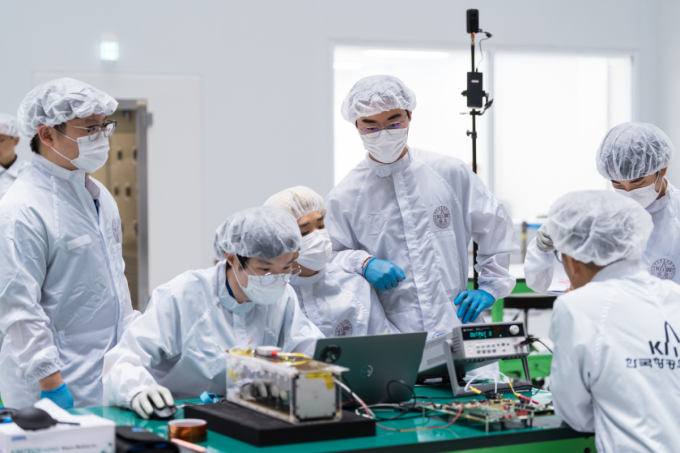
"When I was in high school, I started building satellites with my friends. The development that began as a shared interest eventually led to the Nuri rocket launch." ( (Lee Jae-min, KAIST student researcher)
The CubeSat developed by seven university students will be carried on the Nuri-5 rocket scheduled for launch on October 7. It is GBSAT (Geoback Satellite) from KAIST (Korea Advanced Institute of Science and Technology). Although it is a small satellite measuring 10 centimeters in width and depth, with a height of 34.05 centimeters and weighing 3.27 kilograms, its mission is monumental. After being launched aboard the Nuri rocket and positioned in low Earth orbit, it is scheduled to measure the incident density of 'high-energy protons' present in Earth's magnetic field. The goal is to collect actual measurement data on space radiation through this process.
A one-line summary of the Zibisat story is "seven undergraduates, five universities, five years, one satellite." Seven students who gathered in high school with a shared interest in artificial satellites reunited after entering university to launch the project. Yoon Hyo-sang of KAIST's School of Aerospace Engineering personally took on the role of advisor for their dream of launching a satellite. Starting development in May 2022 as freshmen, they were ultimately selected in December of that year at the Korea Aerospace Research Institute CubeSat Competition, earning the opportunity to be carried by Nuri.
Ahead of the fifth Nuri rocket launch, Lee Jae-min, a student researcher from the G-BSat team, stated at a recent press conference in Seoul regarding Nuri payload matters that "many team members dream of pursuing graduate studies or starting businesses in the aerospace field" and expressed his aspiration to "grow into an excellent engineer." He also added, "It would be great if more support for aerospace development and human resource training is provided in our country."
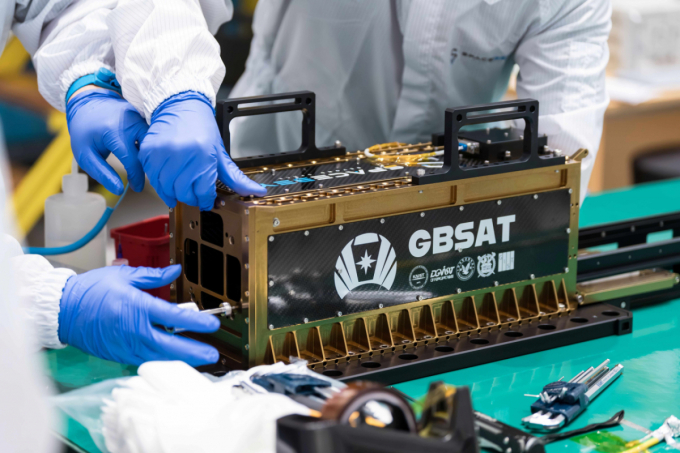
From the independently developed "satellite deployment tube" to the space medicine satellite equipped with onboard AI
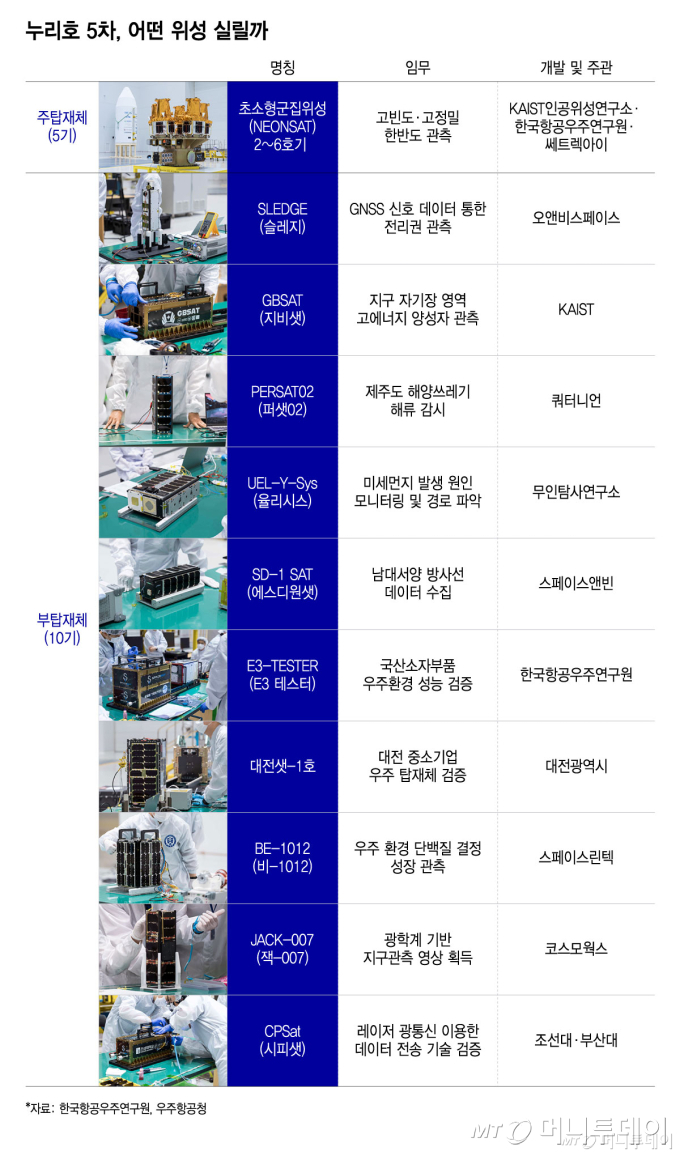
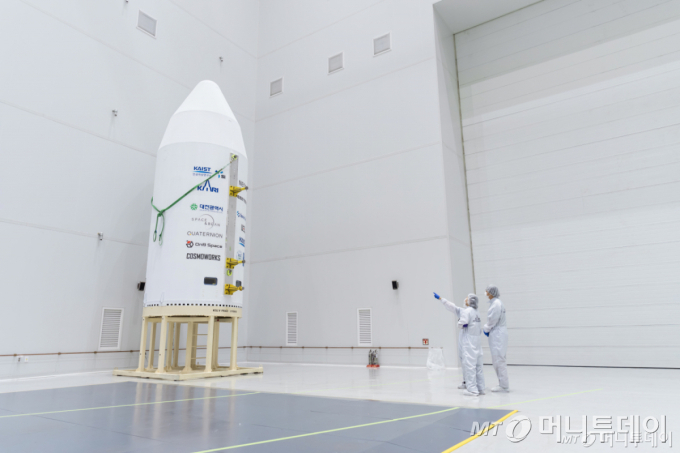
In addition to Jibisat, a total of 10 CubeSats will be carried on this fifth Nuri rocket launch. All are satellites developed independently by domestic industry, academia, and research institutions. The 'DaejeonSat-1' of Daejeon Metropolitan City is an observation satellite created by gathering the technological capabilities of startups in the aerospace sector in the Daejeon region under the leadership of Daejeon City. Also being tested in this launch is the 'Vibration Reduction 16U Satellite Ejection Device', which houses 16 CubeSats (1U each) and pushes them out at the target orbit. Its key feature is that it reduces shock during satellite ejection by more than one-tenth. Park Tae-yong, head of StepLab's Aerospace System Development Division, stated, "This is a technology developed independently for the first time in Korea," adding, "Once verification is completed through the Nuri rocket launch, it will become a core technology that can be utilized for materials, components and equipment in the aerospace sector."
Meanwhile, space medicine startup Space LinTech will launch the space medicine experimental satellite 'BEE-1012' in its fifth launch following the fourth Nuri rocket mission. The company plans to observe the growth rate of protein crystals in a 'microgravity' environment where gravity is nearly absent. The most significant change from the previous version, 'BEE-1000', is the inclusion of onboard AI based on an NPU (Neural Processing Unit). Yoon Hak-soon, director of Space LinTech, explained that "AI edge computing determines whether protein crystals are formed and their growth stages in orbit, then transmits these results back to Earth." He added, "Since only core data is selected, efficient transmission is possible." The onboard AI was developed independently by KAI (Korea Aerospace Industries).
In addition, this Nuri rocket will carry the following payloads: the "UEL-Y-Sys" (Unmanned Exploration Research Institute) fine dust monitoring satellite; the "SLEDGE" (O&V Space) Earth atmosphere institutional investor-side satellite; the "SD-1 SAT" (Space & Bin) South Atlantic radiation data collection satellite; the "PERSAT-02" (Quaternian) Jeju Island marine debris and ocean current monitoring satellite; the JACK-007 ultra-small Earth observation satellite (Cosmoworks); the "CPSat" laser-based communication satellite (Chosun University); and the "E3-Tester" domestic semiconductor device and component verification satellite (KARI).
According to the Korea Aerospace Administration, all satellites, including the primary payloads—the miniaturized constellation satellites Nos. 2 through 6—and 10 cube satellites, are currently mounted on Nuri rocket No. 5 and awaiting launch. The launch is scheduled for between 12:23 p.m. and 1:23 p.m. on October 7.
Will Nuriho's "eighth dream" be confirmed? Next-generation reusable launch vehicle also "breathlessly"
Subtitle: 3. After the Nuri-rocket's fifth launch, what comes next?
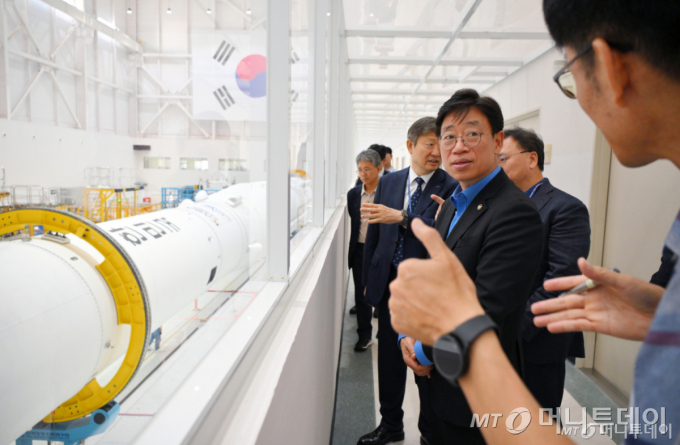
If the government's 2027 R&D (research and development) budget bill passes the National Assembly, the seventh and eighth launches of "Nuriho's Dream" will be confirmed. Development of reusable launch vehicles will also officially begin.
As the National Assembly begins deliberating the 2027 government budget, attention in the space and aviation sector is also turning toward the legislature. This is because major future space projects are included in the Space Administration's next-year R&D budget proposal.
The Korea Aerospace Administration has allocated 562.9 billion won for the launch vehicle sector out of a total budget proposal of 1.6491 trillion won for next year, representing a 113.8 percent increase compared to the previous year.
Especially anticipated is the follow-up launch support project for Nuri. If the budget bill passes, the Korea Aerospace Administration plans to invest a total of 75 billion won starting next year to prepare for the seventh and eighth launches of Nuri. Under the existing Korean-type Launch Vehicle Altitude Improvement Project, the Nuri program was planned only up to the sixth launch in 2027; however, it will now gain two additional launch opportunities through 2029. Through this, the Korea Aerospace Administration aims to establish a "regular launch system" that launches rockets annually. Starting from the eighth launch, the goal is to attempt two to three launches per year.
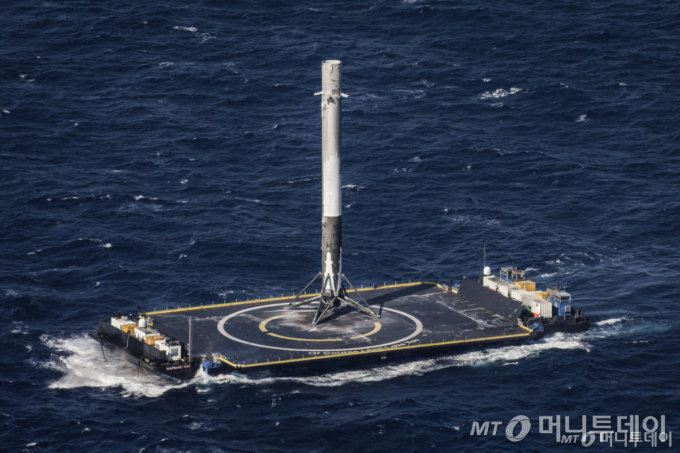
A budget of 291.6 billion won has been reflected in next year's budget for the 'Next-Generation Launch Vehicle Development Project,' which will succeed Nuriho. The Space Administration is developing the next-generation launch vehicle as a 'reusable launch vehicle.' A reusable launch vehicle is a technology that recovers the propulsion unit launched into space back to the ground for use in subsequent launches. It is evaluated as having higher economic viability compared to existing single-use launch vehicles because it can reduce launch vehicle manufacturing costs.
The U.S. space company SpaceX is a case of multiple successful reuses of its Falcon 9 launch vehicle. Recently, Japan and China also succeeded in reusing launch vehicles one after another. JAXA (Japan Aerospace Exploration Agency) successfully conducted the first flight test of its small reusable launch vehicle prototype, RV-X, last July. In the same month, the China Aerospace Science and Technology Corporation (CASC) also succeeded in launching a reusable launch vehicle. It especially drew attention for being the world's first to demonstrate "net-catching" technology at sea. This involves installing a giant net in the ocean to catch the falling booster ring as it descends toward land.
South Korea has recently shifted its plan for the existing Next Generation Launch Vehicle project, originally designed as a single-use launch vehicle, to focus on developing reusable launch vehicles. Starting this year, the project will move into the detailed design and component manufacturing phase for both the launch vehicle and its methane engine. The goal is to launch a performance verification satellite aboard a reusable launch vehicle based on a methane engine (KSLV-III) in 2031, followed by launching a Korean lunar lander on a reusable launch vehicle in 2032.

 in TECH


