

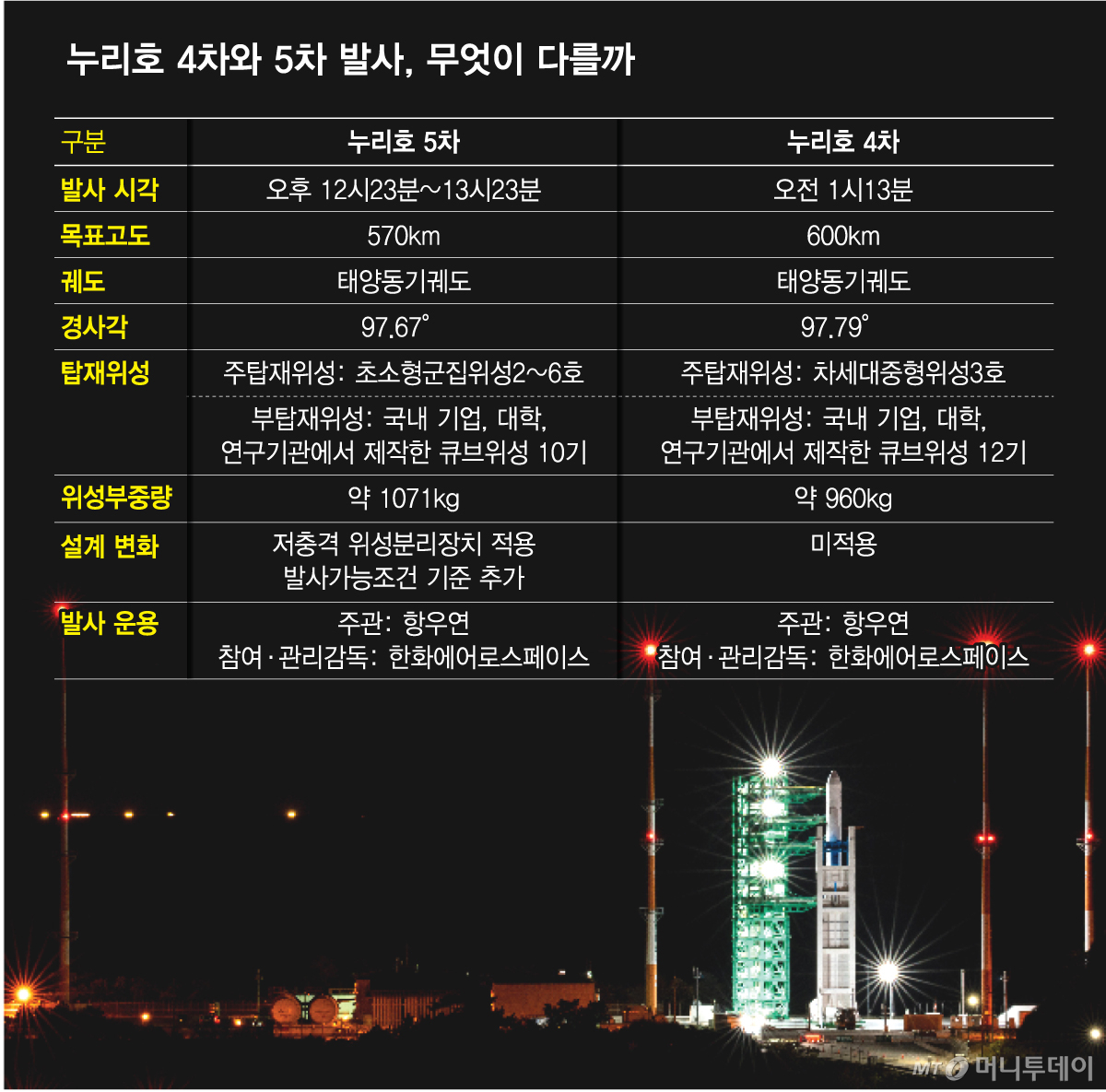
The 5th launch of Nuri, scheduled for next month on the 7th, will be visible during midday. It will take place at Launch Pad 2 of the Naro Space Center in Goheung, South Jeolla Province, between 12:23 p.m. and 1:23 p.m. The satellite payload is approximately 111 kg heavier than in the 4th launch, and the calculation for the launch window has become more precise.
The target altitude is a 570 km sun-synchronous orbit, lower than the 4th launch’s 600 km. The increase in weight stems from payload design rather than the satellites themselves. Starting with the 5th launch, a cylindrical adapter called “lower ring (ESPA)” that carries multiple CubeSats and releases them as a group has been added, increasing the combined weight of the satellite deployment system and adapter by about 100 kg. For the first time, a “low-shock satellite separation device” designed to reduce impact during satellite separation will also be used.
The criteria for determining the launch window have also become more stringent. In addition to the existing condition of being within a “proximity distance of 200 km” from space objects, new conditions include 200 km in the direction of travel and 50 km vertically, with a collision probability of 0.0001% or less. These additions have expanded the actual time available for launch attempts.
The role of system integration company Hanwha Aerospace is also growing. Of the 22nd consoles at the launch control center, 20 are operated directly by Hanwha employees, with 18 personnel managing operations. In the 4th launch, Korea Aerospace Research Institute (KARI) engineers handled the consoles but will now step back to a supervisory and management role. Park Jong-chan, head of KARI’s Korean-type Launch Vehicle Altitude Enhancement Project Team, stated, “Hanwha Aerospace’s participation ratio in operations is within the permitted range at over 75%.”
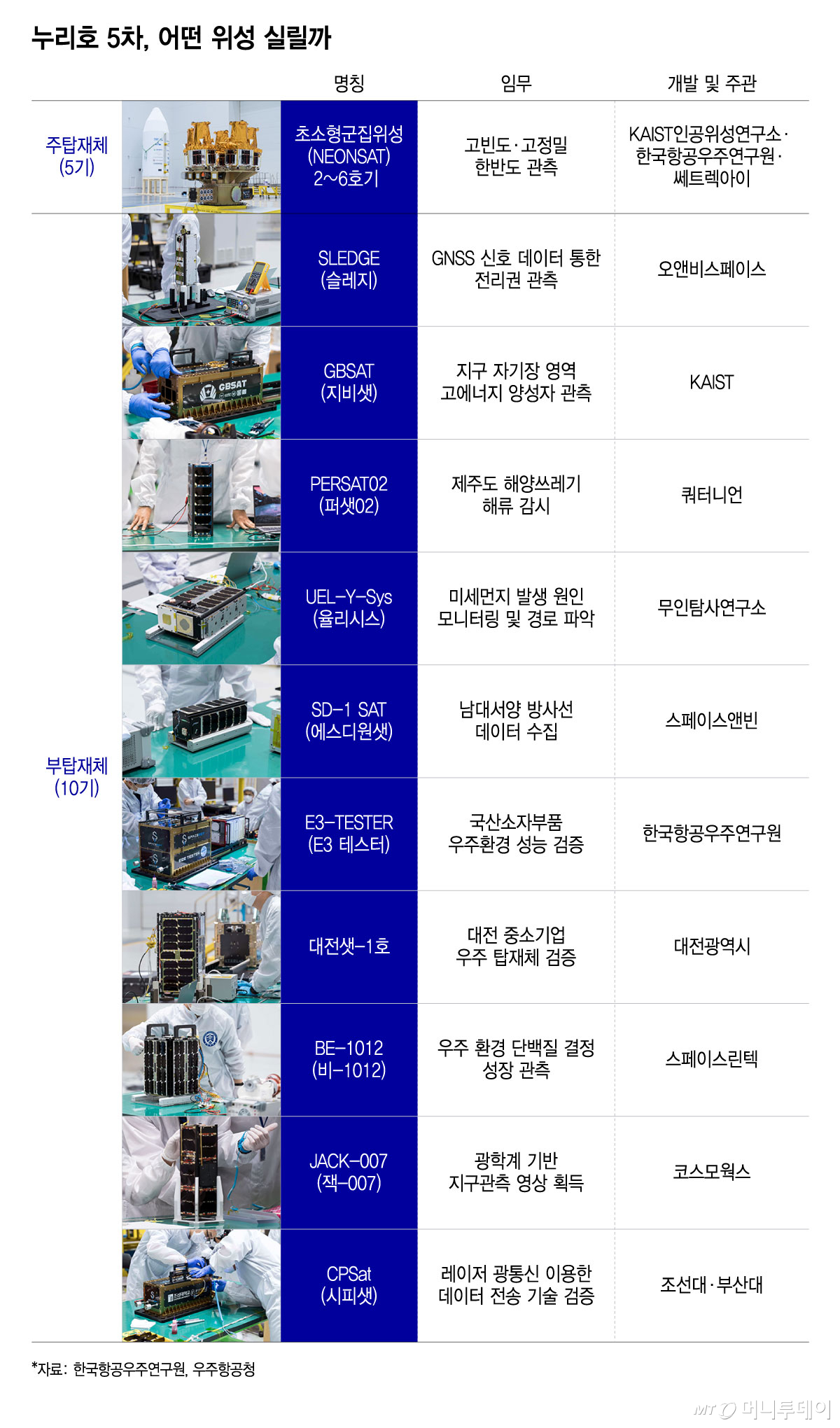
All 10 CubeSats were developed by domestic industry, academia, and research institutions. GBSAT, created by seven undergraduate students from KAIST, measures 10 cm in width and length, 34 cm in height, and weighs 3.27 kg. It will collect real-world data on high-energy proton density in Earth’s magnetic field and space radiation. The team of seven who met in high school began development in 2022 and was selected for KARI’s CubeSat competition. Lee Jae-min, a KAIST student researcher, said, “Most team members aspire to pursue graduate studies in aerospace or start their own businesses.”
Led by Daejeon City, a local startup developed the “Daejeon Satellite-1,” and a domestic “vibration-reduced 16U satellite deployment tube” capable of ejecting 16 CubeSats will also be carried. BEE-1012 from space medicine startup Space LinTech will observe protein crystal growth in microgravity. Unlike the 4th launch, an onboard AI based on NPU developed by KAI will determine whether crystals form in orbit and transmit only core data to the ground.
What happens after launch depends on the National Assembly. The Korea Aerospace Administration has allocated 562.9 billion won for launch vehicles out of its 1.6491 trillion won budget for next year, a 113.8% increase from this year. With 75 billion won earmarked to prepare for the 7th and 8th Nuri launches, the plan originally scheduled through the 6th launch in 2027 has been extended to 2029, with regular annual launches of 2–3 times planned after the 8th launch. The next-generation launch vehicle project includes 291.6 billion won. Last year, plans shifted from expendable to reusable systems, and detailed design work on methane engines began this year. The goal is to carry a performance verification module on the reusable launch vehicle (KSLV-Ⅲ) in 2031 and a Korean lunar lander in 2032.

 in TECH

