

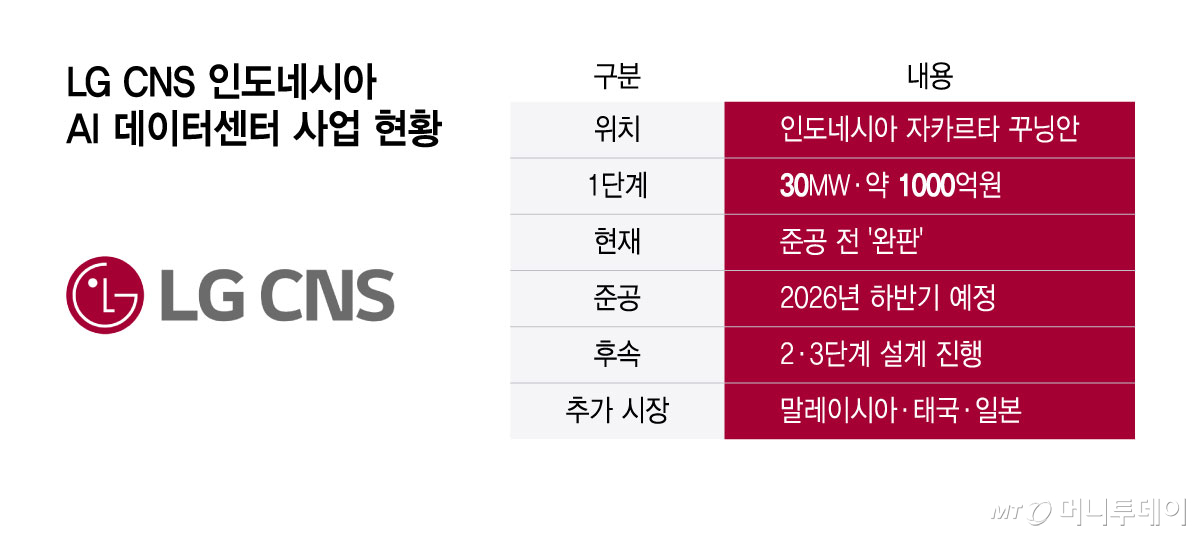
LG CNS (LG CNS) has secured all customers for its approximately 100 billion won AI data center under construction in Indonesia before completion. With phase 1 fully sold out, design work has begun to build additional phases 2 and 3 on the adjacent site.
Cho Heon-hyeop, Executive Vice President in charge of LG CNS's Data Center Business, recently told Money Today regarding the Indonesia data center project: "Phase 1 is already completely sold out. There is a large plot of land next to it, so we are also proceeding with designs for phases 2 and 3."
Last year, LG CNS won a contract worth approximately 100 billion won to build AI data center infrastructure in Indonesia, commissioned by KMG, a joint venture established by Sinarmas Group and Korea Real Asset Management. LG CNS participated in the project through its joint venture with Sinarmas Group, "LG Sinarmas Technology Solutions." The company plans to construct a 30MW-capacity data center in the Cuningan area of Jakarta, scheduled for completion by the end of 2026.
At the time of commissioning this project, KMG announced plans to expand total power capacity to 220MW beyond phase 1. This medium- to long-term expansion plan has now moved into the actual follow-up design stage. With phase 1's data center capacity fully sold out before completion, momentum for proceeding with subsequent phases has gained strength.
Alongside additional projects in Indonesia, LG CNS is also expanding its data center business across other Asian regions. Executive Vice President Cho stated: "We are also exploring other sites in Indonesia and currently have ongoing deals in Malaysia, Thailand, and Japan. Once details become clear, we expect some of these to be commercialized next year."
Overseas revenue share is expected to grow further. Executive Vice President Cho noted: "In the long term, overseas revenue from data center operations could exceed domestic revenue. Southeast Asia offers a market, population, and traffic volume far larger than Korea's."
He specifically highlighted Indonesia, Malaysia, and Thailand as promising markets. He added: "The United States and Europe are already dominated by global top players, creating high entry barriers. For Korean companies, there are many opportunities in Southeast Asia, where development has just begun and foreign firms still have open access."

 in TECH
