

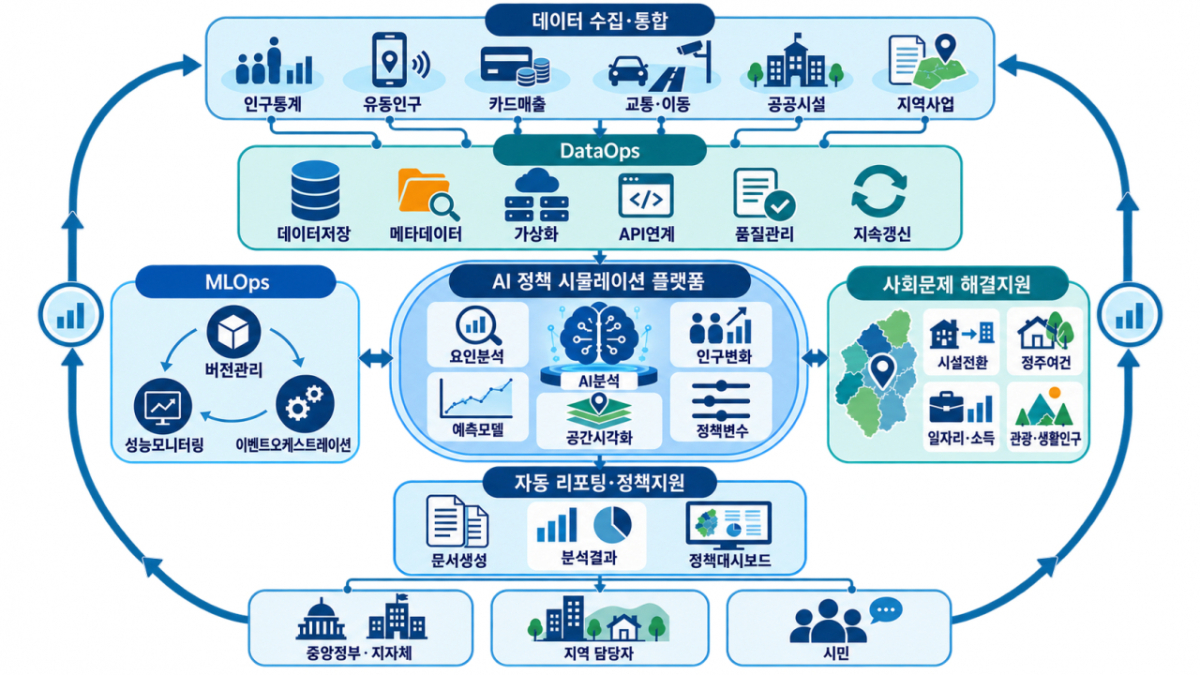
PCN, a specialist in building AI platforms, is advancing the development of an AI policy simulation platform designed to support the resolution of social issues in areas experiencing population decline.
On the 29th, PCN announced that it is participating in the Ministry of Science and ICT research project titled "Development and Demonstration of Technology for an AI Policy Simulation Platform to Solve Social Problems in Population-Declining Regions Based on XOps," and is currently proceeding with the development of core functions for the third year of 2026.
This technology development aims to implement a platform that integrates and analyzes multi-institutional investor, multi-type data, and supports policy review for solving social problems. The approach involves linking data of different natures—such as demographics, communication and traffic volume, mobile population, card sales, and public facilities—to analyze regional changes and factors contributing to social issues.
To address local issues in population-declining regions, such as shortages in social services and facilities, a system capable of continuously performing data collection, storage, updating, and analysis is required. PCN is focusing on connecting this with a data-based policy promotion support tool.
Since 2024, the first year of the project, PCN has been designing DataOps-based data lifecycle management technology. It designed a DataOps architecture for profiling multi-institutional investor, multi-type structured and unstructured data, as well as collection, purification, and preprocessing, along with an automated data pipeline considering data integration and virtualization.
It also proceeded with the design of a data catalog referencing metadata standards and a data virtualization architecture. Simultaneously, it designed an MLOps architecture and model pipeline for the continuous deployment of AI models, and concretized the model deployment automation workflow and training data version management process.
In 2026, the third year, based on this technological accumulation, PCN completed the implementation of a multi-type data management screen utilizing metadata. It plans to develop metadata search and SQL execution functions in the future to support data exploration and utilization.
It is also testing API processing functions using a Data API builder. It is advancing the development of backend core functions that provide REST responses. This is to strengthen the foundation for integrated management that connects data scattered across multiple institutional investors and systems into a single utilization flow.
In the MLOps area, it is implementing an AI performance monitoring dashboard and an event-based AI model orchestration dashboard. It is building an environment where changes in data and model status can be monitored and operational flows managed, ensuring that analysis and prediction models are continuously operated in the field.
As a core development content for the third year, PCN is also advancing simulation technology to support the resolution of social problems. Currently, it has completed screen design suitable for solving social problems and is developing spatial information screen display functions.
The simulation is designed to be used for reviewing policy alternatives based on analysis results such as regional population changes and facility and living conditions. The research and development materials are reviewing the income and job shortage issues in Namwon City and the residential environment support issues in Sinan County as demonstration scenarios.
Automated reporting technology is also being developed simultaneously. PCN has designed an automated reporting screen for solving social problems in population-declining regions. It plans to develop a Local Government report generation function by saving results in various document formats such as Hangul, Word, and Excel in the future.
This is a function to connect analysis and simulation results into document forms that can be utilized for policy review. The purpose is to support the transmission and utilization process of data analysis results.
PCN expects that the DataOps, multi-institutional investor and multi-type data integrated management, MLOps, simulation, and automated reporting technologies accumulated through this research and development will serve as a foundation for continuously grasping the status of population-declining regions and supporting policy review tailored to regional social problems.
PCN plans to continue the demonstration and advancement of a platform supporting the resolution of local social problems based on data integration and AI operation technologies in the future.
Lee Geum-tak, Executive Vice President of PCN's R&D Division, stated, "The significance of this research and development lies not only in simple data integration but in securing a technological foundation that connects everything from data collection to analysis, AI model operation, simulation, and result utilization." He added, "Based on the accumulated XOps-based technology, we will develop it into a demonstration-type platform capable of analyzing regional social problems with data and supporting policy review."

 in TECH
