

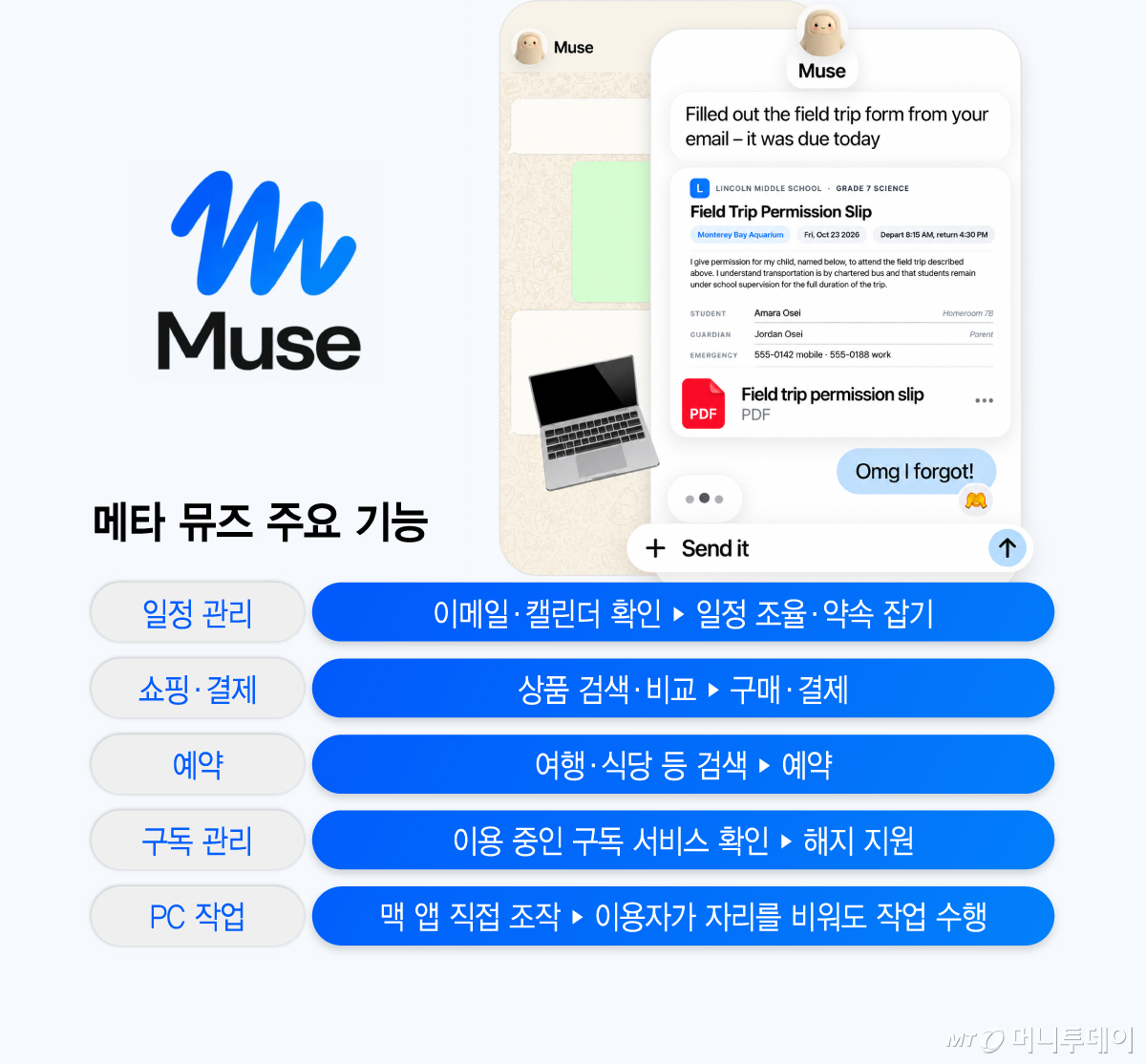
Meta's personal AI (artificial intelligence) agent "Muse" is causing a sensation by not only answering questions but directly handling users' tasks such as booking and purchasing. The three domestic consortia preparing for "AI for All," which are developing similar executable AI, now face the test of whether they can implement services that users will repeatedly seek beyond mere planning.
According to industry sources on the 28th, Muse immediately rose to No. 1 among all free apps in the U.S. Apple App Store after its launch and has been leading the charts daily. According to market research firm AppTopia, downloads over the first 12 days since launch reached 1.8 million for iOS in the U.S. and Canada, surpassing ChatGPT's mobile app (1.3 million) at the same point in time.
Muse connects with email and calendar to manage schedules, handles product searches from start to purchase, and even cancels subscribed services currently in use. Meta also unveiled features that allow direct manipulation of apps on Apple Mac computers and continue tasks left behind even when users step away. Although still available only in the U.S. and Canada, sign-up methods using VPNs (virtual private networks) and user reviews are being shared on domestic online communities and SNS (social networking services).
The capabilities demonstrated by Muse resemble the blueprint set forth by Korea's "AI for All." The three consortia led respectively by SK Telecom, KT, and Kakao are also preparing executable AI agents that handle applications, bookings, and payments. All three consortia have set goals of reaching 5 million monthly active users (MAU) within this year and over 10 million next year.
The focus on expanding the user base is also similar. While operating a paid subscription plan, Muse provides up to 100 million tokens for free weekly and grants an additional 1 billion tokens each to both parties when users invite friends. AI for All is also planning to offer full free access to secure users.
However, for executable AI to handle booking, purchasing, and payment on behalf of users, integration with external platforms is essential. While Walmart and e-commerce platform Shopify are integrating with Muse, Amazon has blocked access to its own site citing violations of terms of service. Analysis suggests that if AI handles everything from product search to purchase, it could impact not only existing customer touchpoints for platforms but also revenue models such as search advertising and product recommendations.
In Korea too, the ability of "AI for All" to implement these functions will depend on how many diverse external services can be connected. A key factor is the extent to which the agents and partnership ecosystems built separately by SK Telecom, KT, and Kakao will interconnect. If each ecosystem remains fragmented, the scope of tasks AI can perform on behalf of users may also be limited.
Lee Seong-yeop, a professor at Korea University's Technology Management Program, stated, "Executable AI must be far more convenient than allowing users to search and purchase directly, and it is crucial that they accurately understand user intent and execute with reliability." Regarding relationships with existing platforms, he added, "If viewed as potentially replacing their own markets, access may be blocked; however, if seen as a new distribution channel, negotiations for mutual benefit could be possible."

 in TECH
