

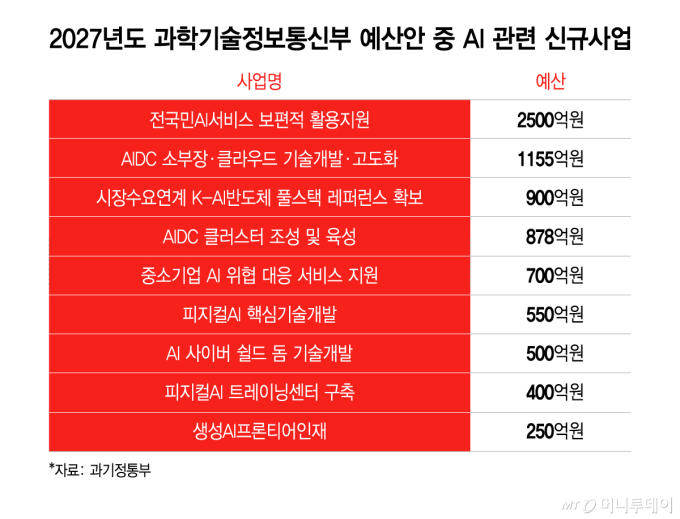
The National Assembly is beginning its review of the 2027 budget alongside the 2026 national audit. The government's 2027 budget, announced earlier this month, includes a "Republic of Korea AI Nation" transition project featuring an approximately 9.4 trillion won investment in artificial intelligence (AI) and related costs. Attention is focused on how these AI budgets will be handled during the deliberations, which will continue for over two months until early December. Here are the major AI projects where the ruling and opposition parties are expected to clash.
The government has newly allocated 250 billion won for the "Universal Support for National AI Service Utilization," commonly known as the "AI for All" project. Based on achievements in securing domestic AI models, this initiative aims to allow all citizens to use Korean AI services without limits and free of charge, envisioning an era where using AI becomes as common as learning language or arithmetic.
The Ministry of Science and ICT selected three consortia led by SK Telecom, KT, and Kakao through a public recruitment process this year. These groups will launch their respective "AI for All" apps, each highlighting unique features, before the end of this year. The 2027 budget is divided into 170 billion won for supporting service GPUs (graphics processing units), 30 billion won (10 billion won per consortium) for the consortia, and 50 billion won for developing specialized AI services.
A total of 5.5937 trillion won will be spent on developing and securing top-tier AI models. This includes the government's ongoing Independent AI Foundation Model (Dokpa-mo) project, which covers both model development and talent cultivation. Of this amount, the budget for strengthening the infrastructure for utilizing AI computing resources stands at 4.2752 trillion won, more than double the 2.1087 trillion won allocated this year. Most of these funds will be used to secure GPU servers.
The government plans to lease 140 racks of next-generation chips called "Vera Rubin" at 27.5 billion won per rack, totaling 3.85 trillion won, and has allocated 388.5 billion won for leasing GPUs, including 4,000 H100-class units and 4,000 B200-class units. Considering the rising prices of GPUs, nearly half of the Ministry of Science and ICT's AI transition budget is being directed toward GPU procurement. The ministry stated, "Depending on market conditions, the models secured may be replaced with higher-tier models offering equal or better performance, and we will flexibly respond to national-level advanced AI semiconductor demand involving industry, academia, and research."
800 billion won will be invested in supporting data for AI training. This is 26.7 times the 30 billion won allocated this year. The plan aims to provide high-quality training data so that domestic models can reach frontier levels within a short period. The secured data will be provided to companies participating in the Dokpa-mo project and those developing security-specialized AI. Investments in people, including 25 billion won for cultivating frontier talent in generative AI, are also included.
How much the AI gap with the United States and China can be narrowed depends on how this funding translates into specific models. The government is expected to change its review direction for the Dokpa-mo project, which is approaching its third review, and may announce the results as early as October.
Bae Gyeong-hoon, Deputy Prime Minister and Minister of Science and ICT, recently told Money Today, "It is important to create AI models that can be widely used by industries and developers." He added, "Beyond demonstrating certain levels of performance, we must ensure widespread adoption so that business models and an AI ecosystem can be built upon them."

 in TECH
