

[For more diverse corporate information on the startup featured in this article, please visit the Unicorn Factory big data platform 'Data Lab'.]
"Will an incident occur within five years in which a country physically damages or disables another nation's satellite during an inter-state dispute?"
In response to the moderator’s impromptu question, three out of four space security experts from South Korea, Canada, Australia, and Japan chose "O" (yes). The moderator remarked that it was a "far more pessimistic answer than expected."
A warning has emerged that inter-state competition occurring thousands of kilometers above the ground may now extend beyond terrestrial security to collisions in outer space. While "invisible attacks" that do not directly destroy satellites but instead disrupt GPS or paralyze functions through cyberattacks have already become a reality, experts diagnosed that competition in space is escalating faster than cooperation.
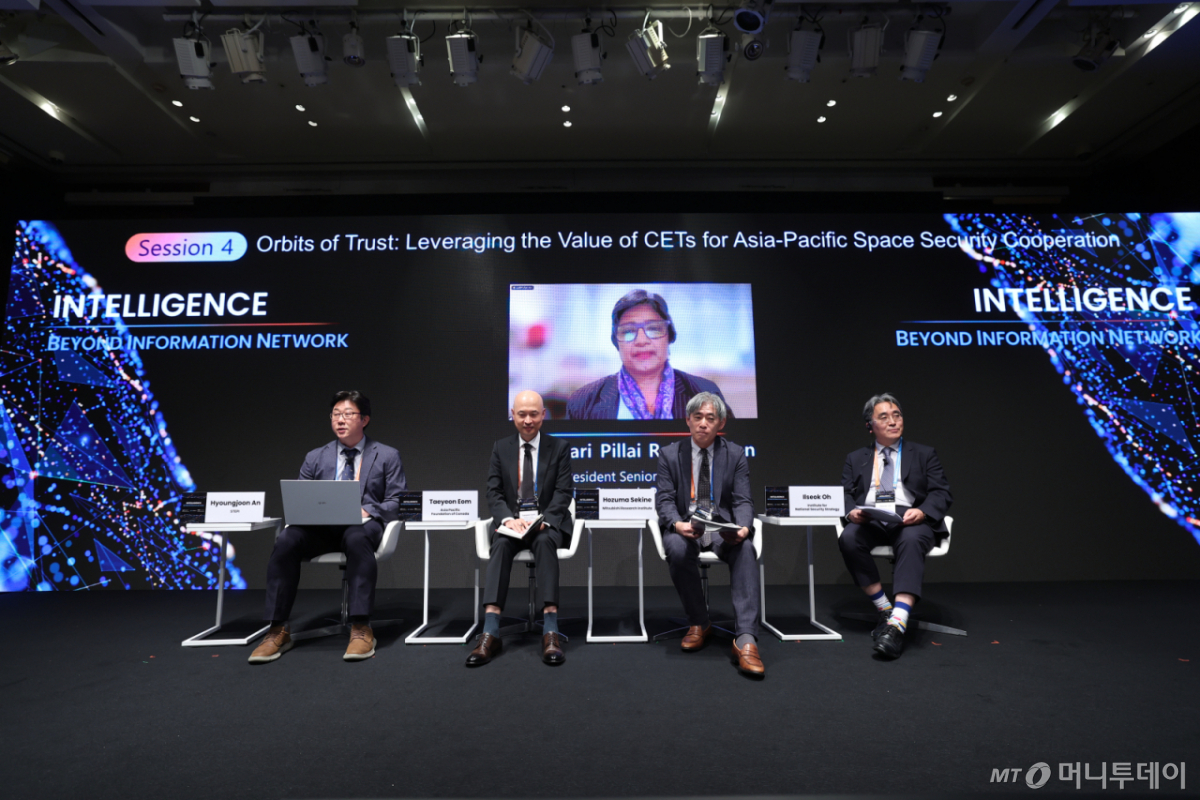
The Science and Technology Policy Institute (STEPI) held the "2026 STEPI Intelligence Dialogue" on the 30th at the Shilla Hotel Seoul’s guest hall, together with the Korean Academy of Science and Technology (KAST). The final session of the day focused on the theme "Orbit of Trust: Leveraging the Value of Core and Emerging Technologies (CETs) for Asia-Pacific Space Security Cooperation."
The discussion was moderated by Research Fellow An Hyeong-jun of STEPI, with panel participation from Researcher Um Tae-yeon of Canada’s Asia-Pacific Foundation (APFC), Dr. Rajeswari Pillay Rajagopalan of the Australian Strategic Policy Institute (ASPI), Dr. Sekine Hojima of Japan’s Mitsubishi Research Institute (MRI), and Director Oh Il-seok of the Institute for National Security Strategy (INSS).
Research Fellow An stated, "As the military importance of space grows rapidly, space security is no longer an agenda item exclusive to a few major powers, but has become a realistic challenge facing all nations." He added, "When people hear 'space security,' they often think of a space war, but it needs to be redefined as a concept encompassing GPS (satellite navigation system) jamming, cyberattacks, and orbital congestion."
Um Tae-yeon, a researcher at Canada’s APFC, explained that "Canada has relied significantly on the United States in national security fields, including space surveillance." She noted that experiencing trade disputes with the U.S. made it clear that this dependence could become a vulnerability for Canada.
Researcher Um explained, "In reality, while Canada participates in systems for conducting joint space surveillance with the U.S., there is a limitation where the Canadian military cannot sufficiently access related information."
Accordingly, Canada is shifting its policy toward strengthening its own national security capabilities. The goal is to activate the space industry and expand domestic space-related facilities, thereby building a foundation to monitor and respond to space situations independently, rather than relying solely on support from allies such as the U.S.
Dr. Rajagopalan of ASPI pointed out China’s rapid expansion of space capabilities. Citing analysis by the U.S. RAND Corporation, she stated, "Over the past eight years, China’s ISR (Intelligence, Surveillance, and Reconnaissance) satellites have increased sixfold, and commercial satellites have increased 17-fold." She diagnosed that this signifies enhanced long-range precision strike capabilities and a deteriorating security landscape in the Asia-Pacific region.
She also pointed out the dual-use issue of on-orbit service technologies such as satellite refueling and repair. Useful technologies for extending satellite lifespans can be converted into weapons depending on intent.
Dr. Rajagopalan stated, "If one country claims legitimacy to build anti-space attack capabilities, other countries will follow suit, ultimately worsening overall space security." She added, "No agreement has been reached among major powers over the past decade, resulting in a lack of effective global governance mechanisms."
She continued, "If the speed of escalating competition in outer space is not matched by the speed of cooperation, rising tensions could eventually lead to physical collisions." She emphasized that now is the time for Asia-Pacific nations to urgently build a robust framework for sharing information and trust.
Dr. Sekine of MRI cited "the definition of security" as Japan’s most significant change. She explained that while space was previously discussed as a separate domain, it is now viewed as part of social infrastructure.
She stated, "When I started my career 30 years ago, it took 10 years to develop and launch a single satellite, but now thousands of satellites are in operation." She added, "It is not an issue that can be simply divided into civilian versus military."
She continued, "The important point is not how to protect the satellite itself, but maintaining service continuity whether in peacetime or wartime." She emphasized the need for backup options against attacks or technical failures, i.e., a "Plan B," and social resilience.
She also noted the role of private companies. Dr. Sekine predicted, "In the future, physical AI will be utilized in satellite operations and lunar orbit services, moving beyond detection to action." She added, "Not only AI, but also quantum technology and fusion will become key technologies." She further stated, "Japan’s situation is very similar to South Korea’s," proposing the need for Japan-South Korea technological cooperation.
Director Oh Il-seok of INSS stated that space security should be viewed through four pillars: △continuous maintenance of space services and functions, △protection of space assets, △securing competitiveness in the space industry ecosystem, and △ensuring equitable access to space systems.
He identified "information sharing" as a necessary task alongside launch vehicle and satellite development. Director Oh stated, "Under the National Intelligence Service’s N2SF (National Network Security Framework), information is classified as confidential, sensitive, or public. However, those with classification authority hesitate to make judgments, leaving much of the data needed for the space industry tied up in confidentiality." He added, "Information levels that can be shared with the private sector need to be further subdivided."
He also called for institutional improvements. Director Oh proposed introducing liability exemption provisions to reduce civil and criminal liability for developers and institutional investors in the event of R&D failure; a structure where budgets are paid in stages so that multi-year satellite procurement projects can avoid delay penalties or contract termination even if they fail at the final stage; and mechanisms where researcher-centered panels mediate issues of damages and criminal liability.
[MoneyToday startup media platform 'Unicorn Factory']

 in TECH
