

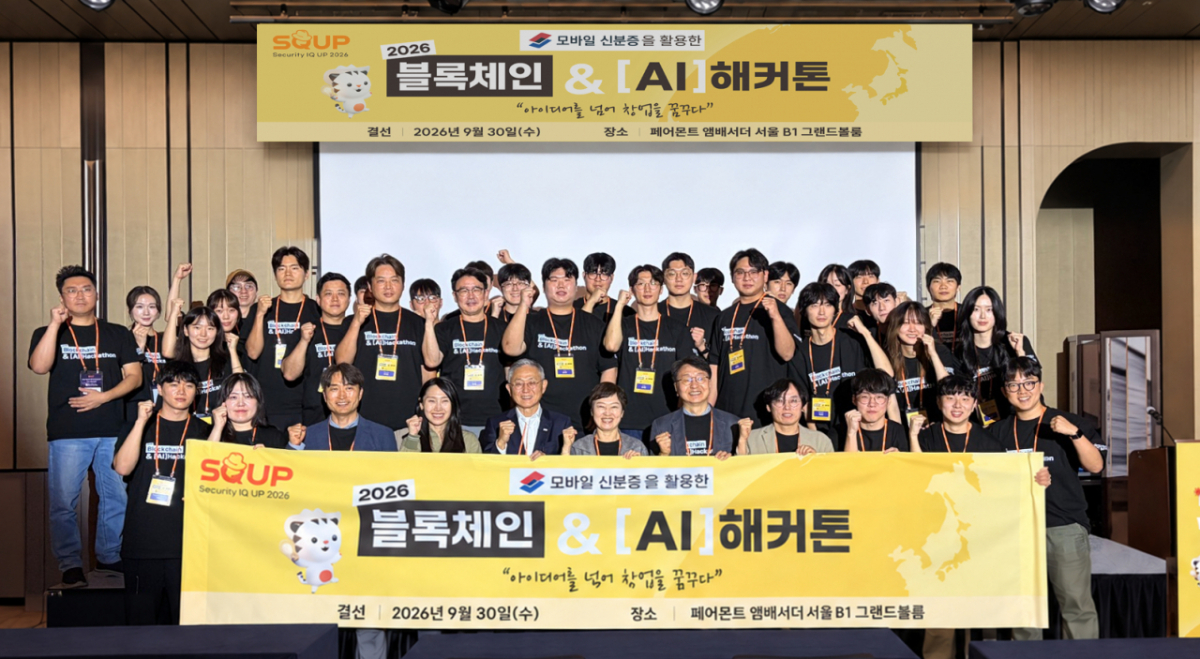
AI security and authentication platform company RaonSecure announced the successful completion of its "2026 Blockchain & AI Hackathon."
RaonSecure stated on the 2nd that the 2026 Blockchain & AI Hackathon, co-hosted with the Global Digital Innovation Network (GDIN), organized by the Korea Digital Certification Association, and sponsored by the Ministry of the Interior and Safety, has concluded.
Now in its second year, this hackathon was designed to discover creative and practical service ideas that combine AI and Web3 technologies based on mobile identification documents. It also aims to promote the expansion of the domestic digital identity ecosystem and related industries. The finals were held at the Yeouido Fairmont Hotel on the 30th of last month.
A total of 318 teams participated in this year's competition, an increase of approximately 51% compared to the 211th teams last year. With a competition ratio of roughly 32 to 1 for the 10th finalist slots, the final 10 teams were selected through document review and face-to-face evaluation to advance to the finals stage.
The finalist teams presented services that integrate AI and Web3 technologies based on national mobile identification documents, such as mobile resident registration cards and mobile driver's licenses. Ideas proposed included a real-name authentication model market, an automatic discount service for Universal Basic Income (UBI) insurance premiums, on-chain wallets, medical information transmission, video authenticity verification, welfare application delegation for the elderly, tokenized securities, AI digital tourism wallets, independent signatures for persons with disabilities, and AI-generated content history management, spanning the finance, healthcare, welfare, tourism, and content sectors.
The participating teams demonstrated the potential for mobile identification documents to expand beyond simple identity verification into a digital trust infrastructure in daily life that safely verifies individual identities, qualifications, and authorities while connecting various digital services.
The "Pascal" team won the grand prize. The Pascal team presented a structure that uses mobile identification documents to verify the authority and consent/delegation of individuals, guardians, and social welfare workers, and records the entire welfare service process on the blockchain.
In particular, the team received high praise for enabling the elderly to use services via phone calls alone, while allowing guardians and welfare institutional investors to manage progress through a dashboard. The Pascal team was awarded the Minister's Prize from the Ministry of the Interior and Safety and a prize money of 15 million won.
Choi U (수상) was awarded to the "B301" team. The B301 team received the Korea Jo Pye-gong-sa (President) Prize and 6 million won in prize money for their project, "farmFi: An STO Platform Verified by Mobile ID and Executed via Smart Contracts."
The "Mobiscore," "Blockchehwa," and "Daily Moment" teams were selected as winners of the excellence award. They each received the President's Prize from the Korea Institute of Defense Intelligence Command, the President's Prize from the Information and Communications Industries Promotion Agency, and the President's Prize from the Korea Internet & Security Agency, along with 3 million won in prize money.
RaonSecure plans to conduct separate reviews for winning teams in collaboration with Axis Investment and UK venture capital firm Simsan Ventures, providing startup support opportunities of up to 1 billion won. GDIN will also support subsequent commercialization efforts for the winning teams, including global expansion, overseas investment attraction, and management consulting.
RaonSecure explained that through this hackathon, it confirmed the potential for mobile identification documents to expand beyond identity verification in the public and financial sectors into a trust foundation for areas closely related to citizens' daily lives, such as healthcare, welfare, content, tourism, and digital assets.
The company also noted that as AI-based services rapidly spread, the importance of digital identity technology for safely verifying users' identities, qualifications, and authorities, and validating delegation relationships, is expected to grow.
Lee Soon-hyung, CEO of RaonSecure, said, "This year saw participation from 318 teams, more than 50% higher than last year, confirming high interest in new services that combine mobile identification documents with AI and blockchain technology." He added, "RaonSecure will continue to expand the Web3 ecosystem and drive technological innovation so that mobile ID and DID technologies can be utilized as a trust foundation for various industries and services."
Yum Heung-yeol, Chairman of the Korea Digital Certification Association, stated, "This year's hackathon was an occasion that demonstrated how mobile identification documents can expand beyond identity verification in citizens' daily lives to become a trust foundation for various digital services." He added, "We will continue to work on creating an ecosystem where innovative ideas integrating AI, blockchain, and digital identity technology can be translated into actual services and industries."
Kim Jong-gap, CEO of GDIN, who is Shim Sa-wi (Director), said, "This year's finalist teams showed a high level of completion by applying AI and blockchain technologies based on mobile identification documents to solving real-world social problems." He added, "From improving accessibility to welfare services to ensuring the reliability of financial transactions, we confirmed the potential for these technologies to lead to actual services and commercialization, given their practicality and scalability across various fields."
RaonSecure is promoting the expansion of the digital identity ecosystem through its Web3-based digital ID platform, "OmniOne Digital ID," and its open-source-based "Open DID." The company is also broadening the application areas of digital identity technology to cover identity, authority, delegation, and verification, which are required in the AI era.

 in TECH
