

DeepNoid received recognition for its technological capabilities at a world-renowned medical imaging AI academic conference.
On the 2nd, DeepNoid announced that it presented a paper on an AI model for white matter lesion segmentation and ranked in the top tier across multiple categories in the official challenges of the International Conference on Medical Image Computing and Computer-Assisted Intervention (MICCAI) 2026.
MICCAI is an international academic conference representing the fields of medical image analysis and computer-assisted intervention. This year’s event was held in Strasbourg, France, from September 27 to October 1.
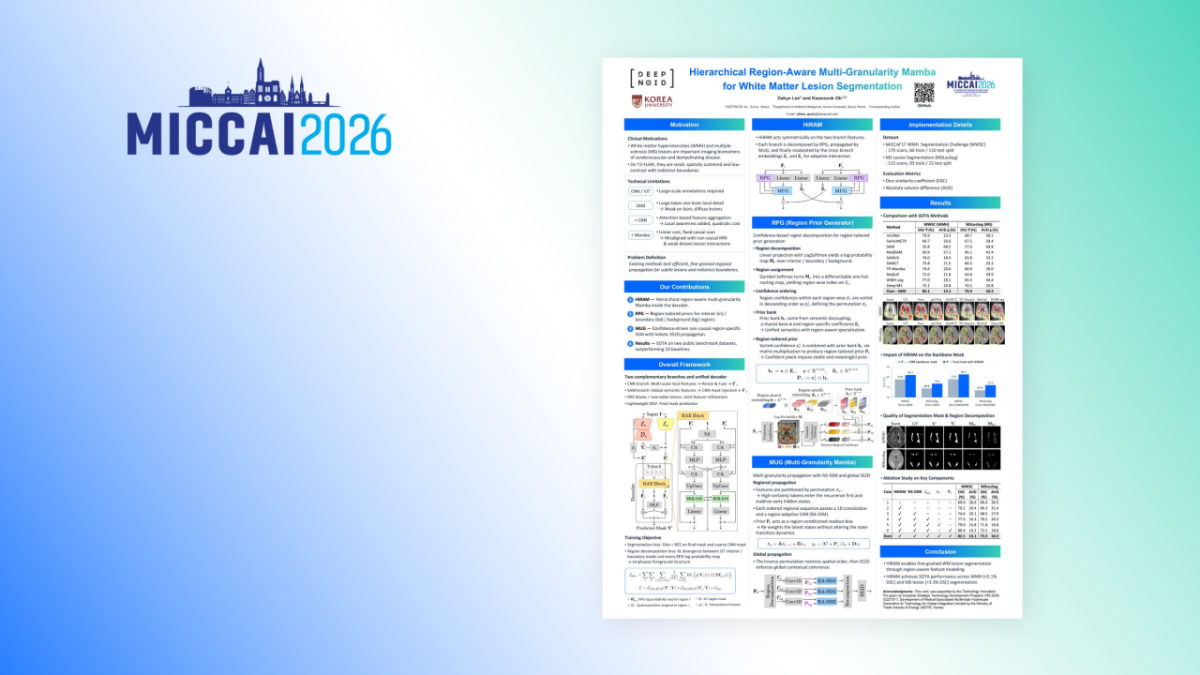
At this conference, DeepNoid proposed 'HiRAM,' an AI model that precisely segments white matter lesions. HiRAM stands for 'Hierarchical Region-Aware Multi-Granularity Mamba.'
White matter hyperintensity lesions and multiple sclerosis lesions observed in T2-FLAIR, a brain MRI imaging technique, are key imaging indicators used for diagnosing and evaluating the progression of cerebrovascular diseases and demyelinating diseases. However, because these lesions are small, scattered across multiple locations, and have indistinct boundaries, it is difficult to accurately distinguish them using AI.
HiRAM is based on the 'Mamba' architecture, which processes image information over wide areas with low computational load. Its key feature is dividing lesions into three regions—internal, boundary, and background—to enable learning tailored to the characteristics of each region.
Performance validation using two public datasets showed that HiRAM outperformed all 10 existing AI models. The Dice coefficient, which indicates segmentation accuracy, was 5.1 percentage points higher for white matter hyperintensity lesions and 3.3 percentage points higher for multiple sclerosis lesions compared to the previous best-performing model.
The company also achieved results in official challenges. MICCAI official challenges are international competitions where research teams from around the world compete on medical imaging AI performance using the same data and evaluation criteria.
DeepNoid secured second place overall in the brain metastasis category of 'BraTS 2026,' a representative challenge in the field of brain tumor segmentation. This task involves segmenting metastatic lesions into detailed regions from brain MRI images. DeepNoid also delivered an oral presentation at the conference venue.
In addition, in the 3D medical imaging vision-language AI challenge 'VLM3D,' the company recorded first place in brain MRI abnormality classification, second place in chest CT abnormality classification, and fourth place in chest CT report generation.
In the chest X-ray tuberculosis AI challenge 'TREAT-MMTB,' DeepNoid secured second place in tuberculosis diagnosis and third place in tuberculosis cavity lesion detection and segmentation. It also ranked fifth in the reading-finding-based 3D CT lesion segmentation challenge 'ReXGroundingCT.'
DeepNoid explained that these results were achieved with support from the Ministry of Trade, Industry and Energy’s project on 'Global-Linked Multimodal Medical-Specific Ultra-Large Generative AI Technology Development.'
Choi Woo-sik, CEO of DeepNoid, stated, "At this MICCAI, our technological capabilities in lesion detection and segmentation, multi-disease classification, and report generation—ranging from chest X-rays to chest CTs and brain MRIs—were comprehensively validated on the international stage." He added, "Achieving balanced results across multiple modalities rather than being limited to specific imaging aligns with DeepNoid’s vision of becoming an agent AI-based medical service company that supports the entire reading workflow."

 in TECH
