

The equity-linked securities (ELS) market, which had contracted following the Hong Kong Hang Seng Index (HSI) crisis, is reviving on the back of rising stock markets, while the risk profile of the products is also changing. Although index-linked products remain at the core of the market, ELSs based on individual stocks such as Samsung Electronics, SK Hynix, and Tesla are growing rapidly, increasing the impact that specific companies' stock price fluctuations have on redemption and losses. Experts point out that investors should carefully examine each product's underlying assets and loss conditions rather than focusing solely on recent high returns and early redemption rates.
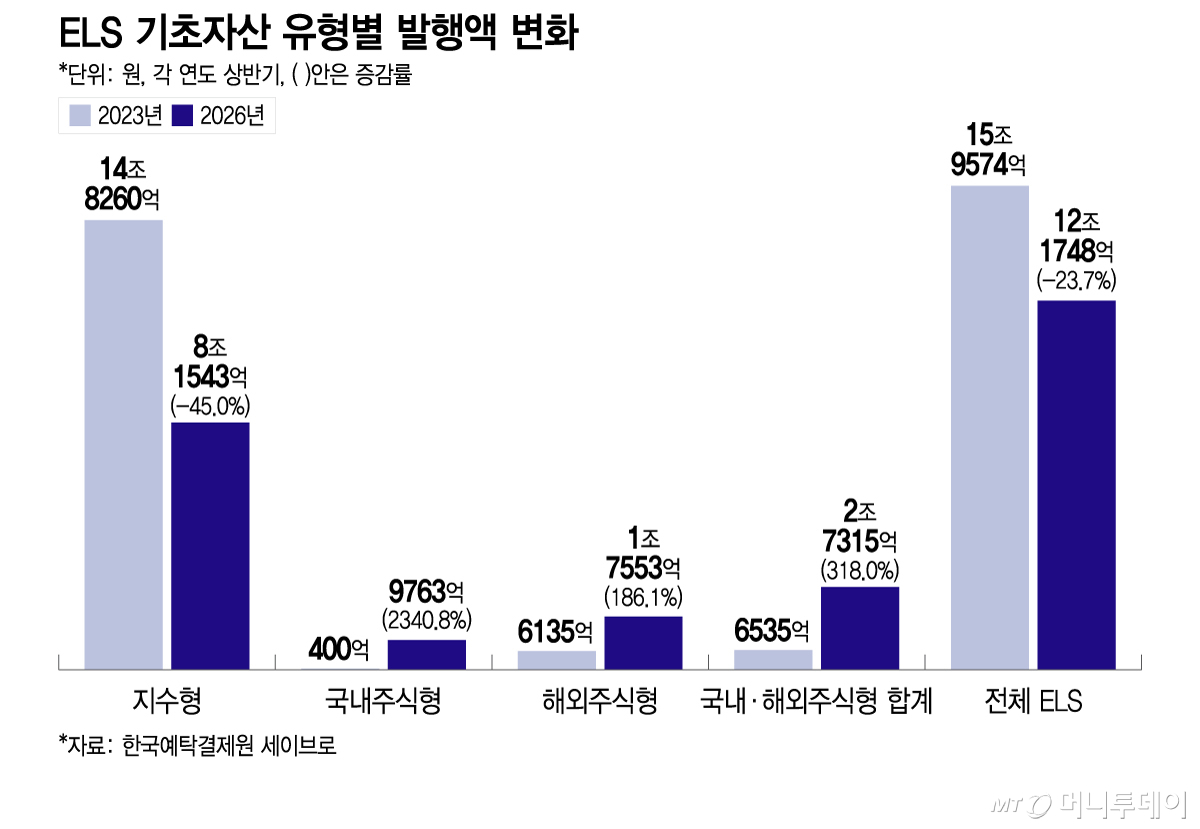
According to the Financial Supervisory Service (FSS) on the 2nd, ELS issuance in the first half of this year reached 1.21 trillion won, a 19.8% increase from the same period last year. The market, which had shrunk after large-scale losses materialized in Hong Kong HSI-linked ELSs in the first half of 2024, is showing signs of recovery alongside rising domestic and global stock markets. Data from the Korea Securities Depository (KSD) also showed that ELS issuance, excluding principal-guaranteed equity-linked derivative bonds (ELBs), increased by 54.1% from 790.29 billion won in the first half of 2024 to 1.21748 trillion won in the first half of this year.
Notably, the growth in products based on individual stocks was striking. According to the FSS, stock-linked ELS issuance in the first half of this year reached 3 trillion won, doubling from 1.5 trillion won in the same period last year. ELSs including Samsung Electronics as an underlying asset had the highest issuance at 1.3 trillion won, followed by Tesla at 1.2 trillion won, SK Hynix at 1.1 trillion won, and Palantir at 900 billion won. Since a single ELS can use multiple stocks as underlying assets, issuance figures by stock may include overlaps.
The changes are even more pronounced when compared to the period before large-scale losses in the Hong Kong HSI materialized. A comparison of ELSs excluding ELBs on the same basis via the KSD's Securities Information Portal (SEIBro) showed that domestic and overseas equity-linked issuance increased 4.2-fold from 653.5 billion won in the first half of 2023 to 273.15 billion won in the first half of this year.
In contrast, index-linked ELS issuance over the same period decreased by 45.0% from 148.26 trillion won to 81.543 trillion won. Total ELS issuance also fell by 23.7% from 159.574 trillion won to 121.748 trillion won. Even as the overall market size has shrunk compared to three years ago, individual stock-linked ELSs have actually increased significantly.
However, it is difficult to say that the center of gravity in the ELS market has shifted from indices to individual stocks. In the first half of this year, index-linked issuance was 81.543 trillion won, roughly three times the 273.15 billion won for domestic and overseas equity-linked products. While the market structure remains centered on index-linked products, the growing presence of individual stock-linked products is a recent change in the ELS market.
Changes in underlying assets also alter the nature of risks that investors must examine. Stock indices are composed of multiple stocks, which disperses the impact of individual companies' stock price movements, whereas individual stocks are directly affected by a company's performance, industry environment, and sudden negative news. This is why, as stock-linked ELSs increase, investors must consider not only the overall direction of the market but also the possibility of sharp declines in specific companies' stock prices.
In particular, many ELSs that bundle multiple underlying assets are structured so that the performance of the weakest underlying asset determines early redemption or maturity gains and losses. Even if the overall stock market rises, if a specific stock included among the underlying assets falls significantly, early redemption may be delayed or the likelihood of loss may increase.
Recent market conditions have been favorable for ELS investors. Of the 1.18 trillion won in ELSs redeemed in the first half of this year, 1.15 trillion won was redeemed early, accounting for 97.5%. The annualized investment return rate for ELSs redeemed early or at maturity also rose to 7.8%, up 0.5 percentage points from 7.3% in the same period last year. It is interpreted that rising domestic and global stock markets increased early redemptions, which in turn contributed to the recovery of demand for ELS investments.
This does not mean that the risk of principal loss inherent in ELSs has decreased. The basic product structure remains unchanged: if the price of the underlying asset falls outside the conditions set for each product, a loss of principal may occur. The FSS emphasized that derivative-linked securities are products where losses can extend to the full amount of the principal depending on declines in underlying assets, and therefore investors must accurately understand the product structure before investing.
Among the 1.43 trillion won in derivative-linked securities issuance in the first half of this year, combining ELSs and other derivative-linked securities (DLSs), knock-in type products—where a knock-in event occurs if the underlying asset price falls below a certain level—accounted for 760 billion won, or 53.1%. However, 98.7% of these knock-in type products were low-knock-in products with the knock-in threshold set at 50% or less of the initial reference price. This figure includes both ELSs and DLSs.
An investment expert emphasized, "Rather than looking only at recent high returns and early redemption rates, it is necessary to check what underlying assets are included and to what level those assets must fall for early redemption to be delayed or for a loss of principal to occur."

 in STOCK
