

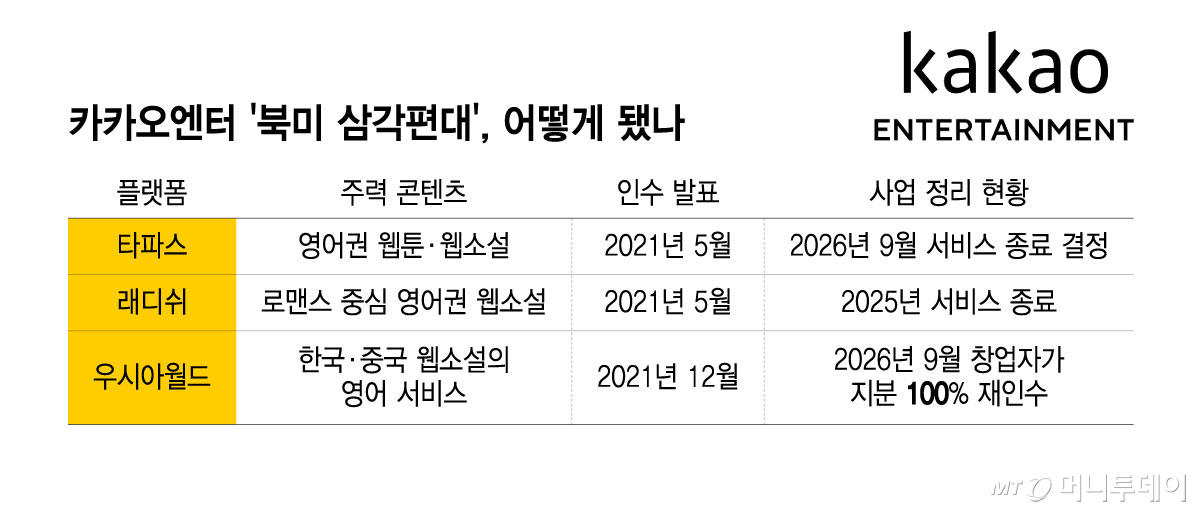
Kakao Entertainment has resold Ucea World, an English-language web novel platform, to its founder. Following the decision to shut down Radish and Tapas, the sale of Ucea World effectively dismantles the “triad” strategy aimed at capturing the North American market, roughly five years after its formation. Internal dissatisfaction is also reportedly mounting over subsequent personnel changes involving executives who were involved in the investments at the time, coinciding with the business wind-down.
According to IT industry sources on the 30th, Ucea World founder Jingping Lai recently reacquired Ucea World from Tapas Entertainment. Lai has returned as the owner and operator holding a 100% stake. The sale price was not disclosed. Ucea World will continue operations under the founder’s leadership without terminating its service.
In December 2021, Kakao Entertainment acquired a 100% stake in Ucea World for approximately 45 billion won through its subsidiary Radish. Ucea World is a service that provides fantasy and martial arts web novels from South Korea, China, and other regions in English. Kakao Entertainment had intended to use the platform, which distributes Asian content to English-speaking readers, as a hub for expanding into the North American market.
The company also anticipated synergies with Tapas, a webtoon platform it had previously acquired, and Radish, which specializes in romance and other female-oriented web novels. The plan was to integrate South Korean intellectual property (IP) and business models such as “wait-and-read-free” into platforms serving different reader demographics. Kakao Entertainment introduced the three companies as its “North American Story IP Triad” and set a goal of tripling global transaction volume within three years.
However, the businesses were wound down sequentially. Last year, Kakao Entertainment announced it would terminate Radish to focus its resources on Tapas. Subsequently, Tapas also entered termination procedures, and with the sale of Ucea World, the strategy of directly operating the three platforms to grow the North American business has effectively been abandoned.
According to the founder’s side, Ucea World also faced the possibility of closure. The founder stated that the termination of Tapas was the direct trigger for the reacquisition, and that without the reacquisition, Ucea World would have soon shut down as well. It took less than a month from negotiations to deal completion, and Kakao is reported to have actively cooperated in the transaction.
When Lai transferred the company to Tapas, monthly gross profit exceeded $300,000, but in July of this year, it recorded a gross loss of approximately $30,000. The price of this recent resale has also not been disclosed, so Kakao’s overall investment profit and loss and recovery amount remain unconfirmed.
Personnel changes following the business wind-down have also become an internal point of interest. Executives involved in what is effectively a failed North American investment are being mentioned for key positions in the new organization after Kakao’s human resources spin-off. There is dissatisfaction that proper evaluation has not been conducted regarding the North American business, which was wound down despite investments exceeding 1 trillion won and only growing losses. However, it has not been confirmed whether specific individuals have been nominated for positions.
In response to related inquiries, Kakao stated, “Currently, there are no decisions beyond the nominee for In Seon-eun (CEO) after the spin-off,” adding, “The priority is for the spin-off to proceed at the shareholders’ meeting, so the information we can provide at this time is limited.”

 in TECH
