

Not only global big tech companies, but also domestic system integrators (SI) have entered a new phase in the race to secure AI talent. The competition is intensifying over "on-site AI engineers" who not only develop models but also enter client sites to analyze business operations and implement AI into actual systems.
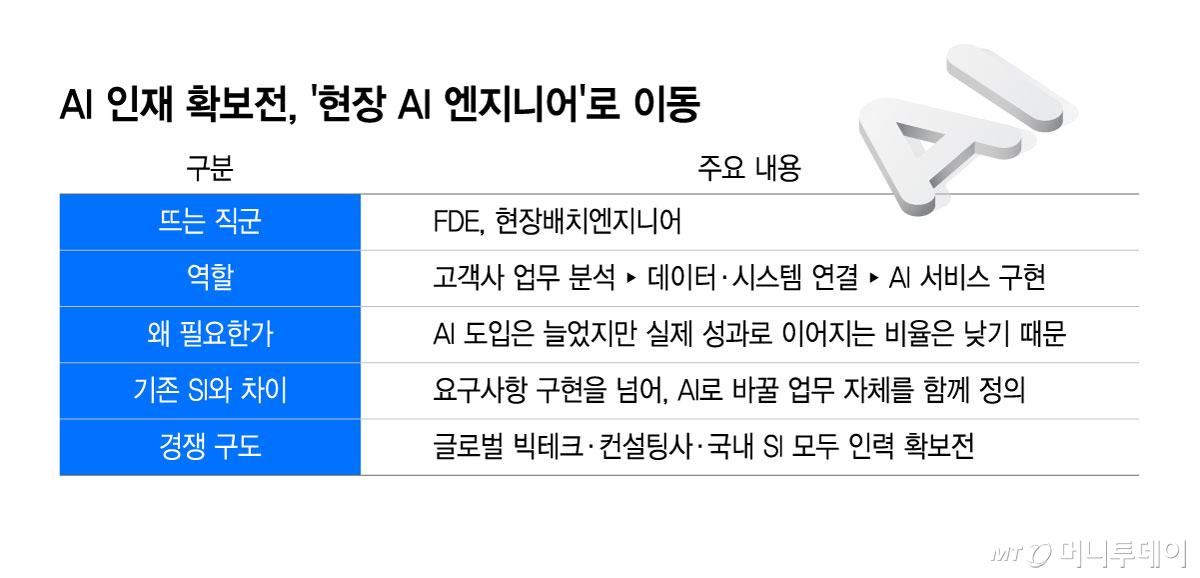
According to IT industry sources on the 6th, the job category whose compensation has risen most rapidly in the AI sector recently is the Forward Deployed Engineer (FDE). This role involves identifying problems that can be solved with AI at client sites and connecting client data and existing systems to complete actual services. It does not end with simply handing over a model; FDEs are responsible for understanding the client's data structure and business processes until the AI delivers results.
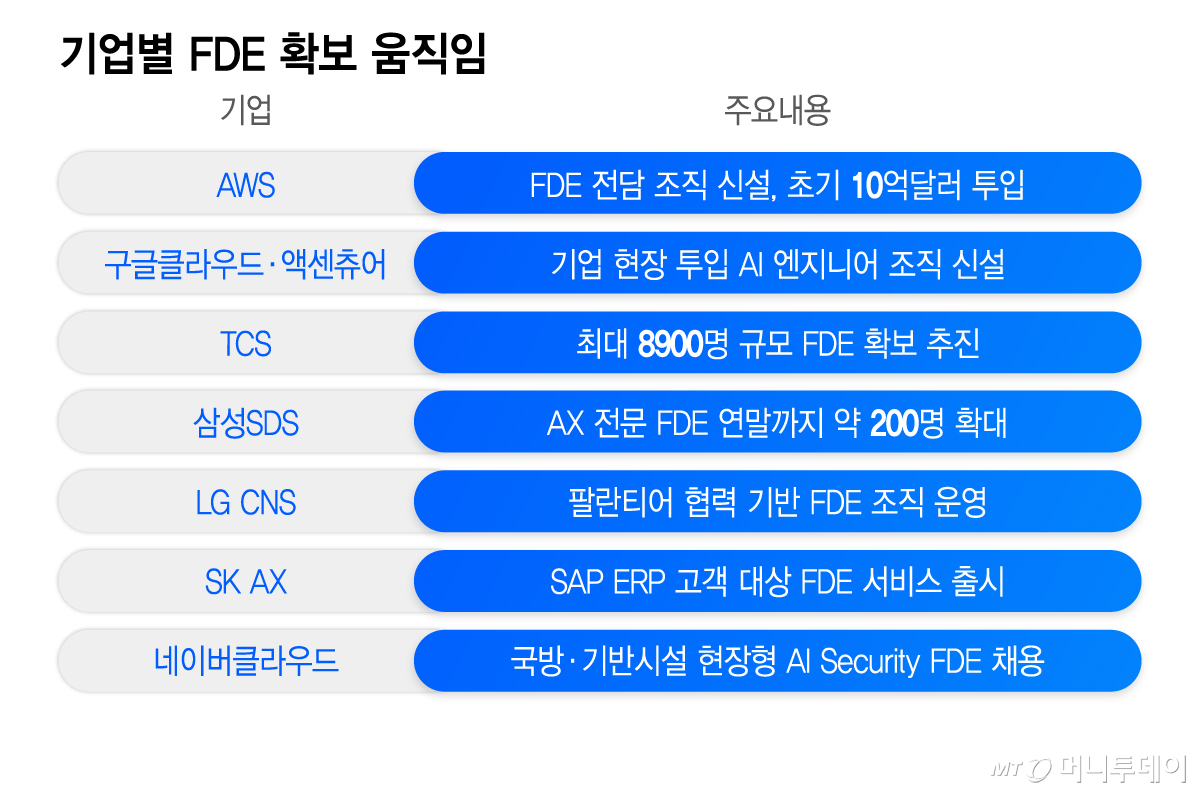
Big tech companies have taken the lead in investment. Amazon Web Services (AWS) announced at the end of June that it would establish a dedicated FDE organization and invest an initial $1 billion. The company plans to deploy teams of five to six engineers to each client for approximately 45 days, with plans to expand the organization to several thousand personnel.
According to LinkedIn recruitment data, demand for hiring in job categories similar to FDEs increased 42-fold last year compared to two years prior, in 2023. Google Cloud and Accenture have established dedicated groups to deploy AI engineers to corporate sites, while India's TCS is pushing to secure up to 8,900 FDEs.
OpenAI and Anthropic have also acquired service companies that support enterprise AI adoption. This follows their assessment that model performance alone makes it difficult for corporate clients to achieve results.
The situation is the same in the domestic IT services industry. Samsung SDS announced that it will increase its number of AX-specialized FDEs to approximately 200 by the end of this year. The strategy involves combining industry-specific experience in manufacturing, finance, and logistics to redesign client business operations themselves. According to a survey cited by Samsung SDS, while 88% of companies have adopted AI for at least one business function, only 6% responded that AI has made a significant contribution to profits. The company aims to bridge the gap between adoption and performance with on-site personnel.
LG CNS established a separate FDE organization in March through cooperation with Palantir, while SK AX partnered with SAP to launch the "SK AX FDE" service, which provides close support at ERP client sites. Naver Cloud proposed a method of directly deploying FDEs into defense closed networks where external data access is restricted, and began recruiting for "AI Security FDEs" to handle infrastructure sites in power, telecommunications, and finance on the 30th of last month.
Opinions in the industry are divided on whether FDEs constitute a profession distinct from traditional SI engineers. Both involve residing at client sites to build systems. The difference lies in the starting point. SI involves implementing requirements defined by the client, whereas FDEs work with clients to define the problem itself—what to change using AI—and then take on the role of iteratively refining models, data, and business processes.
An industry official said, "The stage where companies cannot execute AX because they cannot obtain AI models is passing." They added, "Going forward, people who can understand a company's operations and data while implementing AI into actual services will be in the greatest demand."

 in TECH

