

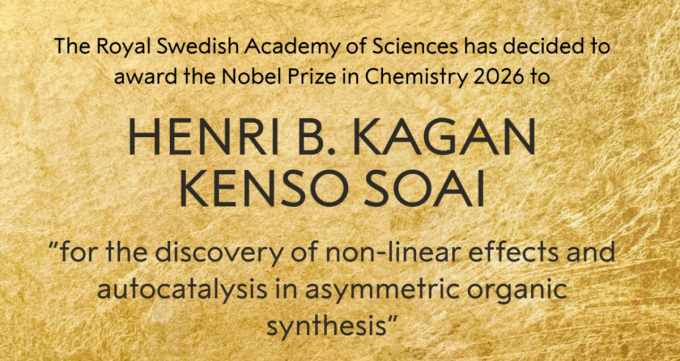
The 2026 Nobel Prize in Chemistry was awarded to Henri Kagan, an emeritus professor at the University of Paris-Sud in France, and Kenso Soai, an emeritus professor at Tokyo University of Science, for elucidating the phenomenon of 'mirror-image isomers' (chirality).
Mirror-image isomers refer to pairs of molecules that face each other like reflections in a mirror but do not overlap. In living organisms on Earth, even if these two variants have identical chemical structures, they bind differently to enzymes and receptors. It is reported that while one variant may be effective as a drug, the other may have no effect or cause side effects. Professor Kagan and So A-i (Prof.) were recognized for their contribution in elucidating the reason behind this.
On the 7th (local time), the Nobel Committee of the Royal Swedish Academy of Sciences selected Professor Kagan and So A-i (Prof.) as this year's Nobel Prize in Chemistry laureates. The Nobel Committee stated that they were selected "for their discovery of nonlinear effects and autocatalysis in asymmetric organic synthesis."
Professor Kagan is recognized for proposing the concept of the nonlinear effect in such catalytic reactions, establishing a theoretical framework explaining "under what conditions a small left-right imbalance can be amplified."
So A-i (Prof.) was the first to prove the 'Soai reaction,' in which adding a trace amount of an asymmetric substance exponentially amplifies only one of the mirror-image isomers. This research provided clues for elucidating the characteristics of biomolecules, such as amino acids found in early life on Earth and in the universe.
Research on 'mirror-image isomers' was decisively prompted by the 'thalidomide' incident, where the drug was sold as a treatment for morning sickness in pregnant women in the 1950s and 1960s. The right-handed molecule had an effect in alleviating morning sickness, but when taken by individuals with the left-handed molecule, it caused birth defects. Subsequently, regulatory authorities such as the FDA established criteria requiring that drugs be approved only if a single mirror-image isomer (homochiral) is separated and synthesized with high purity, rather than as a 50-50 mixture.
Methods for generating high-purity mirror-image isomers have long attracted attention in the chemical community. William Knowles, a former researcher at Monsanto Company in St. Louis, USA; Ryoji Noyori, a special professor at Nagoya University in Japan; and Barry Sharpless, a chair professor at The Scripps Research Institute in the USA, received the 2001 Nobel Prize in Chemistry for their discovery of chiral transition metal catalysts. Benjamin List, director of the Max Planck Institute for Coal Research in Germany, and David MacMillan, a chair professor at Princeton University in the USA, went further to receive the 2021 Nobel Prize in Chemistry for discovering the principle of synthesizing asymmetric organic catalysts using only small, environmentally safer organic molecules.
Professor Kagan and Professor Soai, who were awarded this year's Nobel Prize in Chemistry, did not stop at separation and synthesis techniques. They succeeded in explaining how very subtle differences between mirror-image isomers spontaneously amplify to evolve into perfect 'asymmetry.'
Ryu Do-hyeon, a professor in the Department of Chemistry at Sungkyunkwan University, said, "Given that there have been several Cha Rye (수상) in this field previously, I thought it would be difficult for the Nobel Prize in Chemistry to be awarded for some time." He added, "I believe great significance was placed on the fact that they achieved experimental proof providing answers to the origin of life, rather than the phenomenon itself being directly utilized in human daily life or contributing to industrialization."

 in TECH
