

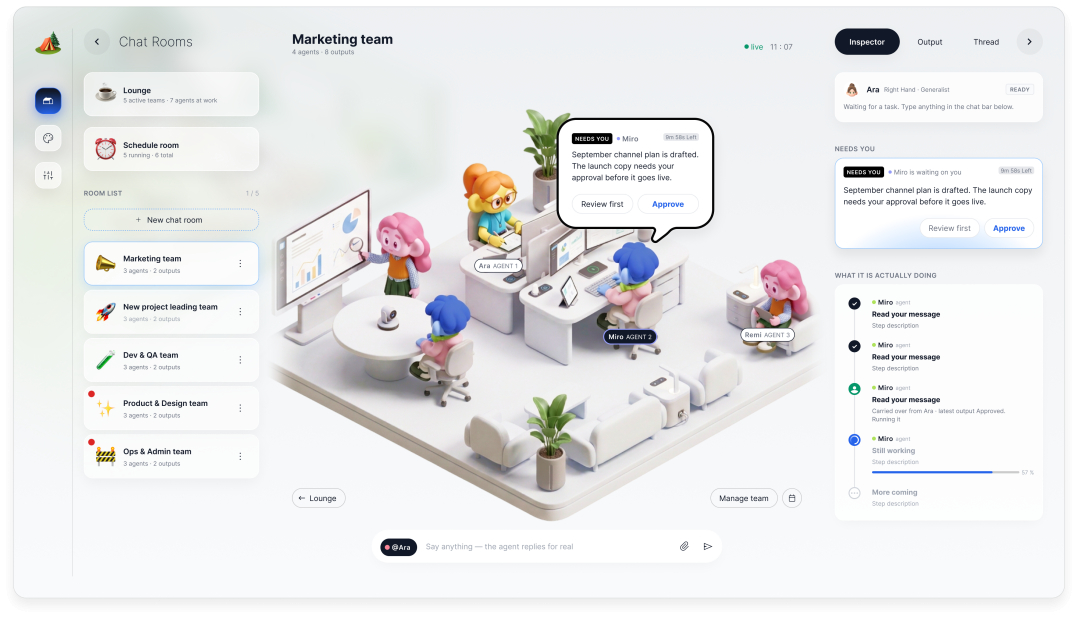
Hancom is teaming up with Amazon Web Services (AWS) to target the U.S. market with its AI workforce platform, ‘Nomadian.’ The two companies will jointly design everything from product enhancement to pricing policies, launch strategies, and marketing, while also pursuing sales channels through the AWS Marketplace.
On the 8th, Hancom announced that it is conducting a 10-week joint development program with AWS called “Hancom × AWS CoLab” and will release Nomadian in the U.S. market.
The collaboration between the two companies will proceed along two tracks: product and market. In the product sector, supported by AWS technical teams, Hancom will enhance Nomadian and complete an initial product that functions within the AWS environment. In the market sector, they will jointly validate factors such as market size, customer willingness to pay, pricing policies, and revenue structures. Hancom will be responsible for the product vision and key decision-making.
CoLab is a program in which AWS supports customers in developing new products and business models. Based on Amazon’s “working backward” approach, it designs initial customer segments, market entry strategies, and launch roadmaps by working backward from the moment customers use the product.
Hancom and AWS held a CoLab kickoff meeting on the 21st of last month. Kim Yeon-su (CEO), Chief Technology Officer Jung Ji-hwan, and other Hancom executives attended, along with representatives from AWS’s technology, business development, and sales organizations.
Nomadian is an AI workforce platform that allows users to hire AI agents as if they were employees to form teams. Its primary target is solo entrepreneurs. Users can select AI agents for required roles, such as data analysts or content marketers, and place them in a 3D workspace.
When users issue work instructions in natural language, Nomadian divides the tasks and assigns them to individual AI employees. These AI employees utilize Hancom’s document technology to create reports, proposals, presentation materials, and more. Nomadian is scheduled to unveil its beta service in the U.S. at the end of December this year and commercialize it as a subscription-based service in 2027.
Hancom is also moving to secure sales channels in the U.S. market. The company plans to register Nomadian on the AWS Marketplace. Its strategy is to establish initial customer touchpoints through a digital catalog where AWS customers can search for, purchase, and deploy software.
It is also pursuing participation in the “AWS ISV Accelerate Program,” a joint sales program for AWS partners. The company plans to use this to review regulatory and governance requirements for its product within the AWS environment, as well as to conduct security and stability verification for enterprise customers.
The customer segment Hancom is focusing on in the U.S. market consists of solo business owners and small enterprises. According to 2024 nonemployer business statistics from the U.S. Census Bureau, there are 31.99 million businesses in the U.S. operated without employees. This represents an increase of more than 1.5 million compared to the previous year.
AI adoption among small enterprises is also growing rapidly. A survey conducted by Goldman Sachs this January and February of 1,256 small enterprises found that while 76% responded that they use AI, only 14% said it was fully integrated into their core operations. Lack of technical expertise and difficulty in selecting appropriate tools were cited as obstacles.
Hancom aims to connect its growing domestic AI revenue with the U.S. subscription market. In the first half of this year, on a standalone basis, revenue was 98.6 billion won, and operating profit was 31 billion won, recording an operating profit margin of 31.5%. During the same period, AI revenue reached 13.47 billion won, already surpassing last year’s annual AI revenue of 8.91 billion won.
Kim Yeon-su, Han Keom (CEO), stated, “By working with AWS from product design to market entry, we will establish Nomadian in the U.S. market and use it as a stepping stone for global business expansion.” He added, “We will pioneer the AI workforce market so that anyone can become an ‘agent owner’ who grows their own business.”

 in TECH
