

A "lifeline" has been opened not in the distant universe, but right above Earth... The "LEO industry" is set to go into full swing
[For more diverse corporate information on startups, please refer to the 'Data Lab' of the Unicorn Factory big data platform .]
The center of gravity in the space industry is shifting from the "deep space" of the Moon and Mars to the immediate vicinity of Earth. The "low Earth orbit (LEO), located 160 to 2,000 kilometers above the Earth's surface," which was once the stage for exploration, has now transformed into an "extended version of the Earth economy" where communications, observation, manufacturing, and logistics are intertwined.
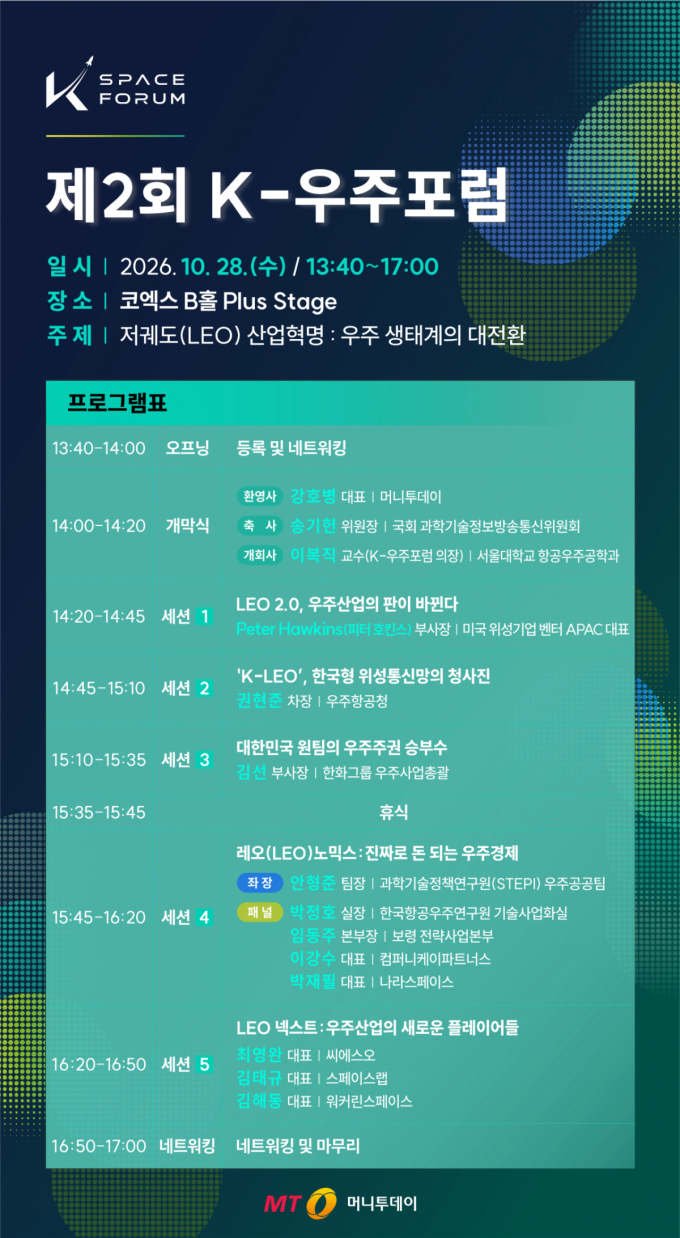
The reason the theme of the 2nd K-Space Forum Flagship Forum, to be held from 2 p.m. to 5 p.m. on the 28th at Seoul Coex in Samsung-dong, Seoul, by the 'K-Space Forum' bringing together industry, academia, research, and government, along with Money Today's startup media platform 'Unicorn Factory,' was set as "Low Earth Orbit Industrial Revolution: The Daejeon of the Space Ecosystem" ((Registration: https://url.kr/2hgl5j)).
This forum focuses not on the launch vehicle itself, but on what it carries, what kind of data is generated, and who will purchase it. It is being organized as a venue to explore how domestic space companies can secure demonstration track records and customers, and how they can grow, by connecting technology, capital, policy, and the market.
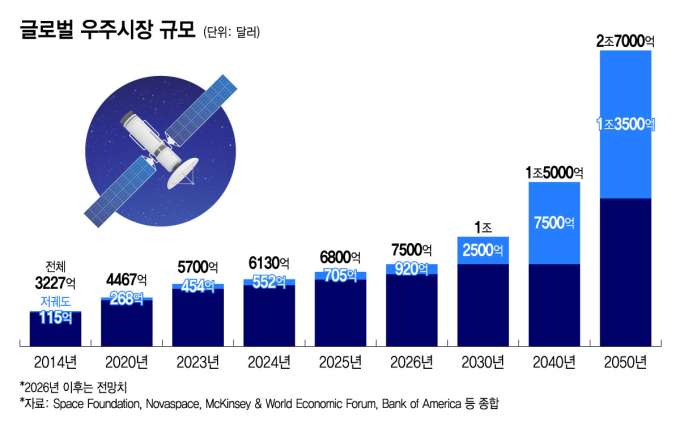
According to a comprehensive analysis of reports from major global investment banks, including McKinsey, the World Economic Forum (WEF), NovaSpace, and Bank of America, conducted by Unicorn Factory, the size of the global low Earth orbit market grew 163% over five years, expanding from $26.8 billion (approximately 39.3 trillion won) in 2020 to $70.5 billion (approximately 103.4 trillion won) last year.
The outlook is even more dramatic. Major institutional investors expect the low Earth orbit market to grow to $250 billion (approximately 366 trillion won) by 2030, $750 billion (approximately 1,100 trillion won) by 2040, and $1.35 trillion (approximately 1,980 trillion won) by 2050. Its share of the overall space market is projected to be 25% in 2030 and more than 50% from 2040 onward.
This means that the center of gravity of the space economy is rapidly shifting from geostationary Earth orbit (GEO), located at an altitude of approximately 36,000 kilometers above the ground, to low Earth orbit, which offers shorter signal delays and lower launch costs.
LEO is not limited to communications and observation. Technologies from terrestrial industries are expanding into low Earth orbit, including "space biotech"—which involves testing new drug candidates and growing protein crystals in a microgravity environment—optical communication for transferring large volumes of data between satellites, on-orbit data centers, and all-solid-state batteries.
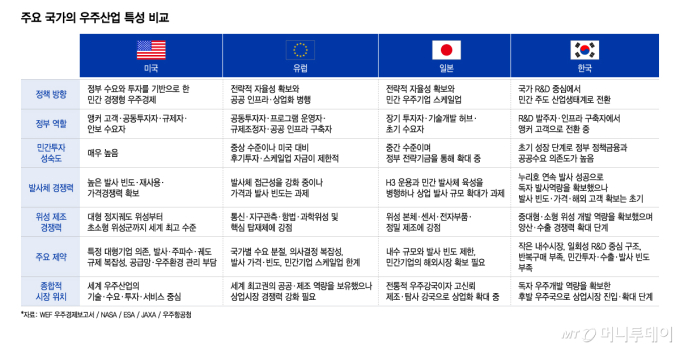
The problem lies in South Korea’s position. The country has a very weak market in which private companies can repeatedly generate revenue. A structure in which sales cease along with the end of a project after completing government R&D (research) tasks, and a lack of “heritage” — performance verified in space — are cited as the biggest bottlenecks to growth.
Experts are in agreement on the structural issues. Lee Bok-jik, a professor at K-Woo Ju-po-reom (Chairman) (Department of Aerospace Engineering, Seoul National University), pointed out, "When it comes to space business, customers ask whether something has been verified in space. The fact that K-space companies lack any experience to answer that question is their biggest barrier."
An Hyeong-jun, a Woo Ju-gong-gong (Team Lead) at the Science and Technology Policy Institute (STEPI), emphasized that “if space policy remains tied to a government procurement structure, private-sector-led development is impossible,” adding that “there is an urgent need for a decisive shift away from a system in which the government controls every stage toward one that fosters the growth of the private market.”
On the 28th, the K-Space Forum will focus on discussing the conditions for this transition. The forum will bring together companies and investors across the entire space industry value chain, as well as policy and research institutional investors, to address not only “what should be developed” but also “who will buy it, where it will be verified, and how recurring revenue can be generated.”
Hanwha Group, equipped with 'launch vehicles, satellites, and services,' expands 'K-space territory'
The low Earth orbit (LEO) market hinges on three key factors: launch vehicles, satellites, and services. The critical questions are how cheaply and frequently launches can be conducted, how quickly a large number of satellites can be deployed, and what services those satellites provide. This is also why SpaceX, the world’s leading space company, has integrated rockets, satellites, and communication services under one corporate roof. In South Korea, Hanwha Group is the only company that has achieved vertical integration by establishing all three pillars at the group level.
At the core of this effort are five space-related subsidiaries, including Hanwha Aerospace, Hanwha Systems, and Satrec. The Hanwha Group’s vision is to integrate these entities into a single collaborative structure and link them with land, sea, and air weapon systems to grow both its defense and space businesses in tandem. In July, Hanwha announced plans to invest 5 trillion won in the aerospace and artificial intelligence sectors by 2040. Specifically, Hanwha Aerospace is set to allocate approximately 2.3 trillion won to launch vehicles, while Hanwha Systems will invest roughly 2 trillion won in satellites, space AI data centers, and low-orbit communication networks.
Hanwha Aerospace is responsible for the launch vehicle. As the system integration company for the Nuri rocket, Hanwha Aerospace has overseen the entire manufacturing process and demonstrated its private-sector-led operational capabilities during the fifth Nuri launch conducted on the 7th. The company played a key role in transferring a significant portion of the practical launch operations, previously led by the Korea Aerospace Research Institute (KARI), to the private sector.
The next challenge for the launch vehicle business is to improve launch efficiency and cost-effectiveness. As low Earth orbit satellite projects gain momentum, the importance of launch capabilities that can stably and continuously transport multiple satellites into space is also growing. In response, Hanwha Aerospace is participating in the government’s project to develop a next-generation reusable launch vehicle. Hanwha has begun detailed design work on a methane engine equipped for recovery and reuse, with the goal of fully launching reusable operations by 2031 through carrying a performance verification satellite on this launch vehicle.
Satellite manufacturing is led by Satrec Initiative and Hanwha Systems. Satrec Initiative, founded by the development team behind South Korea's first satellite, Wooree-1, has demonstrated its unrivaled technological capabilities by developing 25-centimeter-class ultra-high-resolution optical satellites since being integrated into Hanwha Aerospace in 2021.
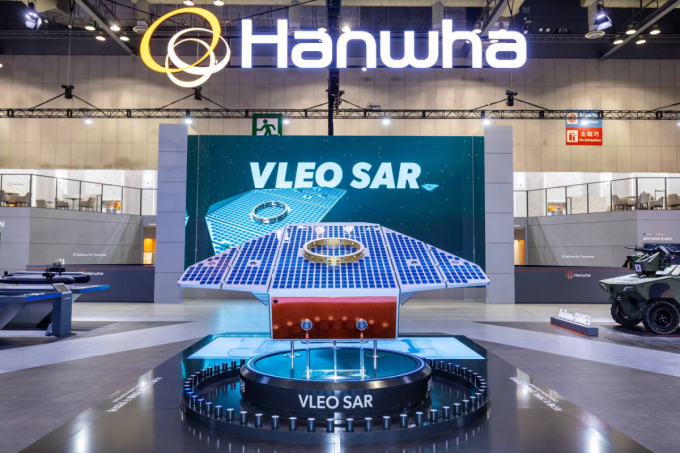
Hanwha Systems is pursuing differentiation with an ultra-high-resolution (UHR) synthetic aperture radar (SAR) satellite targeting the very low Earth orbit (VLEO) environment at altitudes below 400 kilometers. The company plans to launch a SAR satellite with a resolution of 25 centimeters within this year, and it is also developing a satellite with a 15-centimeter resolution capable of even more precise analysis. In December last year, the company completed the Jeju Space Center in Seogwipo, Jeju, on a 30,000-square-meter site, consolidating its satellite development, assembly, and testing facilities. The center has a production capacity of up to 100 satellites per year.
The next step is to expand into service areas that can be scaled through satellites. In the satellite communications sector, Hanwha Systems has completed development of a communication system and terminals that link the current Eutelsat OneWeb network with military tactical networks, and it plans to build its own low-orbit communication network in the long term. In the Earth observation field, the company is expanding its business areas centered on satellite image sales and artificial intelligence (AI) video analysis services.
In the rapidly evolving global low Earth orbit market, the vertical integration strategy and specific blueprint for space-defense synergies being drawn by Hanwha, a leading Korean space company, will be unveiled at the "2nd K-Space Forum" to be held on the 28th at COEX in Seoul. Kim Sun, Vice President and Head of Space Business at Hanwha Group, is scheduled to take the stage that day to present the strategy for building a space value chain that Hanwha is pursuing in the low Earth orbit industry, as well as the vision of expanding the space frontier through collaboration between the government and private enterprises.
The Low Earth Orbit Pioneer Era in Full Bloom... The Trio of Startups Highlighted by the 'K-Space Forum'
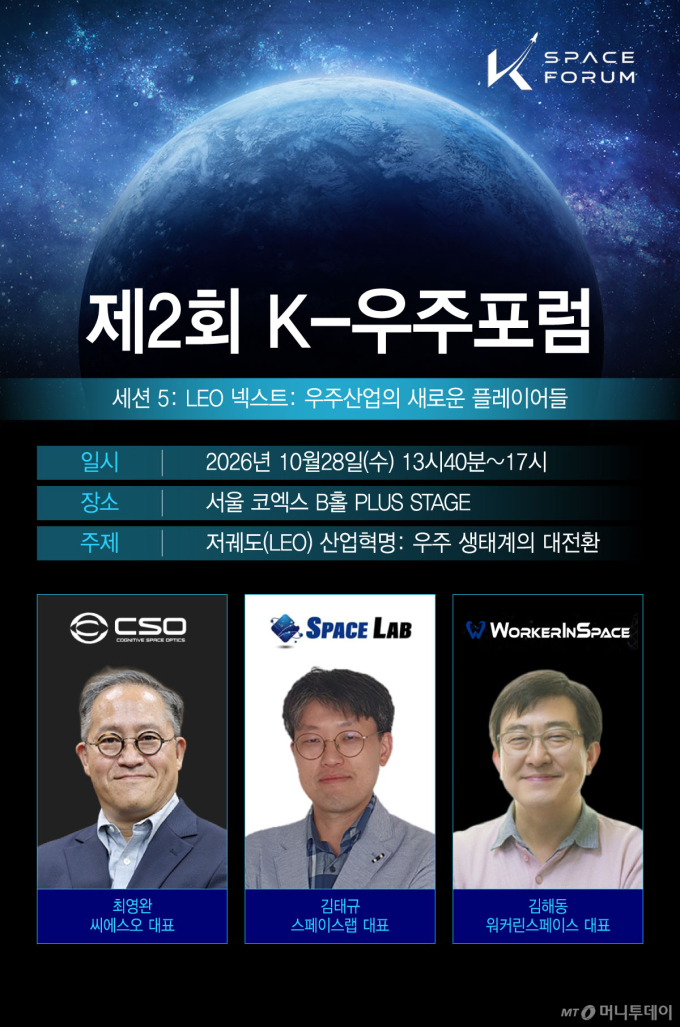
Earth's low orbit is becoming increasingly crowded. As launch costs decline and private sector space activities expand, centered on small satellites, the number of satellites entering Earth's orbit is growing rapidly. Consequently, the competitive landscape of the space industry is also shifting. The new competitive edge now lies not only in how well satellites are built and launched, but in how valuable information can be obtained from satellites once in orbit, how freely they can maneuver, and how long they can be operated.
Technologies that enhance the value of satellites already in orbit are also drawing attention. The related market is expanding rapidly, ranging from high-resolution cameras capable of precise Earth observation to thrusters that maneuver satellites into desired orbits, and even on-orbit servicing (OOS) systems designed to revive satellites with depleted fuel or malfunctions.
At the "2nd K-Space Forum – Session 5," to be held on the 28th at Seoul COEX, three domestic startups that have issued a challenge to these industrial changes will take the stage in front of space industry stakeholders and investors. The companies are CSO, which develops ultra-small high-resolution satellite cameras; Space Lab, which manufactures thrusters—the "engines" of satellites; and Walkerin Space, which is preparing on-orbit services for repairing and refueling satellites in space.
CSO, which will take the stage first, is developing a micro high-resolution optical camera that serves as the "eyes" of satellites. A key feature of the system is its proprietary patent-based four-mirror optical design, which achieves high resolution while reducing size and weight. The company has signed a supply contract worth approximately $6 million (about 9 billion won) with Ghalam, an entity under the Kazakhstan Space Agency, for six satellite cameras. This marks the second domestic export achievement in satellite optical cameras, following Setec AI. CSO also began its first space demonstration of its own camera through the fifth Nuri rocket launch scheduled for the third quarter of this year.
Space Lab develops chemical thrusters, which serve as the "engines" of satellites. Its core technology is an "electrically controlled chemical thruster," which uses electricity to decompose a low-toxicity propellant (fuel) that it has developed in-house, rather than relying on a catalyst. Because no catalyst is used, the system is also well-suited for future "on-orbit refueling," allowing satellites to continue operating by simply replenishing the propellant. In next year's sixth Nuri rocket launch, a satellite equipped with the thruster will perform a proximity maneuver mission in which it approaches another satellite and captures images, marking the first step toward securing "space heritage."
Walker Space aims to establish a "satellite repair station" in space. Through its versatile robotic satellite, VEROS, equipped with dual-arm robot arms, the company is developing on-orbit servicing technologies for fuel refueling, repair and parts replacement, inspection, and orbital towing. Last year, Walker Space became the first private company in South Korea to build a "3D microgravity simulation ground test facility," which replicates a space-like microgravity environment on Earth to conduct mock tests of on-orbit missions such as satellite maintenance and fuel refueling. The company plans to complete its commercial demonstration satellite, VEROS-1, by 2029 to begin technology verification in the actual space environment.
The value chain of the space industry, which had previously focused on building and launching satellites, is now expanding into observation, orbital maneuvering, and maintenance. CSO, SpaceLab, and Walkerin Space are each taking on this newly evolved space mission by leveraging their respective roles as a satellite's "eyes," "engine," and "maintenance facility."
<The 2nd K-Space Forum: The Low Earth Orbit Industrial Revolution: The Daejeon Turn of the Space Ecosystem>
Date and time: Wednesday, October 28, 2026, 2:00 p.m. to 5:00 p.m.
Location: Hall B Plus Stage, COEX, Seoul
Target: VC and CVC investment professionals, as well as those interested in investing in the space industry
Key Contents: Global Low Earth Orbit Market Trends, Announcement of Anchor Company (Hanwha) Space Business Strategy, Space Startup IR
Registration: https://url.kr/2hgl5j
[Money Today Startup Media Platform Unicorn Factory]

 in TECH


