

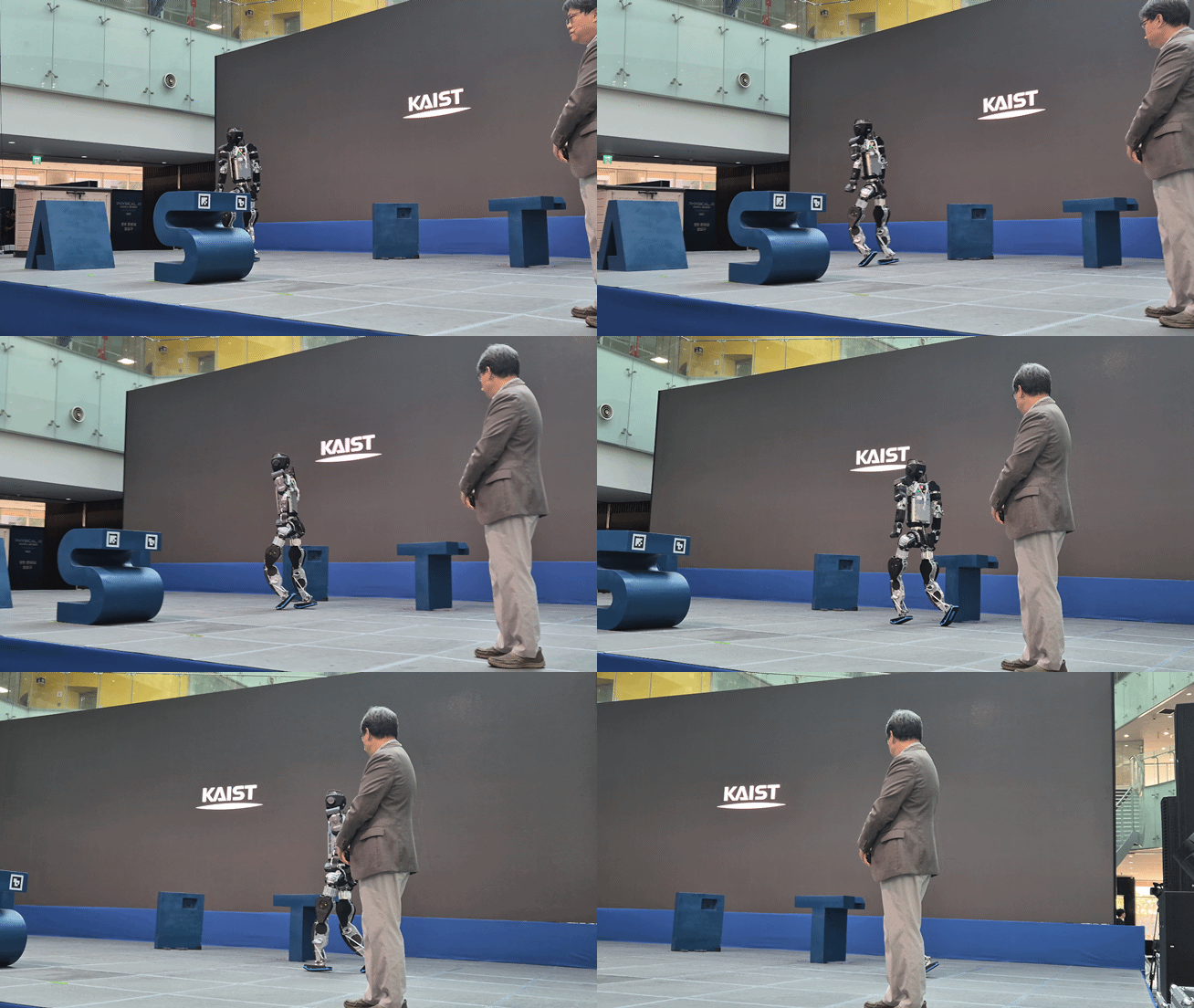
"As a welcome, we will first show you the 'Moonwalk.'"
No sooner had Park Hae-won, professor at KAIST's Department of Mechanical Engineering, finished speaking than the humanoid robot standing at the edge of the stage assumed a ready position. Applause and cheers erupted from the audience. The humanoid had perfectly executed the 'Moonwalk,' Michael Jackson's signature dance move, in which the feet lightly skim the ground as the dancer glides backward.
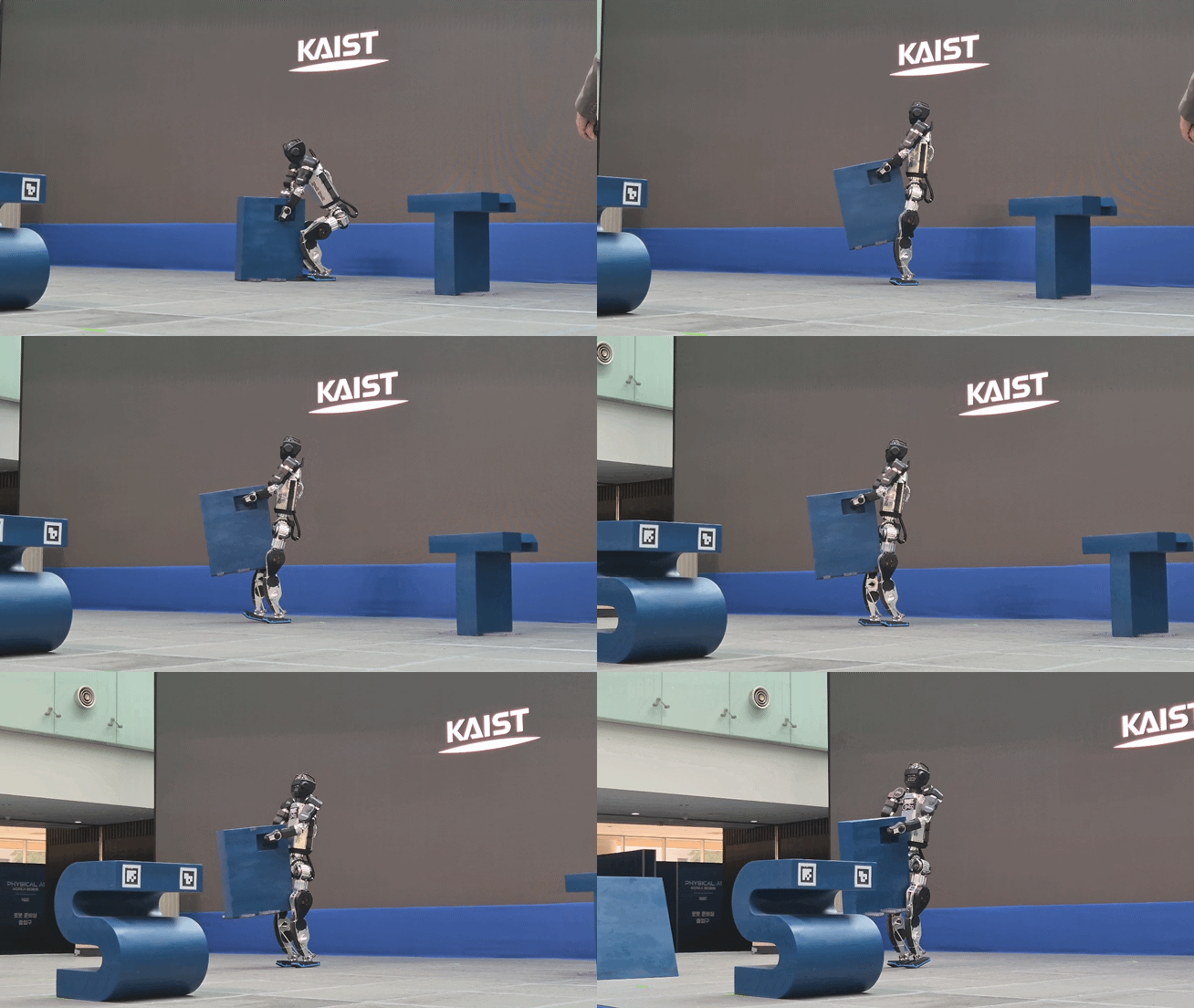
The humanoid then began picking up and moving letter-shaped blocks spelling 'K.A.I.S.T' placed on the stage. It used various methods to move the objects. For blocks that could be pushed, it applied force with its legs and torso to push them. For blocks that could be lifted, it bent its knees to assume a stance before lifting them up with both hands.
KAIST held 'Physical AI Korea 2026' on Tuesday at the KI Building in its Daejeon main campus, announcing various physical AI platform technologies under research and development, as well as education and startup strategies.
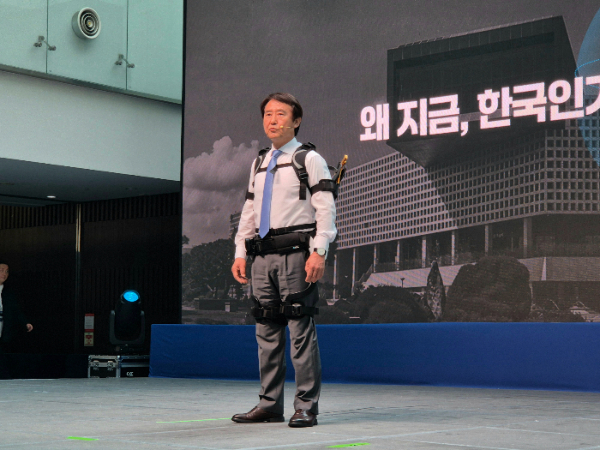
The school's president Bae Chung-sik took the stage wearing a wearable robot developed by the research team of Gong Kyung-chul, professor at the Department of Mechanical Engineering. Simultaneously, health information about President Bae recognized by the wearable robot was displayed on the stage screen.
President Bae said, "South Korea is aging faster than any other country in the world," adding, "The number of people available to work is decreasing, while the number of people requiring care is increasing. Every day, more places in factories, hospitals, rural and fishing areas, and at borders are becoming inaccessible to human hands." He emphasized, "What can fill those gaps is not intelligence that merely thinks, but intelligence that understands and moves in the actual physical world."
On that day, KAIST unveiled five physical AI models, including the humanoid robot from Park Hae-won (Prof.). These included: a wearable robot (Professor Gong Kyung-chul, Department of Mechanical Engineering) that analyzes and provides health information based on data obtained from the wearer's movements; a humanoid pilot robot named 'Pybot' (Professor Shim Hyun-cheol, Department of Electrical and Electronic Engineering) where the robot directly operates cockpit devices and performs piloting missions based on flight information; autonomous movement technology (Professor Myung Hyeon, Department of Electrical and Electronic Engineering) that recognizes unfamiliar spaces to independently determine its own position and travel route; and medical imaging equipment technology (Professor Bae Hyun-min, Department of Electrical and Electronic Engineering) that enables precise ultrasound examinations anywhere without a human doctor.
Among these, the 'robot pilot' Pybot was actually deployed in July to operate a Navy warship. Professor Shim said, "A robot weighing only 70 kilograms (kg) operated a 7,000-ton warship," adding, "It will likely be the first unofficial record of a robot operating a device 100,000 times its own body weight." 'Barrel Eye,' a startup founded by Professor Bae using medical AI technology, successfully secured Series A investment worth 14 billion won last year. Professor Bae stated, "Think of it as radiation and a doctor being inside the robot," noting, "(Ultrasound) scan time was reduced by 49% compared to before, and the scan success rate reached 90%."
Prof. Gong Gyeong-cheol, founder of Angel Robotics, a KOSDAQ-listed company, said, "Providing technology platforms needed for industry is KAIST's role and responsibility," adding, "At next year's Physical AI Korea, we will reveal real-world examples of physical AI created by field experts."

 in TECH


