

Krafton has unveiled its self-developed large language model (LLM), 'Raon-1 mini.' The model employs a structure that activates only the necessary 4 billion out of a total 30 billion parameters. It also demonstrated performance surpassing comparable overseas models in key benchmarks such as reasoning and Korean conversation.
Krafton said Wednesday that it has released a preview version of its 30B-class LLM, 'Raon-1 mini.' The model is available on Hugging Face under the Apache 2.0 license, allowing free use not only for research but also for commercial services and product development.
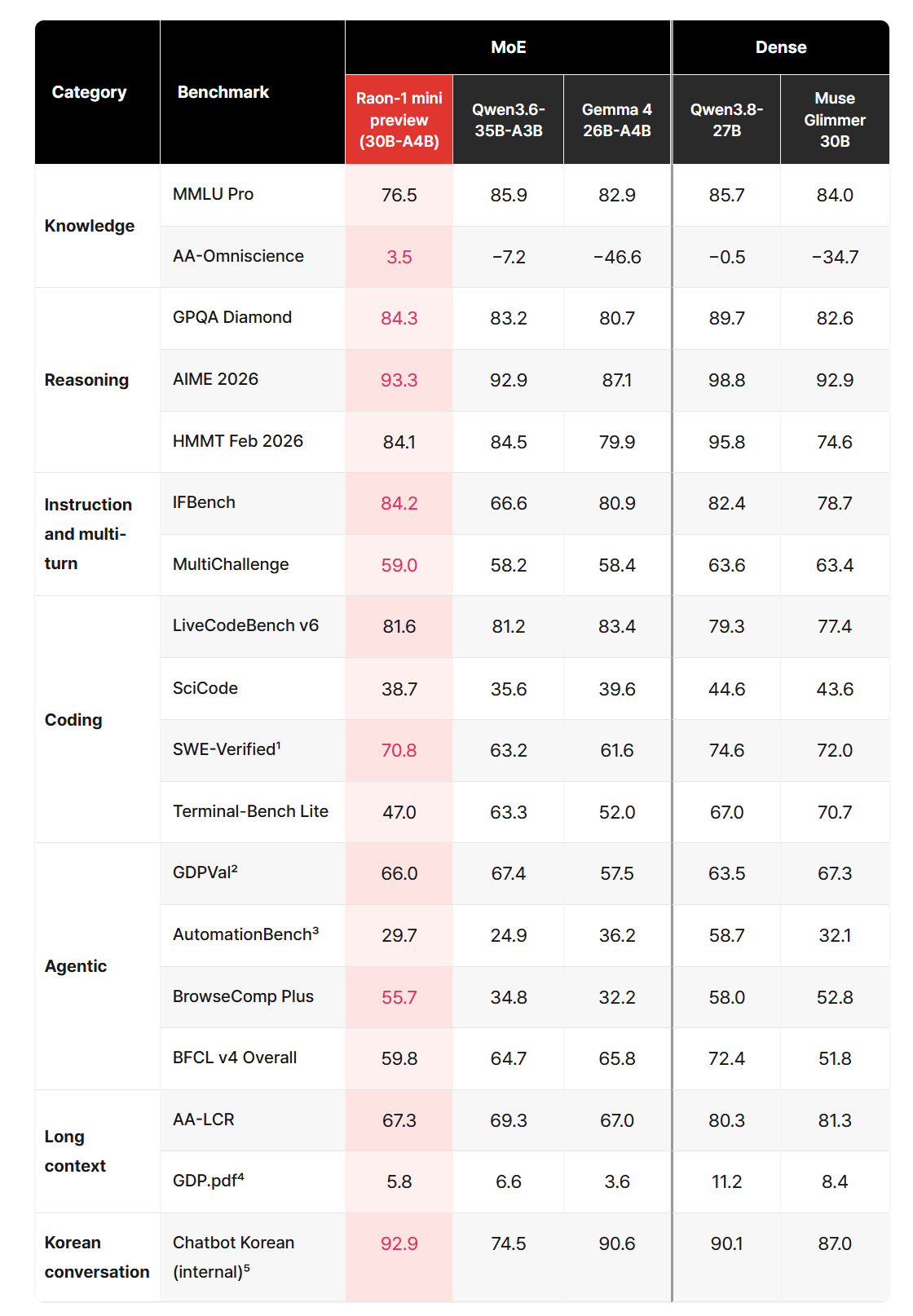
According to performance evaluations disclosed by Krafton, Raon-1 mini recorded a score of 84.3 on 'GPQA Diamond,' which assesses reasoning capabilities. It outperformed comparable overseas Mixture-of-Experts (MoE) models, including Qwen3.6-35B-A3B (83.2 points) and Gemma 4 26B-A4B (80.7 points). It also surpassed the scores of these two models on AIME 2026, a mathematical reasoning metric, with a score of 93.3 compared to their 92.9 and 87.1 points, respectively.
On IFBench, which evaluates how accurately a model follows user instructions, Raon-1 mini scored 84.2. Qwen3.6-35B-A3B scored 66.6, while Gemma 4 26B-A4B scored 80.9. It also significantly outperformed the two models on BrowseComp Plus, which assesses an agent's web browsing capabilities, with a score of 55.7 compared to their respective scores of 34.8 and 32.2.
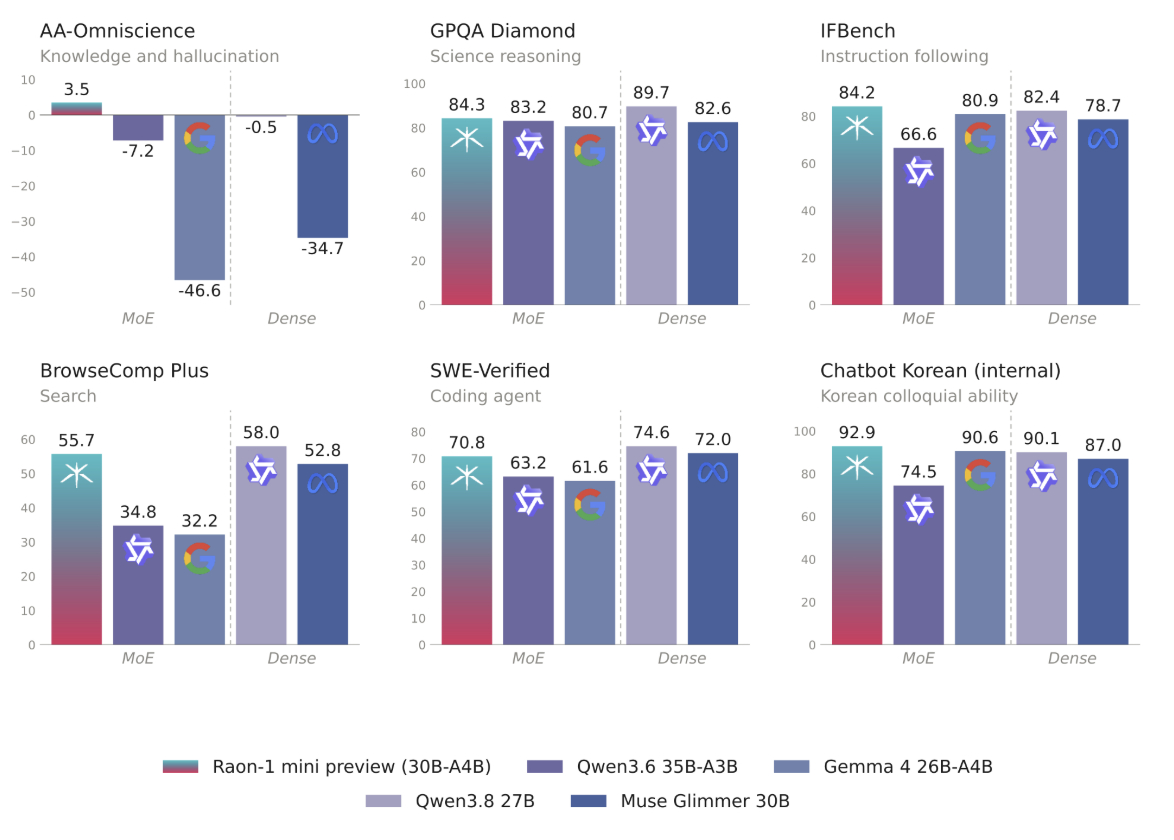
The gap was even wider in Korean conversation performance. On 'Chatbot Korean,' an internal evaluation by Krafton, Raon-1 mini recorded a score of 92.9, surpassing Qwen3.6-35B-A3B (74.5 points) and Gemma 4 26B-A4B (90.6 points). However, there were differences across metrics, with the model recording lower scores than competing models on MMLU Pro and certain coding and long-context evaluations.
Raon-1 mini is an in-house LLM that Krafton developed independently, from model design to training. It supports English and Korean.
The core of the model lies in its Mixture-of-Experts (MoE) architecture and Krafton's self-developed linear attention technology. Instead of utilizing all 30 billion parameters every time, it activates only the 4th billion necessary for a given task. The company explained that this approach increases response speed and reduces inference costs.
Krafton initiated development with 'performance per cost' in actual service environments as the core of model competitiveness, rather than simple benchmark scores. In particular, it focused on Korean conversation, fast responses, and the ability to follow user instructions.
Instruction-following capability is also a crucial element for implementing AI agents that can autonomously perform multi-step tasks. Krafton plans to utilize Raon-1 mini as a foundational model for developing various future AI models and agent services.
The company will further improve the model's performance in the future and release an official version. Upon its official launch, it also plans to publish a technical report detailing the training process and final performance.
Kang Woo-kyung, Krafton's Chief AI Officer (CAIO), stated, "This is the result of independently developing a competitive language model through our AI research and development capabilities accumulated over more than five years." He added, "We will expand the scope of AI utilization across various industries with a cost-effective LLM that offers high performance while reducing cost burdens."
In April last year, Krafton launched its AI model brand 'Raon' and released four open-source AI models in the fields of voice, real-time voice conversation, text-to-speech, and vision. Raon-1 mini is expected to serve as the foundational LLM for future AI models developed by Krafton.

 in TECH


