

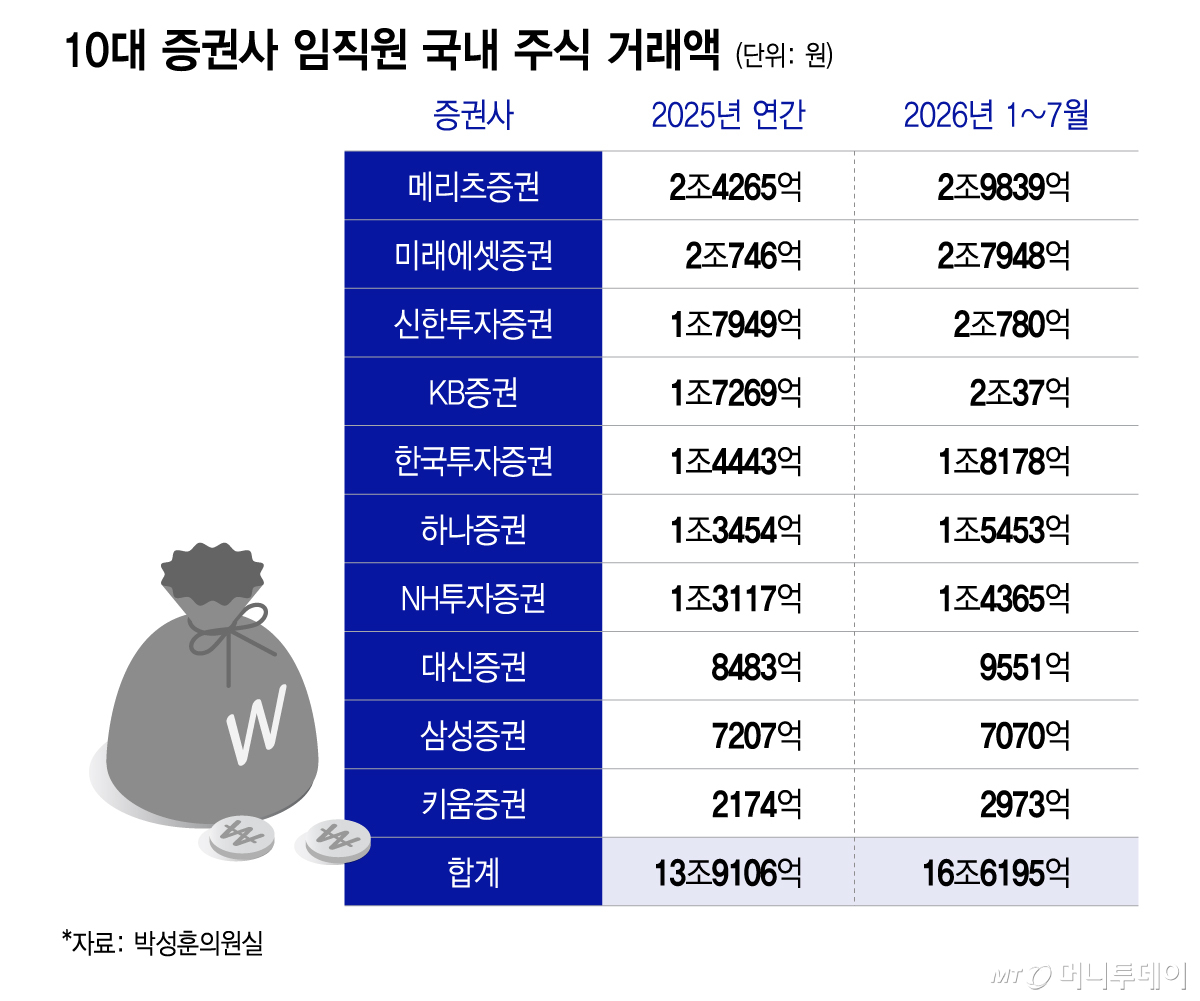
The stock trading volume by executives and employees of the top 10 domestic securities firms has surpassed last year's annual total within just seven months this year.
Domestic stock trading alone is approaching 17 trillion won, and including overseas stocks, the total exceeds 21 trillion won. As financial authorities have repeatedly warned, citing unfair trading by securities firm executives and employees as a case of internal control failure, the effectiveness of proprietary trading management systems has come under scrutiny.
According to data from the Financial Supervisory Service (FSS) obtained on Wednesday by MoneyToday through the office of People Power Party lawmaker Park Sung-hoon, a member of the National Assembly's Political Affairs Committee, the domestic stock trading volume by executives and employees of the top 10 securities firms by equity capital totaled 16.6195 trillion won from January to July this year. This is 2.7089 trillion won (19.5%) higher than last year's annual trading volume of 13.9106 trillion won.
By firm, Meritz Securities had the highest volume at 2.9839 trillion won. Mirae Asset Securities (2.7948 trillion won), Shinhan Investment Corp (2.78 trillion won), KB Securities (2.03 trillion won), and Korea Investment & Securities (1.8178 trillion won) followed. Overseas stock trading volume also reached 4.8369 trillion won during the same period, bringing the combined domestic and overseas trading volume to 21.4564 trillion won.
Trading volume is the sum of purchase and sale amounts and differs from actual investment principal. Given that overall market trading value has surged due to a booming stock market, the expansion of employee trading itself is not an issue.
However, because securities firm executives and employees have access to non-public information in the course of their duties as well as customer transaction data, strict management is required to prevent conflicts of interest and unfair trading.
Financial authorities have also repeatedly called for strengthened internal controls at securities firms. FSS Chairman Lee Chan-jin pointed to unfair trading by some executives and employees and financial incidents as cases of internal control failure during a meeting with securities firm CEOs in February last month. Last month, FSS Deputy Commissioner Seo Jae-wan urged the strengthening of internal controls, including post-trade management and monitoring, at a meeting with compliance officers from securities firms.
Violations of proprietary trading regulations have also been confirmed. According to FSS data disclosed during last year's National Assembly audit period, 56 executives and employees of securities firms and asset management companies were caught trading in accounts registered under others' names between 2020 and August last year. The scale of these transactions reached approximately 7.675 billion won.
The FSS also included the management of employee financial investment product trading as a key inspection item in its internal control review this month of approximately 30 private equity fund (PEF) operators dedicated to institutional investors. This reflects the growing importance of proprietary trading management across the financial investment industry.
The core issue is not restricting individual investments, but the effectiveness of existing management systems. There are calls to verify whether account reporting, review of trading records, and mechanisms to prevent the use of non-public information are functioning properly.
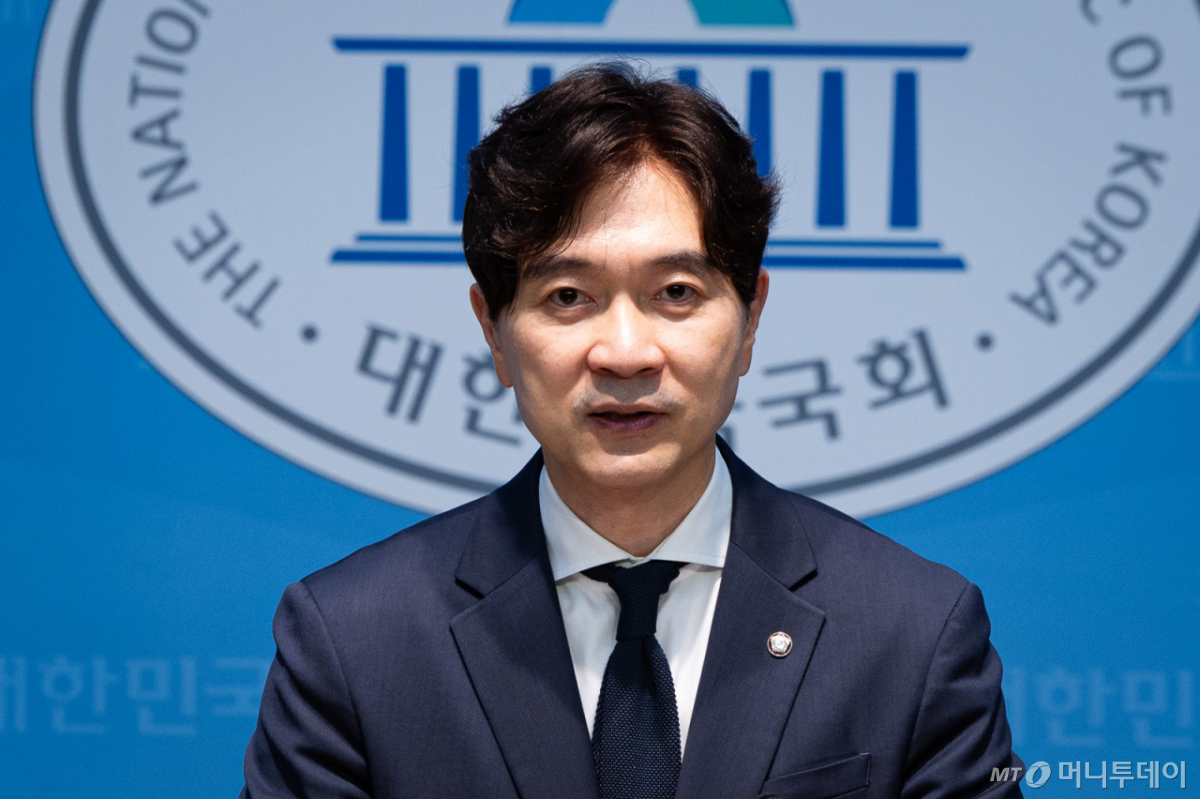
Rep. Park said, "Personal investments by securities firm executives and employees must be conducted within permitted limits," adding, "The status of market experts must not become a blind spot in internal controls."
He further emphasized, "Financial authorities should inspect whether management systems for preventing conflicts of interest and unfair trading are functioning properly in response to the increase in employee trading volume."

 in STOCK

