

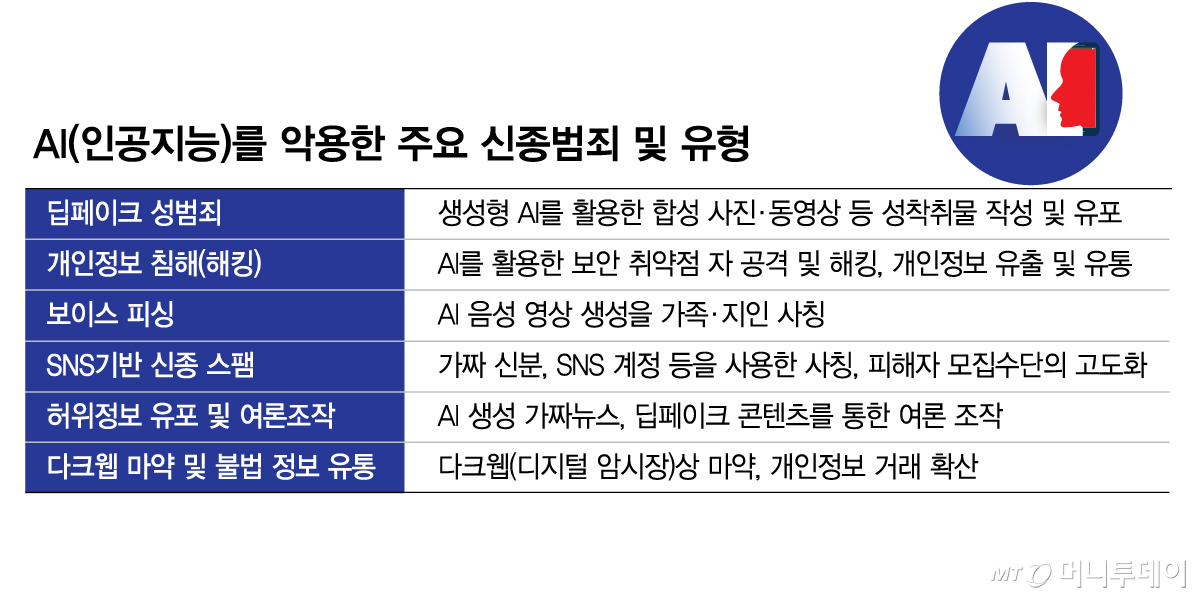
Since the emergence of "generative AI," which produces outputs based on user queries or commands, crimes exploiting AI have surged, and their methods are evolving. Meanwhile, it is pointed out that the public safety system has not even established separate statistics on emerging AI-related crimes. The government's formal launch of efforts to build a scientific public safety system for responding to emerging AI crimes is interpreted as an attempt to keep pace with the spread and advancement of crimes exploiting AI.
According to the National Police Agency and others on the 26th, the commissioned study "Building a Scientific Public Safety System for Responding to Emerging Crimes in the AI Era and Formulating a National Strategy," ordered last month by the National Science and Technology Advisory Council, is a follow-up measure based on the "Korea AI Action Plan" released this February by the National Artificial Intelligence Strategy Committee (hereinafter referred to as the National AI Strategy Committee).
In the Korea AI Action Plan, the National AI Strategy Committee stated, "The spread of AI is creating new battlefields that threaten national trust and social safety," adding, "AI-based crimes such as △deepfakes (image and voice synthesis technology), △voice phishing, △spoofing (deceiving others by impersonating a different identity), △fraud bots, △identity theft, and △automated production of false information overwhelm existing legal frameworks and investigative systems in terms of speed, scale, and sophistication. Such misuse is not merely a technical crime but an issue concerning national security, social order, and the protection of citizens' rights."
In fact, deepfake sexual exploitation materials identified by investigative authorities last year accounted for approximately 1,500 cases, or 35% of all cybersexual violence crimes, representing the largest proportion among types of cybersexual violence crimes. Nevertheless, public safety authorities have yet to establish separate crime statistics utilizing AI and are handling it as one type of general cybersexual crime.
Unlike in the past, AI can be used to commit crimes easily without special technical skills, and damage spreads rapidly, so opinions both inside and outside public safety authorities hold that a separate crime classification is necessary. Just as voice phishing crimes initially concentrated harm on the elderly, who were unfamiliar with new methods, there are concerns that crimes utilizing new technology may disproportionately affect vulnerable groups such as children, adolescents, women, and the elderly.
Following the National AI Strategy Committee's recommendation in the AI Action Plan for cross-ministerial measures, the Broadcasting Media Communications Commission launched the "Cross-Ministerial Consultative Body on AI Crime Response" this June and began preparing a "Comprehensive Response Plan to Eradicate AI Crimes." The National AI Strategy Committee recommended that relevant ministries develop crime response plans tailored to each field, including △financial crimes, △AI-utilized sexual crimes such as deepfakes, △personal information infringement crimes, and △illegal fund circulation.
The "Study on Building a Scientific Public Safety System for Responding to Emerging AI Crimes and Formulating a National Strategy," undertaken by the National Science and Technology Advisory Council, also aligns with the policy formulation recommendations of the National AI Strategy Committee. Through the commissioned study, the plan is to grasp the occurrence status by crime type and the damage situation among vulnerable groups, and to create a Jeonju-based response system leading from crime prevention to investigation, and then to victim protection and support, through analysis of AI technology misuse principles and crime scenarios.
The National Police Agency and the National Science and Technology Advisory Council plan to complete the commissioned study by February 2027 and formulate a national-level strategy for responding to AI crimes based on the results. Additionally, the scope of the research includes clarifying the criteria for crime response ministries with ambiguous boundaries in specific cases, such as the National Police Agency, Ministry of Gender Equality and Family, Ministry of Justice, Financial Services Commission, Broadcasting Media Communications Commission, and Ministry of Science and ICT, to minimize gaps in responsibility. The plan is also to establish a basis for cross-governmental response to serious crimes such as large-scale personal information breaches and financial sector hacking.
A National Police Agency official explained, "In accordance with the Korea AI Action Plan released by the National AI Strategy Committee, more than 10 ministries, including the Broadcasting Media Communications Commission and the National Police Agency, are carrying out tasks to respond to AI crimes," adding, "We are systematically researching what preparations need to be made, starting from defining AI crimes, identifying crime types, formulating preventive measures, and protecting victims."
Lee Jung-heon, a Democratic Party of Korea lawmaker, emphasized, "If institutions and investigative capabilities fail to keep up with the speed at which AI technology is misused for crime, damage to citizens could grow even larger," adding, "It is necessary for relevant ministries to respond actively so that it does not stop at the commissioned study but leads to effective follow-up measures and research and development investment."

 in TECH
