

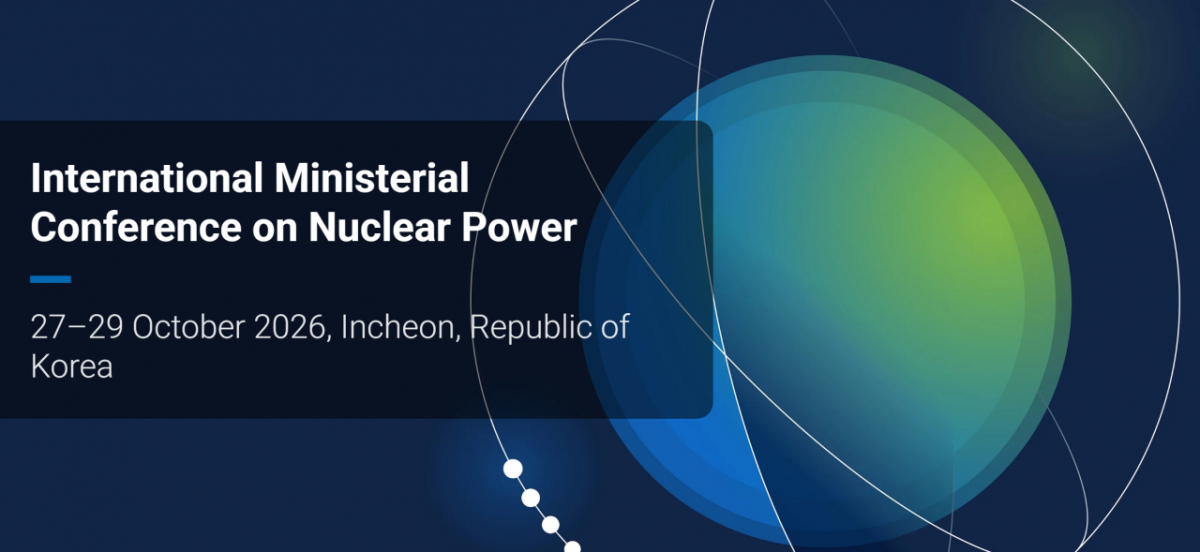
The International Atomic Energy Agency (IAEA) Ministerial Conference on Nuclear Energy is being held in South Korea for the first time.
The Ministry of Science and ICT announced on the 27th that the IAEA Ministerial Conference on Nuclear Energy opened at Songdo Convensia in Incheon.
The IAEA Ministerial Conference on Nuclear Energy is a representative high-level policy conference that discusses the peaceful use of nuclear energy and future policy directions. It is typically held every four years, having started in Paris, France, in 2005, and after being held in China, Russia, the United Arab Emirates, and the United States, the sixth meeting is taking place in South Korea this year.
The conference will continue until the 29th, with Vice Prime Minister and Minister of Science and ICT Bae Kyung-hoon serving as chair. Approximately 800 people attended, including ministerial-level representatives from the governments of 60 member states, eight international organizations, and approximately 85 domestic and foreign companies.
In his opening address, Vice Prime Minister Bae emphasized, “We must cooperate to pool each country’s technology and experience in accordance with the principles of safety, nuclear security, and nuclear non-proliferation, so that the benefits of nuclear energy reach more countries and people.” He also stated that, as the host country, he would make this conference an opportunity to expand substantive cooperation among nations.
In subsequent keynote speeches, three core policy directions for South Korea were presented: △ strengthening trust based on safety and transparency, △ safe development and demonstration of Small Modular Reactors (SMRs), and △ leapfrogging into a global production hub.
The plenary session will address policy directions and specific implementation tasks for the safe expansion and new applications of nuclear energy. The high-level session will discuss key policies and strategies that support energy security and carbon neutrality, including nuclear power plant introduction, regulation, and SMRs. The expert session will explore ways to cultivate talent, secure funding, and build social trust necessary to translate policies into actual projects.
South Korea will lead the “A New Era of Nuclear Energy” session, presenting directions for technological innovation and international cooperation based on digital and nuclear capabilities. It will focus on cooperation plans to enhance the safety and efficiency of nuclear energy using AI and to expand the utilization of SMRs and marine nuclear power.
Meanwhile, 150 representatives from 50 companies and institutional investors from both countries participated in the “Korea-US Nuclear Industry Dialogue” jointly hosted by the Ministry of Science and ICT and the U.S. Embassy in South Korea on the previous day. Major U.S. companies such as TerraPower, NuScale Power, Oklo, Kairos Power, and Centrus Energy attended, along with Korean companies including Korea Hydro & Nuclear Power, Doosan Enerbility, Hyundai Engineering & Construction, Samsung C&T, SK Innovation, and Samsung Heavy Industries.
Vice Prime Minister Bae stated, “Based on the SMR Special Act and the ‘Seven Major SEED Projects,’ we will consolidate public and private sector capabilities to promote the safe development and demonstration of SMRs and open a new future for K-nuclear.”

 in TECH
