

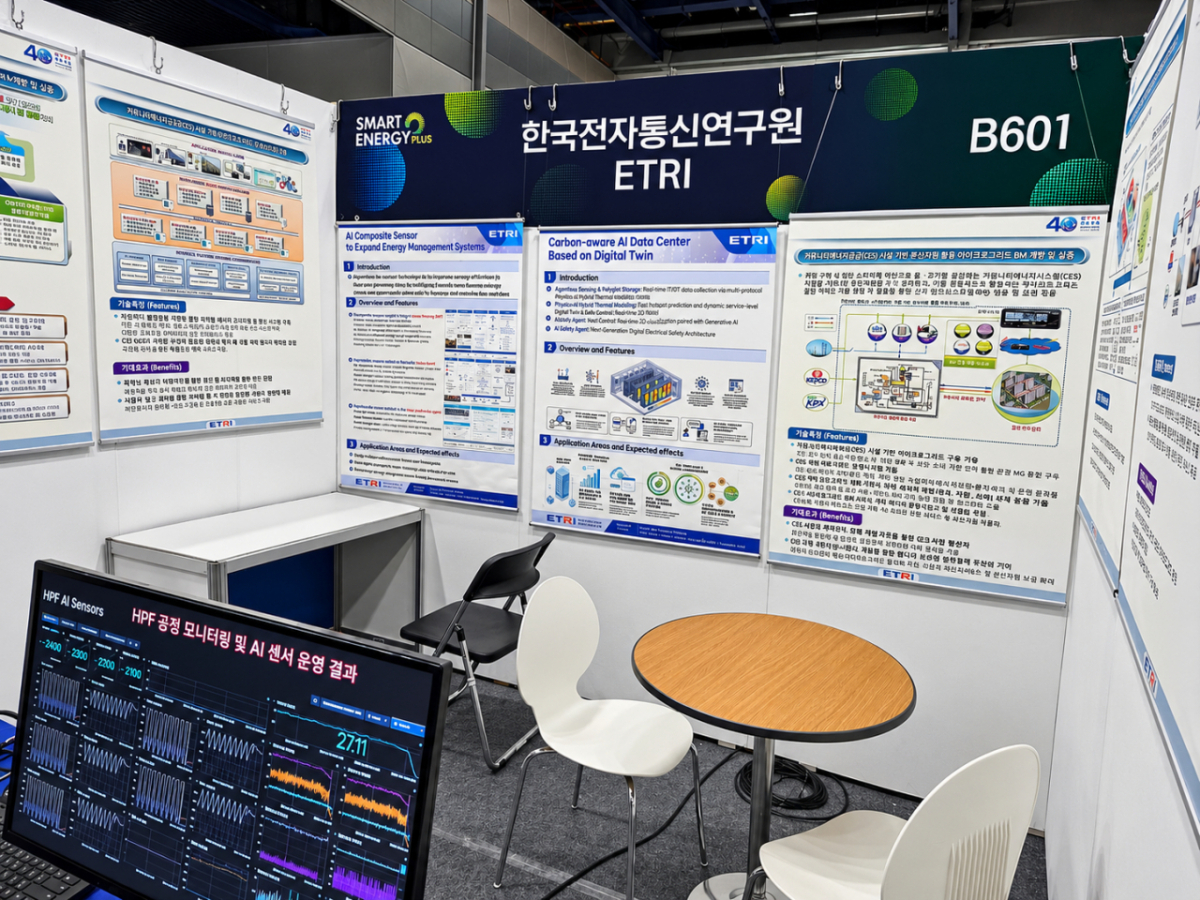
At the "Smart Energy Plus (SMART ENERGY PLUS·SEP) 2026" exhibition held on the 28th in Hall B of COEX in Samsung-dong, Seoul, monitors installed at the Electronics and Telecommunications Research Institute (ETRI) booth displayed real-time graphs indicating the temperature and operating status of factory equipment. This is a technology that uses AI to analyze equipment data to identify energy waste.
On this day, ETRI introduced technologies for improving energy efficiency in factories and data centers using AI. Rather than simply measuring electricity consumption, the focus was on analyzing equipment status to reduce energy consumption and enhance operational efficiency.
The "AI composite sensor" technology drew particular attention. This method involves AI analyzing various data collected from factories and industrial facilities, such as temperature, pressure, and flow rate, to optimize energy use for each piece of equipment. While existing sensors were limited to measuring individual values, AI composite sensors synthesize multiple data points to provide information necessary for equipment operation.
In an application case presented by ETRI for a hot press forming process for automotive parts, results showed a 23.2% reduction in energy usage in heating furnaces and a 32.5% reduction in energy consumption in cooling systems. In the textile dyeing process as well, the effectiveness of using AI to reduce energy consumption in drying and tentering equipment was confirmed.
Technology for reducing power consumption in AI data centers was also introduced. ETRI exhibited technology that analyzes data center temperature and power usage in real time based on digital twins and controls cooling equipment.
A digital twin is a technology that implements real-world equipment in a virtual space to analyze operating status. ETRI combined this with an AI-based thermal analysis model, designing it to predict heat generated by servers and adjust the cooling system. It also included operational decision support functions utilizing generative AI.
According to exhibition materials, the technology aims to improve the annual Power Usage Effectiveness (PUE) of data centers by approximately 5% and shorten the payback period by 2 to 3 years. PUE is a value obtained by dividing total data center power consumption by IT equipment power consumption, with lower values indicating higher efficiency.
Technology for efficiently managing regional-scale power supply and consumption was also unveiled. ETRI introduced microgrid operation technology that links solar power, Energy Storage Systems (ESS), and the power grid in apartment complexes and other areas. This method uses AI and data analysis to predict power generation and consumption and optimally allocate energy resources.
In particular, it presented technology for independently supplying power using local generation equipment and ESS even if problems occur in the external power grid. This is an attempt to enhance not only the reduction of power consumption but also supply stability.

 in TECH
