

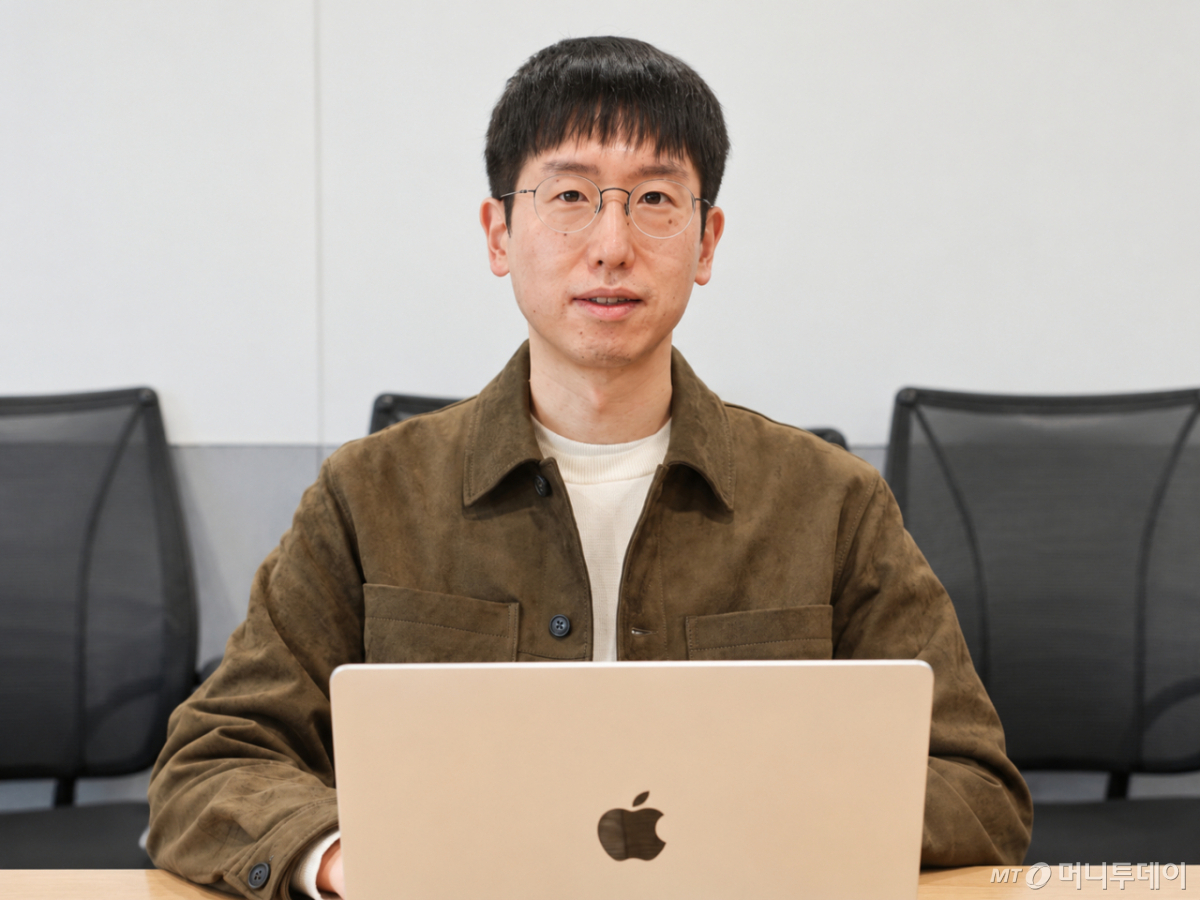
"Our goal is not to grow one good tree and transplant it, but to study how to create a forest and share that knowledge with the world."
Kim Hyeon-woo, Director of the NVIDIA-Korea Advanced Institute of Science and Technology (KAIST) AI (Artificial Intelligence) Joint Research Institute, said this during an interview conducted on the 10th at the NVIDIA Korea office in Seoul Gangnam-gu. Kim, who also serves as an assistant professor at KAIST's School of Computing, outlined a plan to publicly release data and learning methods that multiple companies can utilize, rather than focusing on a specific AI model.
NVIDIA and KAIST announced the establishment of the joint research institute in July and agreed to invest 300 million dollars (approximately 403.2 billion won) over the first five years. Kim, born in 1991, said, "There are interesting projects being prepared, so I think everything will be revealed by the second half of next year."
The two pillars of the research are 'synthetic data' technology, which enables AI to generate learning data, and learning techniques that allow models to extract more content from existing data. Kim stated, "In artificial intelligence, data is as important as GPUs (Graphics Processing Units)," pointing out that "there is a problem where data learning know-how is not disclosed and is shared only within each company."
In Google's multilingual learning dataset 'mC4', English documents number approximately 3.93 billion, which is 163 times the 24th million Korean documents. As of last month, the proportion of Korean in the public web document archive 'Common Crawl' was only 0.88%. Kim said, "It is really difficult to find high-quality public datasets in our language," adding that "they are lacking in every field."
Kim cited KAIST's research capabilities and the characteristics of the Korean language as the reasons behind NVIDIA establishing a research institute in Korea. He stated, "KAIST has become a school that is receiving significant attention worldwide." While Korean has less data than English or Chinese, it falls under 'mid-resource languages' that have established research foundations compared to minority languages. He revealed, "We will disclose 'open recipes' and data learning methods that can be applied to other languages starting from Korean."
The 'Nemotron Persona Korea' dataset, led by Kim and released by NVIDIA in April, ranked as the world's number one popular dataset on Hugging Face for ten days and was downloaded approximately 140,000 times. It was also utilized in LG AI Research Institute's K-Exaone 2.5. Kim said, "Nemotron is just one of many trees in the forest," stating that research results would be made public so they could be applied to other AI models and used commercially.
Of the total support amount, 250 million dollars will be provided as computing resources. The types and quantities of GPUs have not yet been finalized. Kim said, "Everyone knows that domestic researchers are suffering from a lack of GPUs," adding that "the influx of NVIDIA's vast computing resources is news like a timely rain."
The joint research institute will support at least 10 KAIST researchers annually and provide NVIDIA internship opportunities. It is also promoting the recruitment of regular research staff. Kim, who returned to Korea after working overseas, emphasized, "I think people can come back because there are good opportunities," adding that "bringing our country's talents from overseas back to Korea is one of our major goals."

 in TECH
