

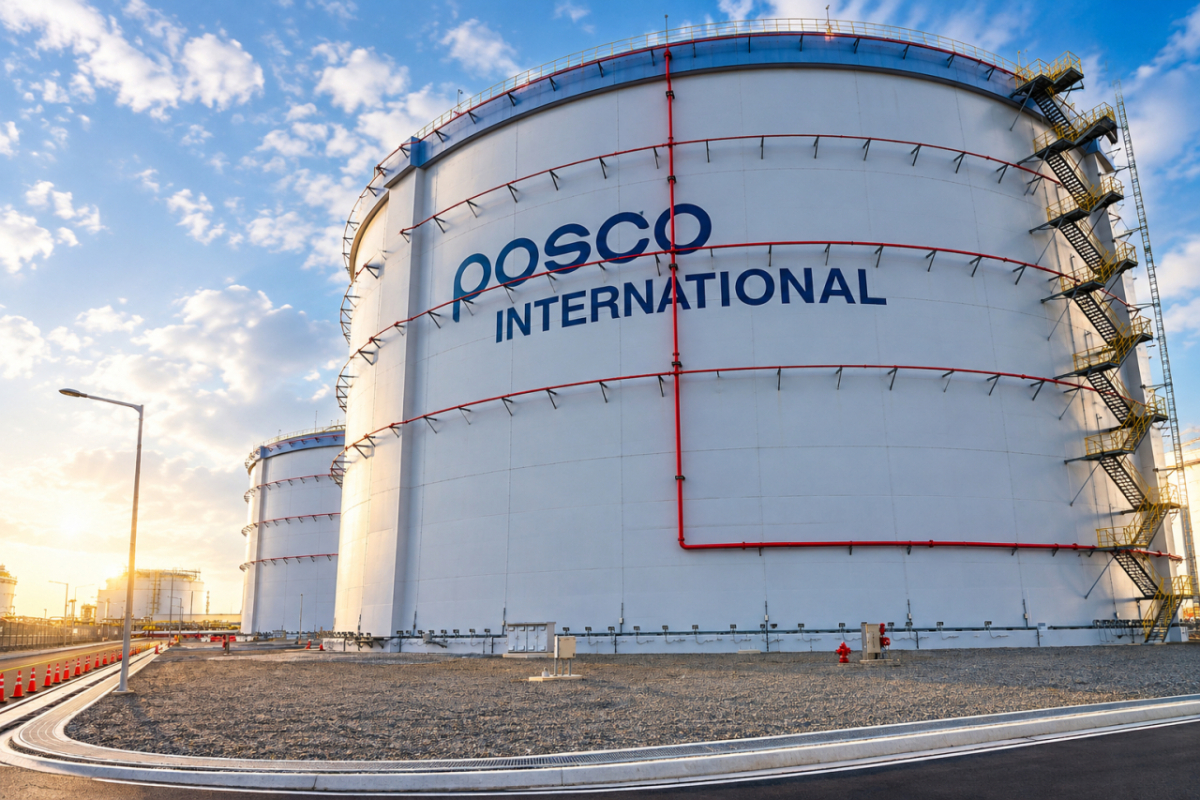
POSCO International has completed the comprehensive construction of the Gwangyang No. 2 Liquefied Natural Gas (LNG) terminal, strengthening its energy and resources capabilities, a key pillar of the POSCO Group's Triple Core strategy. The company aims to contribute to South Korea's energy security through this achievement.
POSCO International held a completion ceremony on the 10th at the Gwangyang No. 2 LNG Terminal located in Gwangyang City, Jeonnam-Gwangju Integrated Special Metropolitan City. Attendees included National Assembly member Kwon Hyang-yeop, Bank of Korea Industrial Bank Chairman Park Sang-jin, Jeonnam-Gwangju Integrated Special Metropolitan City Deputy Mayor for Industry and Economy Kang Myung-soo, Gwangyang Mayor Park Seong-hyun, along with officials from the government, local authorities, and client companies. Also present were POSCO Group Chairman Jang In-hwa, POSCO International President Lee Gye-in, and other group executives, totaling over 100 people.
Constructed over 47 months with a total investment of 949.2 billion won, the Gwangyang No. 2 LNG Terminal features two 200,000 kiloliter-class LNG storage tanks and related facilities. Combined with the existing 930,000 kiloliter storage capacity of the first terminal, the total storage capacity of the Gwangyang LNG Terminal reaches 1.33 million kiloliters. This is a scale capable of storing heating gas sufficient for the entire nation's use for 40 days. The facility also includes a wharf accommodating 270,000 cubic meter-class LNG carriers and a bunkering wharf for vessels up to 20,000 cubic meters in size.
An LNG terminal is infrastructure that unloads and stores LNG imported by demand-side entities, then vaporizes it and supplies it to consumers through pipeline networks. The POSCO Group began commercial operations of the Gwangyang LNG Terminal in 2005, becoming the first private enterprise in South Korea to do so. Since POSCO International took over the LNG business in 2019, it has been gradually expanding its facilities.
POSCO International is building a value chain spanning from gas field development and production to LNG trading, terminals, and power generation. With this completion, the company plans to enhance its LNG storage and processing capabilities and strengthen its trading competitiveness by linking global LNG procurement capabilities with domestic infrastructure. It has also secured land in advance for the expansion of storage tanks numbered 9 through 12.
Based on the expansion of terminal infrastructure, the company will also expand related businesses such as vessel sea trials and LNG bunkering. The Gwangyang LNG Terminal currently operates a sea trial business that checks the normal operation of LNG carriers before delivery to shipowners, and a Port-to-Ship (PTS) bunkering business that supplies fuel-grade LNG from the wharf to vessels. Going forward, it plans to expand into Ship-to-Ship (STS) bunkering, which supplies LNG between vessels, thereby diversifying the revenue base for its vessel fuel supply services.
POSCO Group Chairman Jang In-hwa stated, "The Gwangyang No. 2 LNG Terminal is a clear result of execution that proves the POSCO Group's energy and resources strategy within its Triple Core on the ground." He added, "With this completion, we will enhance the completeness of the LNG value chain and contribute to national energy security."

 in INDUSTRY
