

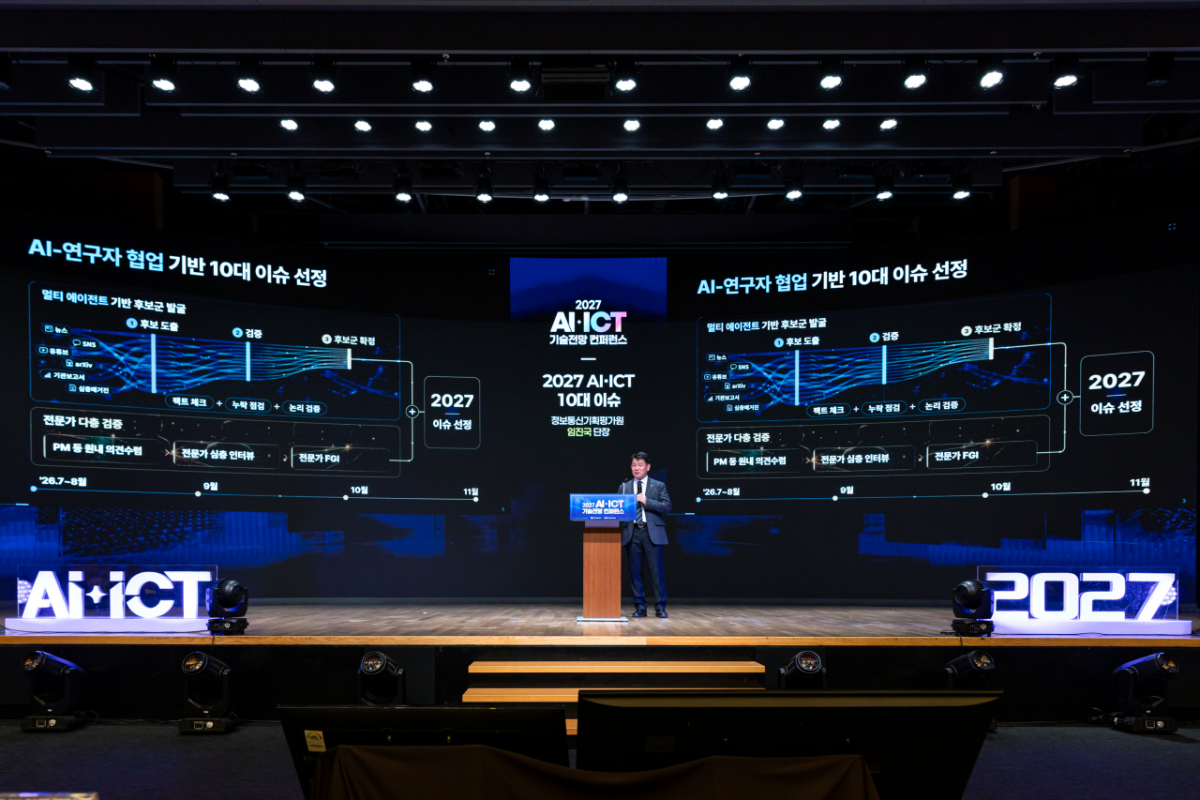
A forecast has emerged that the center of gravity in artificial intelligence (AI) technology competition will shift from performance improvement to actual productivity and cost efficiency. As the utilization of AI agents and robots expands, efficiency competition is also expected to become important in semiconductors and data centers.
Im Jin-guk, head of the Digital Future Policy Division at IITP, announced the "Top 10 AI and ICT Issues for 2027," which includes this content, at the "2027 AI and ICT R&D Technology Outlook Conference" held on the 11th at the Korea Chamber of Commerce and Industry in Jung-gu, Seoul.
Division head Im stated, "AI has now reached a stage where it must answer with results, revenue, and productivity in the market, going beyond merely demonstrating possibilities or performance," adding that "the biggest theme for 2027 will be the realization of AI Transformation (AX) productivity." He also introduced an analysis stating that while 88% of global companies have adopted AI, only 6% have achieved meaningful results.
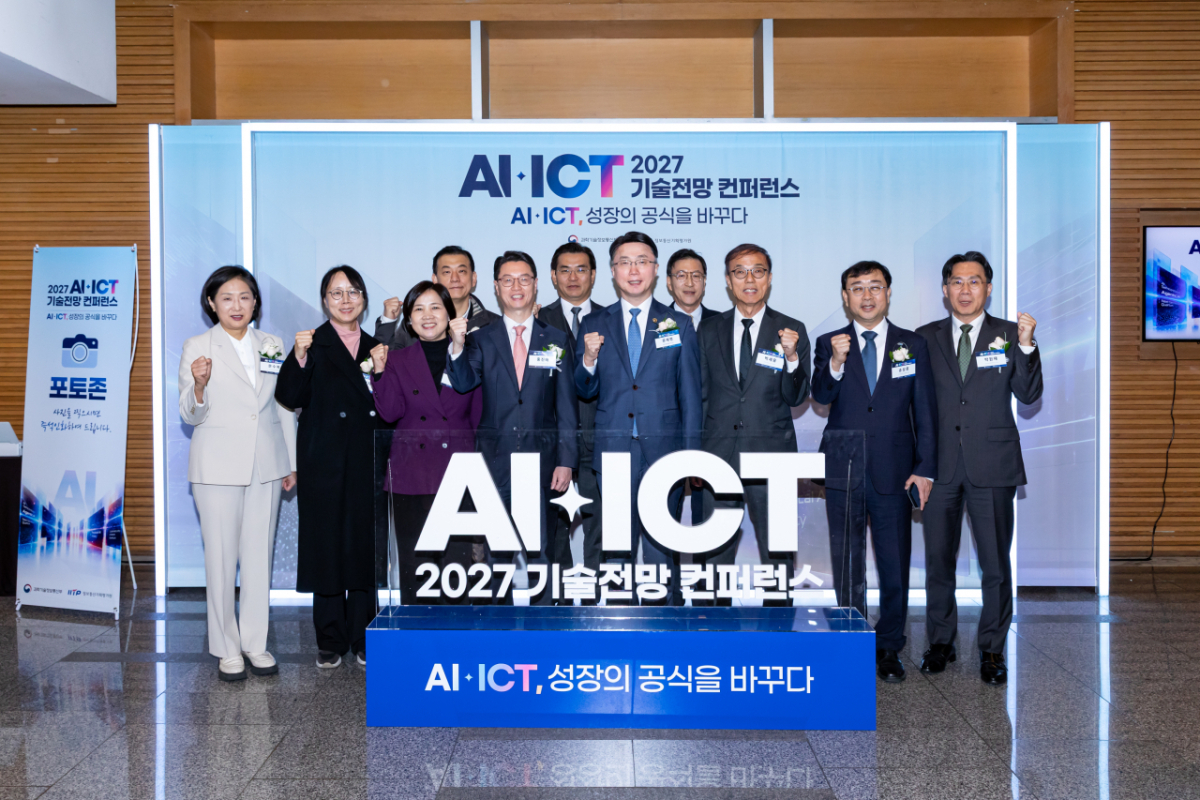
Ryu Je-myung, Second Vice Minister of the Ministry of Science and ICT, mentioned the uncertainty in the AI investment environment following the U.S. midterm elections in his welcome address, stating it is "a golden opportunity to narrow the gap with leading countries and secure overwhelming national AI competitiveness through bolder and faster investment and technological innovation." Hong Jin-bae, president of IITP, emphasized, "In 2027, beyond technical performance, the practical results created by AI—namely AX productivity—will be the most important theme."
The top 10 issues are: △Agentic Economy △Challenges in the generalization of Physical AI △A turning point in the Artificial General Intelligence (AGI) competition △AI semiconductor optimization △Dual competition on speed and performance for AI Data Centers (AIDC) △Maximizing token efficiency △Evolution of spatial computing △AI-native 6G (6th-generation mobile communication) △Cyber Shield Dome △Full-stack Sovereign AI.
Division head Im cited Gartner's forecast, explaining that the number of AI agents operated by a single company among the Global Fortune 500 could increase from 15 in 2025 to approximately 150,000 by 2028. He said, "While it was initially important how to question and instruct AI, recently the direction is shifting toward creating an environment where AI can work well."
Regarding Physical AI, he explained, "While various movements of humanoids have attracted attention so far, the issue is now shifting to how to work like humans." The ability to respond to unfamiliar environments and autonomously recover from errors during tasks was presented as a core challenge.
Cost reduction is key in semiconductors and data centers. Division head Im noted that inference accounts for approximately two-thirds of AI computing this year, and forecasted the expansion of open computing environments combining Graphics Processing Units (GPUs) and Neural Processing Units (NPUs). He also emphasized the importance of operational efficiency, stating, "While the unit price per token has become about 1/300th cheaper than in the past, the cost per mission is increasing significantly."
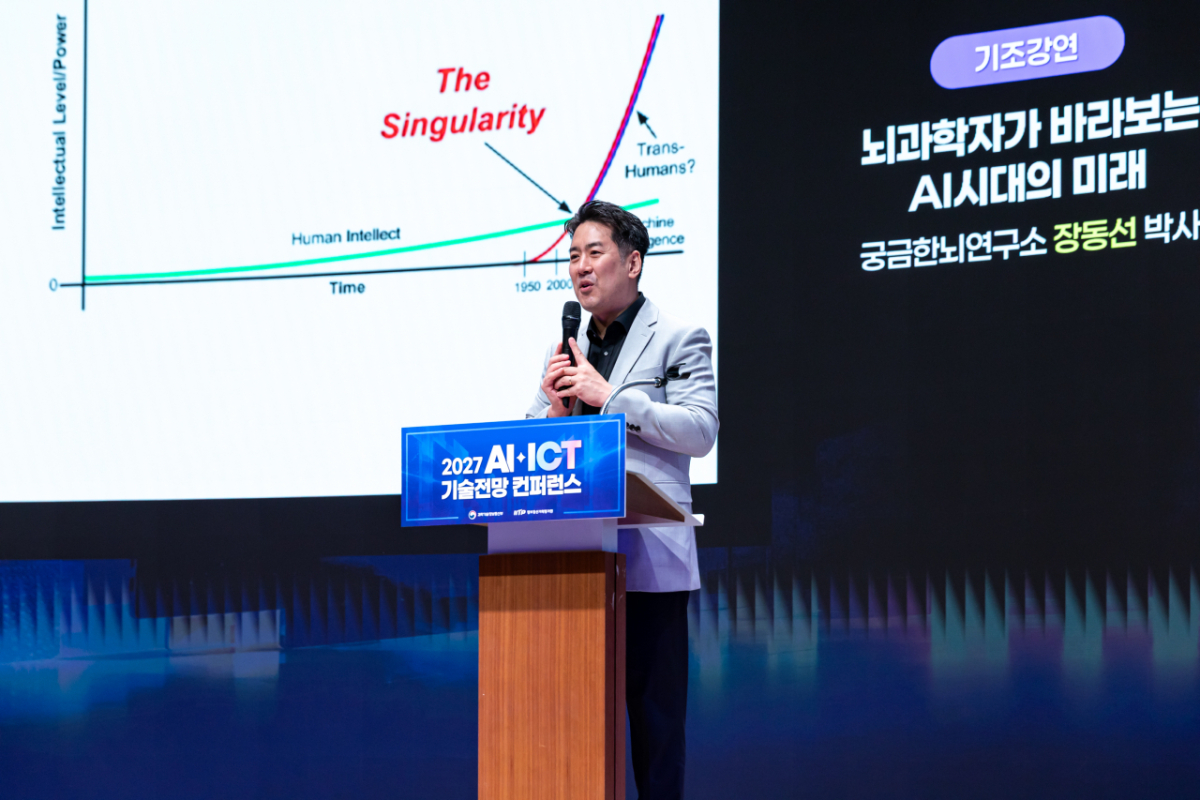
Meanwhile, neuroscientist Dr. Jang Dong-sun, who delivered a keynote speech on the same day, stated that while individual research outcomes may improve with AI utilization, research diversity could decrease, and emphasized the need to maintain human self-directedness and collaboration skills.

 in TECH


