

It has been confirmed that numerous domestic companies have visited Ashburn in Loudoun County, Virginia, U.S., over the past year to find solutions for building AI (artificial intelligence) data centers. The advice obtained there is that they must become good partners to local communities and that they should reflect the power and cooling demand of semiconductors five years from now.
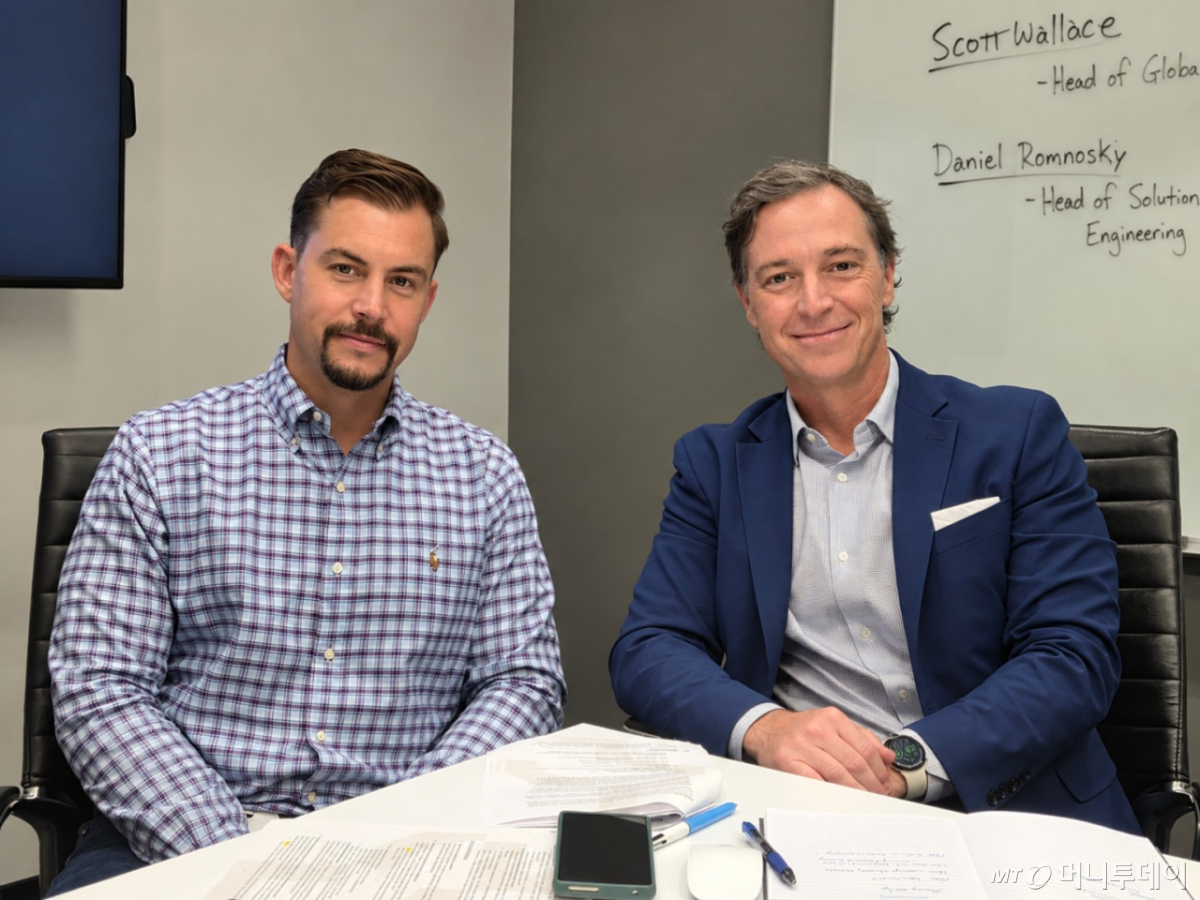
Scott Wallace, Senior Director at Digital Realty, whom we met at the IAD39 Digital Realty data center in Virginia, U.S., stated, "Over the past year, major Korean companies, including manufacturers, financial firms, and telecom carriers, have successively visited Ashburn," adding that they showed interest in building high-density 'AI factories,' as well as data center design and construction, and power utilization.
In particular, domestic companies visited the 'DRIL' (Digital Realty Innovation Lab) to examine construction plans by testing and verifying AI infrastructure in an actual data center environment.
Senior Director Wallace explained that it is important to help local communities understand this, noting, "People often do not know well what data centers do or how they use natural resources such as power and water." Daniel Romnossky, Director of Solution Engineering at Digital Realty, also stated, "It is important to be a good partner to the local community," adding that the number of employees hired to operate data centers in Northern Virginia is around 450 to 500 people, including engineers, facility managers, sales staff, and security personnel.
The starting point for Northern Virginia, the world's largest data center cluster area, was the internet network. Senior Director Wallace explained, "We started by gathering routers in one place to connect different networks," adding that as routers grew larger and used more power, cooling became necessary, and specialized buildings were built for this purpose. He said that as demand expanded from cloud to AI, the relationship between data centers and local communities emerged as an important issue.
When asked whether data centers should be built in the metropolitan area or in regional areas, Senior Director Wallace answered that the location can vary depending on service characteristics. While stating, "Some AI services, such as healthcare and education, need to be close to users," he added, "The more high-density fiber optic networks are built, the less important physical proximity becomes."
Senior Director Wallace evaluated (Korea) as a "strategically important AI construction region in the world," while emphasizing, "However, facilities being built now must consider the 3rd- to 5-year technology roadmap of semiconductor companies." This means that design should take into account not only the semiconductor specifications at the time of AI data center completion but also the power and cooling demand of next-generation chips that will emerge thereafter.
He warned, "The pace of change in AI is very fast," adding, "When Korea builds AI data centers, it must closely cooperate with power suppliers to accurately predict future power demand. Otherwise, it may end up building facilities that can only be used for one year."
The spread of AI is also changing the physical conditions of data centers. Due to high-density GPUs (graphics processing units), power density per rack has increased from around 30 kW (kilowatts) to over 200 kW. Senior Director Wallace added, "We have reached a critical point where air cooling is no longer the optimal method," stating that other designs, such as liquid cooling, are needed.
[Production Support: Ministry of Culture, Sports and Tourism, Public-Centered Communication Activation Project]

 in TECH
