

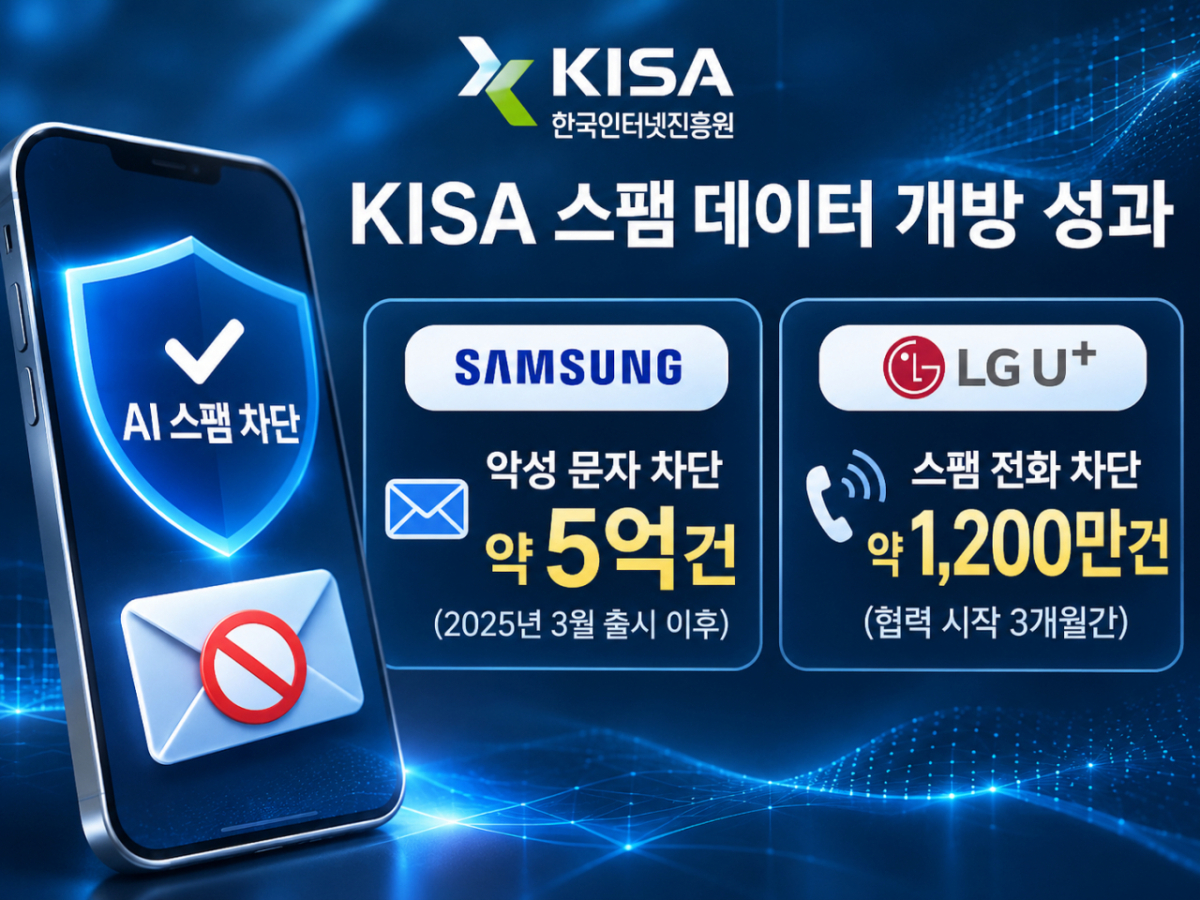
The Korea Internet & Security Agency (KISA) has blocked about 512 million malicious text messages and spam calls through its cooperation with Samsung Electronics and LG Uplus. This is a result of analyzing spam data reported by citizens using artificial intelligence (AI) and providing it to private companies.
KISA and the Broadcasting, Media and Communications Commission held the "2026 Spam Data Openness Achievement Sharing Event" on the 20th at the Seoul Peace & Park Convention Center, disclosing these achievements.
Samsung Electronics launched an AI-based "Malicious Message Blocking" service in March of last year in cooperation with KISA. By utilizing spam report data provided by KISA to automatically detect malicious text messages, the company has blocked approximately 500 million malicious messages before users received them since its launch.
LG Uplus has been sharing voice spam data with KISA since July. Through this, it has improved the accuracy of spam call analysis for its AI calling service, "ixi-O," while also providing spam caller numbers analyzed and extracted by ixi-O to KISA for integration into a real-time blocking system. Within three months of starting the cooperation, approximately 12 million spam calls were blocked in advance.
KISA automatically classifies and analyzes large-scale spam data reported by citizens using AI and provides it to public institutions and private companies. The need for response through data sharing has grown as illegal spam is increasingly exploited as a means of crime, such as illegal gambling, illegal finance, and phishing, going beyond simple advertising.
In the public sector, the National Police Agency, Financial Supervisory Service, Integrated Gambling Industry Supervisory Commission, Ministry of Gender Equality and Family, and the Ministry of Food and Drug Safety are utilizing spam report data.
Each institutional investor is responding to illegal activities in their respective areas of jurisdiction through measures such as linking with investigations, suspending phone number usage, and blocking URLs (internet addresses).
Shin Dae-gyu, head of KISA's Digital Infrastructure Division, said, "Spam data openness is a cooperation model that combines KISA's AI analysis technology, the response capabilities of specialized agencies in each field, and the technological prowess of private companies."
He added, "We will continue to expand cooperation with relevant institutional investors and companies, and further enhance our AI-based analysis and data openness systems."

 in TECH
