

Users will be able to use local currency (local love vouchers) as a payment method when using Baemin (hereinafter referred to as Baemin).
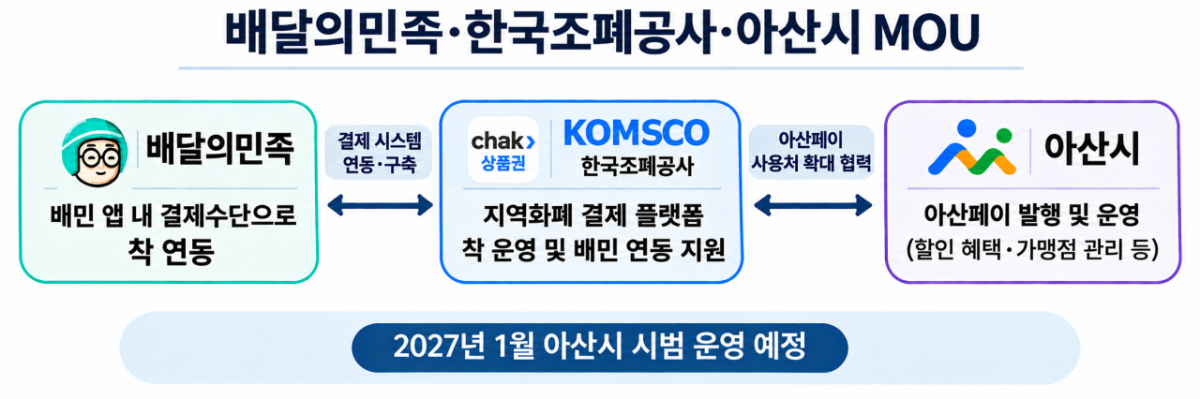
According to industry sources on the 23rd, it is expected that “Asan Pay,” the local love voucher issued by Asan City in Chungnam Province, will be usable on Baemin starting next January. This marks the first time a local currency, previously only usable on public delivery apps, will be accepted on a private delivery app.
Woowa Brothers, the operator of Baemin, will sign a memorandum of understanding (MOU) with the Korea Minting and Security Printing Corporation and Asan City in Chungnam Province on the 24th. The core of the agreement is to integrate the Korea Minting and Security Printing Corporation’s local currency platform “Chak” with Baemin. The plan is to first conduct a pilot operation in Asan City and then expand the target Local Governments based on the results. Baemin intends to apply a low intermediary fee rate, comparable to that of public delivery apps (0–2%), for transactions paid with local currency.
This MOU was carried out in the sequence where the Minting Corporation and Baemin first agreed on the introduction of local currency before proposing it to Asan City. Asan City is a Local Government that issued the most local currency among 15 cities and counties in Chungnam Province from last year through May this year, and was evaluated as suitable for the pilot operation. Asan City issued local currency worth 550 billion won last year. Baemin is also considering mutual benefit measures, such as supporting additional in-app exposure for merchants who integrate local currency.
Local currency is a payment method issued by Local Governments that can only be used within a specific region. Typically, discount benefits of around 10% are provided, with the funding for discounts covered by national and local budgets. In principle, businesses with annual sales exceeding 3 billion won are excluded from merchant registration, and illegal gambling industries, among others, cannot become registered merchants. If introduced to Baemin, it can only be used at small and medium-sized restaurants registered as merchants on the platform.
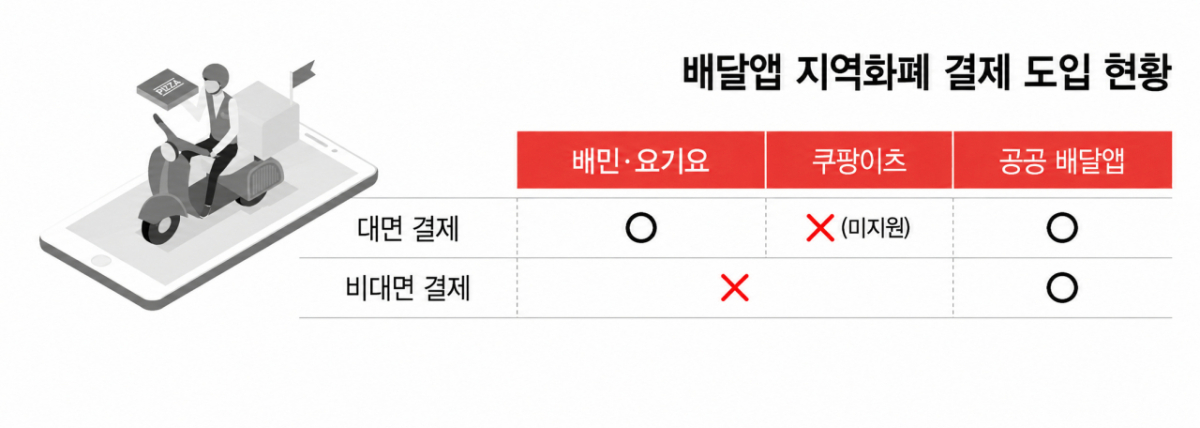
Private delivery apps have repeatedly attempted to introduce local currency to diversify payment methods and provide discount effects, but these efforts have failed every time. Currently, local currency can only be used for in-app payments on public delivery apps such as Ttaenggyeoyo and Baedal-ui Myeongsu. On Baemin and Yogiyo, local currency can only be used for face-to-face payments, while Coupang Eats does not support it because it does not offer face-to-face payment options. However, it is assessed that the introduction became possible due to the alignment of interests between the Minting Corporation, which needs to increase the utilization rate of “Chak,” and Asan City, which has been proactive regarding local currency.
Competitors Coupang Eats and Yogiyo are currently not considering the introduction of local currency. An industry official explained, “We have attempted to introduce local currency several times in the past, but all were aborted,” adding, “This was because public delivery apps have lower fee rates than the top three delivery companies, leading to strong backlash from self-employed business owners.”

 in TECH

