

Socar, which has recorded a profit for nine consecutive quarters, is raising fees for its value-added services. The move is seen as an effort to improve profitability based on its market share after escaping losses through improved vehicle operating efficiency.
Starting from the 18th of last month, Socar raised the fees for its "delivery" service, which brings a vehicle to a desired location, and its "one-way" service, which allows users to return a vehicle to a location different from where it was rented.
The delivery service, which was previously free for rentals of 24 hours or more, now costs 4,900 won. In Jeju, the fee, which had been waived for rentals of 48 hours or more, has been raised to 9,900 won. However, fees for rentals of less than 8 hours (15,900 won in Seoul, 21,900 won in Jeju, and 16,900 won in other general areas) and for rentals of 8 to 24 hours (9,900 won in Seoul, 19,900 won in Jeju, and 10,900 won in other general areas) remain unchanged. The free benefit for first-time users of the delivery service is also maintained.
The one-way service will see an increase in long-distance fees. For distances between 50 and 100 kilometers between the rental and return locations, the per-kilometer fee rises by 20% from the previous 500 won to 600 won. For segments of 100 kilometers or more, the per-kilometer fee doubles from 300 won to 600 won. In contrast, fees for segments under 5 kilometers (1,600 won per kilometer), between 5 and 15 kilometers (1,300 won per kilometer), and between 15 and 50 kilometers (900 won per kilometer) remain unchanged.
In November 2023, Socar announced its "Socar 2.0" strategy to increase revenue per vehicle. The approach involves extending the vehicle operating period from the previous three years to four years, allocating vehicles to short-term car-sharing during peak seasons and to monthly subscription services during off-peak periods.
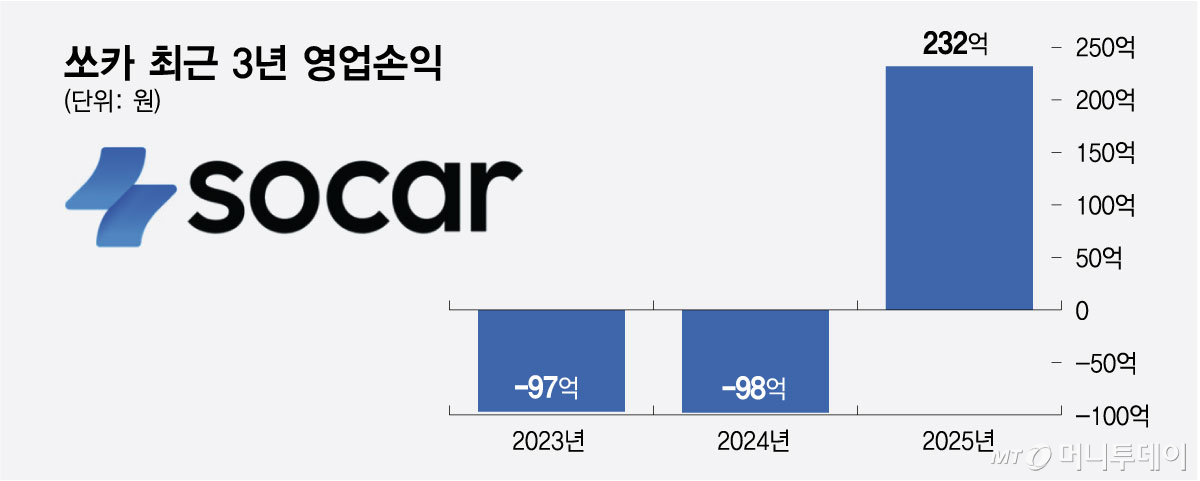
Gross profit per vehicle over its lifecycle stood at 14.2 million won for the 2024–2025 period, an increase of approximately 40% compared to the 2022–2023 period. Socar recorded operating losses of 9.7 billion won and 9.8 billion won in 2023 and 2024, respectively, but successfully turned a profit last year with an operating profit of 23.2 billion won. In particular, the number of uses for the delivery and one-way services reached 291,000 in the third quarter of this year, a 35% increase from the same period last year.
According to Socar's quarterly report for the third quarter of this year, Socar's payment volume accounted for approximately 82% of the combined payment volume of the three major car-sharing companies (Socar, G Car, and Turoka) (estimated based on monthly payment amounts from Hyundai Card). In its quarterly report, Socar analyzed that "an oligopolistic market has formed because the leading company in the car-sharing market possesses high accessibility, which is the biggest purchasing factor for users."
A Socar official stated, "Since the launch of the delivery service, the company has borne the transportation costs associated with car-sharing rentals of 24 hours or more," adding, "We have had no choice but to raise fees in order to continue providing convenient services, but Socar still covers approximately 80% of the costs."

 in TECH
