

AI-assisted cheating can be detected by tracing and connecting digital footprints through various IT tools, including mobile carriers' communication records and metadata and log records held by major tech companies.
This is the basis for the Ministry of Science and ICT's confidence that it can identify students who used AI to cheat during this year's College Scholastic Ability Test (CSAT).
According to the current Telecommunications Secret Protection Act on the 25th, investigative prosecutors or judicial police officers may request communication fact confirmation data from mobile carriers when it is difficult to prevent the execution of a crime by other means, or when it is difficult to discover and secure the perpetrator or collect and preserve evidence.
Communication fact confirmation data includes records of when a user communicated with whom, when they connected to and disconnected from the internet, and where they connected. It is possible to verify whether AI was accessed during exam hours at CSAT test sites.
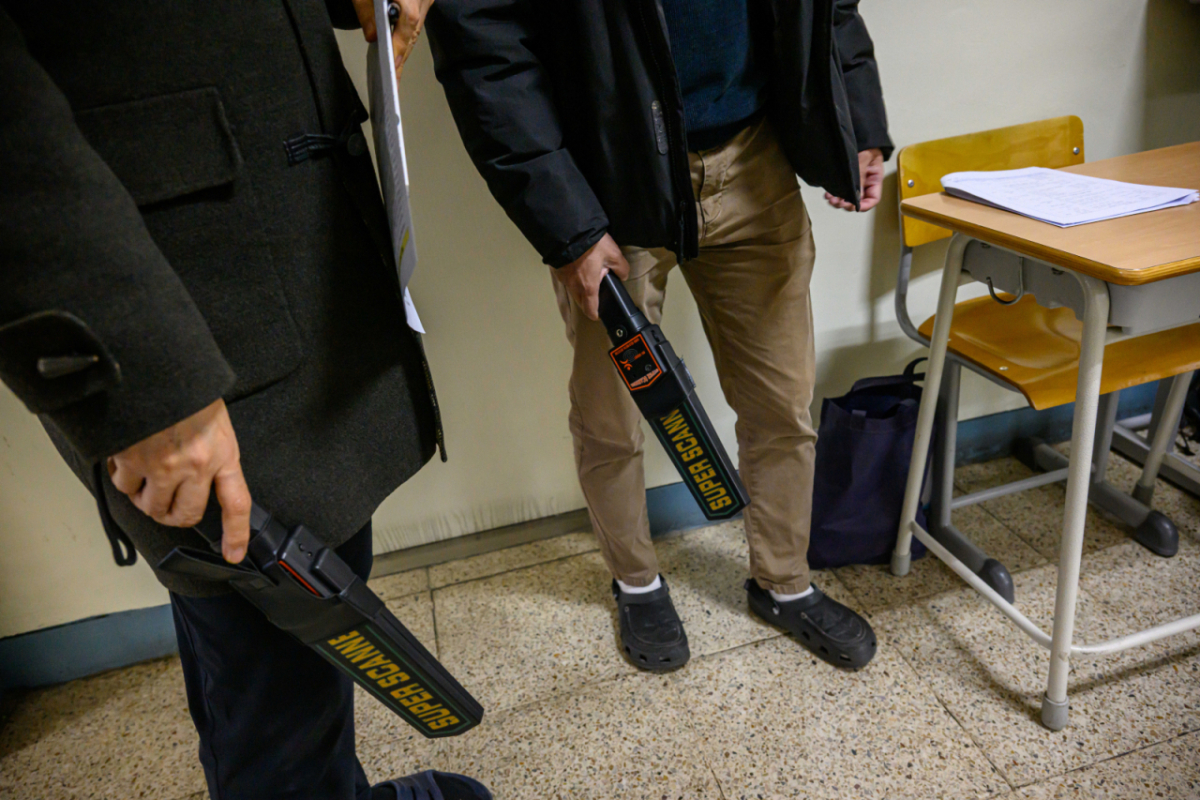
Previously, corridor supervisors present at the scene on CSAT day recorded communication signals before the exam and monitored in real time for any abnormal communication signals during the exam.
Relevant authorities believe that matching these records with mobile carriers' communication fact confirmation data will make it possible to identify perpetrators.
While cooperation from law enforcement authorities is required, smooth cooperation is expected given that President Lee Jae-myung has firmly labeled this misconduct a "serious crime."
The day before, at a State Council meeting, President Lee emphasized, "Misconduct in any exam steals the opportunities of others who have worked diligently and destroys the core principle of fair competition within our community," adding, "We must track down every suspicious case without exception and strictly punish offenders to serve as an example, in accordance with law and principle."
A mobile carrier official stated, "If requested by law enforcement authorities, we will actively cooperate," adding, "Communication fact confirmation data allows us to verify connection records for specific individuals during specific time periods, so I believe it can help uncover CSAT misconduct."
However, in past CSAT cases, the ability to identify perpetrators may vary depending on whether mobile carriers retained the relevant data.
Metadata and log records from big tech companies can also be secured through cooperation requests from law enforcement authorities. AI systems retain records of commands entered by users, uploaded files, connection dates and times, and IP addresses on their servers.
Although big tech companies such as OpenAI and Anthropic are global corporations, they maintain that data submission is possible under lawful requests from the Korean government.
The government has established a friendly cooperative relationship with big tech companies, including participating in OpenAI's AI security cooperation body, the "GTAC" (Trusted Access for Cyber Threats) program.
Even Telegram, a messenger that was once a breeding ground for all kinds of criminal activities due to the difficulty of tracing senders, recently responded to more than 95% of data requests from Korean police, indicating active investigative cooperation between the Korean government and global companies.
A senior official at the National AI Strategy Committee noted, "They likely repeatedly took photos with ultra-small cameras and uploaded them to AI for problem-solving, which is a very distinctive pattern," adding, "Since free versions do not solve problems well, they would have used paid models from frontier AI companies, in which case payment records would remain," expressing high confidence in the possibility of identifying perpetrators.

 in TECH
