

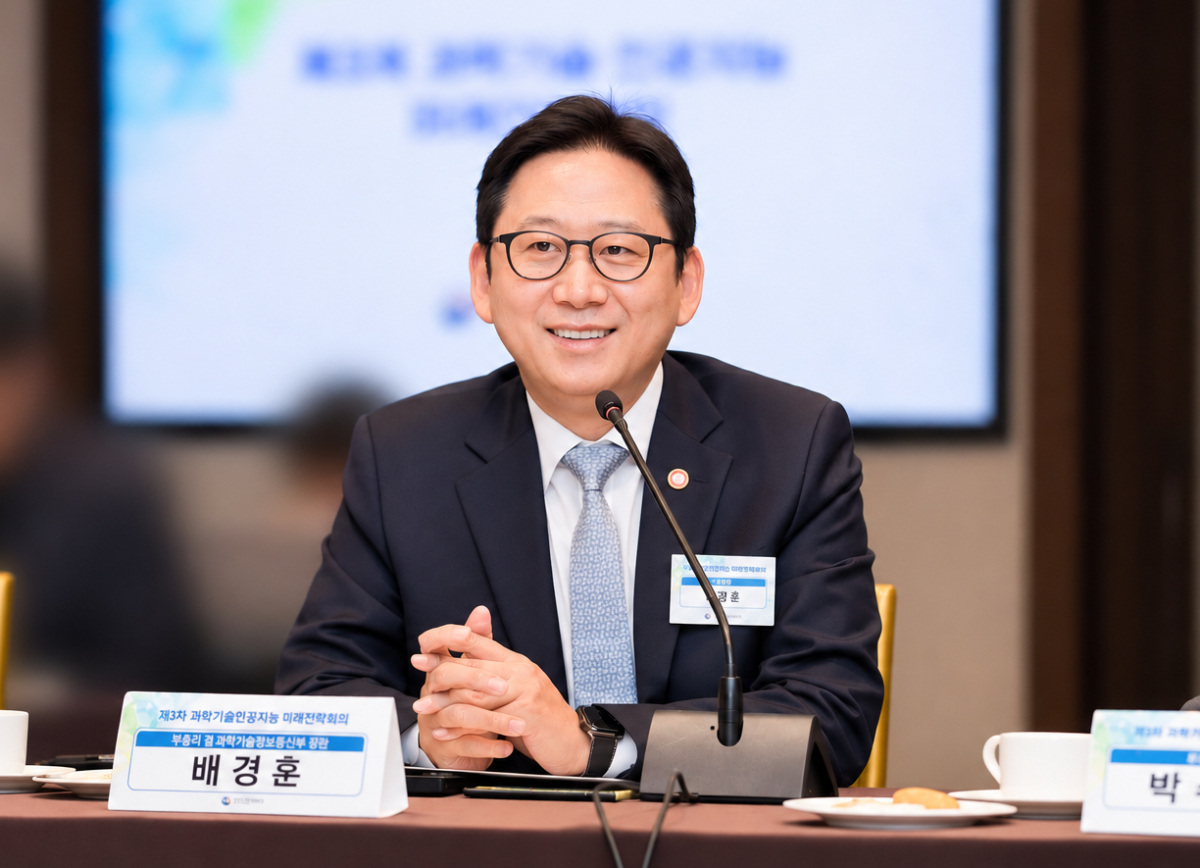
Deputy Prime Minister and Minister of Science and ICT Bae Kyung-hoon stated that he is reviewing various measures, ranging from inserting watermarks into exam papers to radio wave detection and blocking, in response to recent controversies over AI cheating on the College Scholastic Ability Test.
He also emphasized the need for swift discussion, noting that overseas observers are showing interest in Korea's response to AI cheating.
At the 3rd Science, Technology and Artificial Intelligence Future Strategy Conference held at the Royal Hotel Seoul in Jung-gu, Seoul, Wednesday, Bae said, "It is important for the Republic of Korea to move forward with this discussion quickly. It seems that people around the world are watching this situation in Korea with great interest and appear to have expectations about how it will be resolved."
He cited communication and radio wave detection, inserting watermarks into exam papers, behavior recognition using CCTV, and blocking communications such as Wi-Fi as measures being considered by the Ministry of Science and ICT.
Specifically regarding radio wave jamming, he explained, "Jamming technology is used temporarily in special situations, such as presidential security or military purposes, making it difficult to use for long periods," adding that they are technically reviewing whether it can be applied at a reduced output level.
Meeting with reporters immediately after the conference, Bae addressed the successive introduction of bills related to blocking communications within exam venues in the National Assembly.
"We must not carelessly use jamming or such technologies. Would you want to take a four-hour exam while high-power radio waves are being emitted?," he said. "All of these must be technically verified, including safety checks. We also need to consider how to handle certification for devices coming from overseas and review related laws, such as the Radio Waves Act."
Regarding cooperation with global AI companies such as OpenAI and Anthropic, he conveyed that "Big Tech companies share our concern about the issue, and we are currently at the stage of discussing it together."
On the timing for announcing a comprehensive countermeasure plan against AI cheating, he stated, "The release of a single measure does not mean it is a perfect solution," adding, "We must continue to search for and supplement measures while doing our utmost with what we can do now."
Bae explained, "Currently, the measures are too short-term, but in reality, there are over 800 national exams, which is a very large number," adding, "We have formed a TF (task force) to formulate a plan for how to comprehensively handle all of these."
He also said, "The government will continuously review measures to be implemented immediately this year and policies that should be pursued in the medium to long term."
Bae pointed out that the education system also needs to be reconsidered in light of the recent CSAT cheating controversy.
He said, "Beyond simply preventing cheating using AI, we face various concerns and challenges, such as how to transform secondary and university education and how to nurture the future saplings of the nation in the AI era."

 in TECH
