

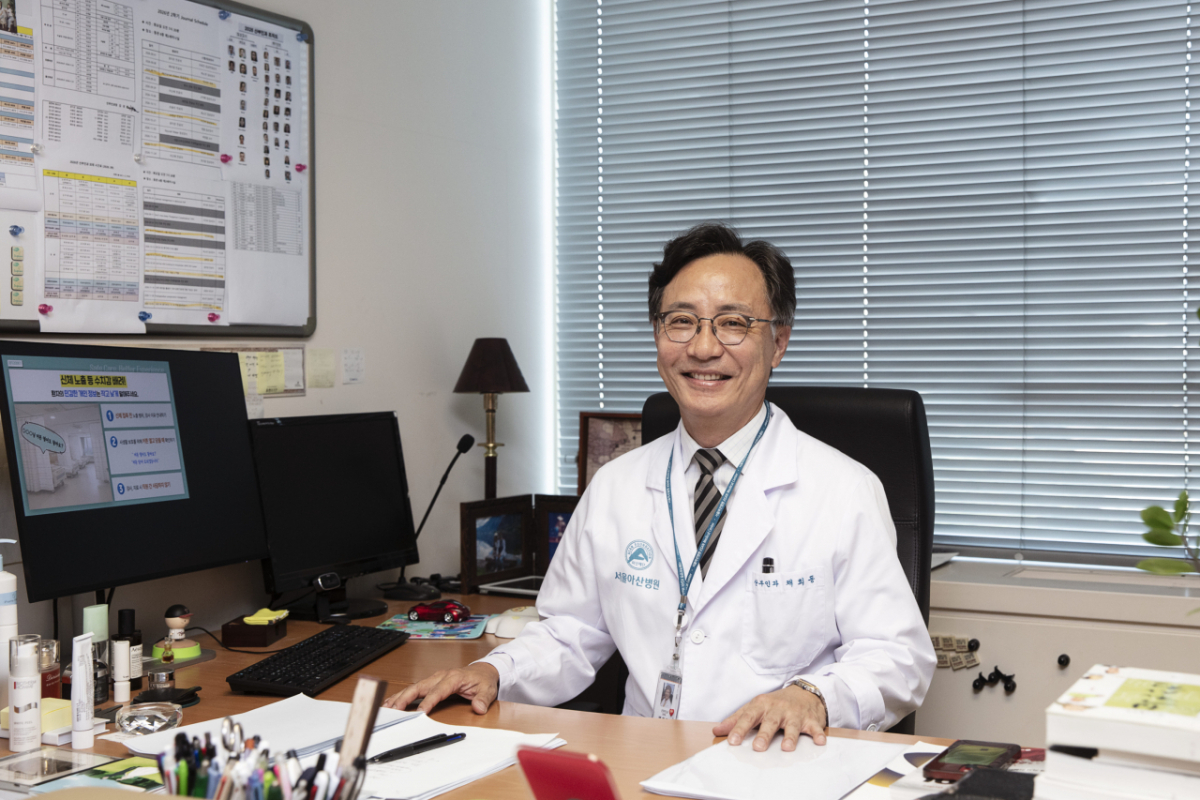
"Menopausal women may gain weight due to a deficiency in female hormones. We expect that using GLP-1 (glucagon-like peptide-1) obesity drugs like 'Wegovy' alongside hormone therapy will not only treat menopausal symptoms but also show beneficial effects on endocrine and metabolic disorders, as well as cardiovascular diseases."
Professor Choi Hee-dong of the Department of Obstetrics and Gynecology at Seoul Asan Hospital, Ulsan University (photo) said this in a recent interview with Money Today conducted in his research office at Asan Hospital in Songpa-gu, Seoul. Professor Choi, who has served as Han Pye-gyeong-hak (Chairman), is an authority in the field who also co-authored "A Guide for Menopausal Women: Health During Menopause."
Professor Choi stated, "Foreign statistics indicate that over 70% of menopausal women are overweight or obese, but we believe that more than 50 to 60% of women in our country fall into the overweight or obese category," adding, "Many menopausal women are concerned about weight gain."
He explained, "The increase in weight among menopausal women is partly due to a decrease in basal metabolic rate and physical activity. However, because female hormones are no longer produced as before, fat redistribution and distribution change, leading to an increase in visceral fat and a thicker waist circumference." He added, "Weight gain also affects glucose metabolism and lipid metabolism, worsening overall health."

Accordingly, his view is that menopausal women who are overweight or obese and have comorbidities should use GLP-1 obesity drugs in conjunction with hormone therapy. Professor Choi said, "There are research results showing that using female hormones together with weight-gain-suppressing medications like Wegovy for menopausal women not only aids in the therapeutic effect on menopausal symptoms but also yields better weight loss effects."
He continued, "Estrogen, a female hormone, has effects such as vasodilation, antioxidant properties, and prevention of cardiovascular disease. As this decreases, the risk of cardiovascular disease increases in postmenopausal women." He emphasized, "There are many studies showing that when hormone therapy is combined with obesity treatment in menopausal women, additional improvements are seen in glucose metabolism issues and various cardiovascular disease indicators. Therefore, combining these two treatments would offer many benefits."
In fact, according to the 'SELECT' clinical trial, when Wegovy 2.4 mg was administered to perimenopausal and postmenopausal women with obesity and heart disease, the risk of MACE (cardiovascular death, non-fatal myocardial infarction, non-fatal stroke) decreased by 42% and 13%, respectively. In a study conducted in the United States, among postmenopausal women who received Wegovy, the weight loss rate at the 12th-month mark was 16% for those who also underwent hormone therapy, compared to 12% for those who did not.
Even young women who are not menopausal are recommended to undergo treatment with obesity drugs like Wegovy for their health if they are obese. Professor Choi said, "Obesity or being overweight can lead to ovulation disorders. In fact, people who are significantly overweight may experience irregular menstruation." He added, "As one approaches a normal weight, ovulation and menstruation improve, and the risk of endometrial cancer may also decrease."
He also emphasized the need for National Health Insurance coverage for GLP-1 obesity drugs. Professor Choi stated, "Obesity is not a matter of willpower, so it should be viewed and approached as a disease," adding, "From the perspective of disease treatment, it is necessary to apply National Health Insurance to GLP-1 obesity drugs."

 in THEBIO

